
[Originally published: 4th Dec 2022]
Hello readers! This week we passed another milestone: over 200 copies of my books have been ordered on Amazon. In fact, the total now stands at 230. Many thanks to everyone who contributed towards this statistic!
Breaking down the sales…
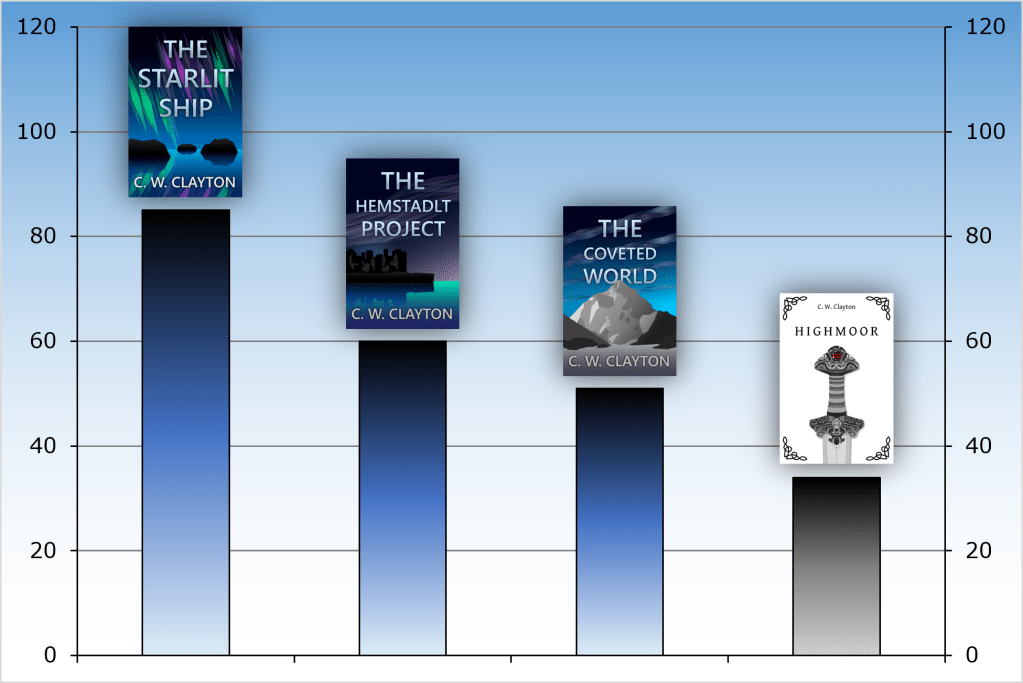
This morning I made a graphic to show the popularity of my books. The best-seller is The Starlit Ship, which perhaps isn’t so surprising given that it was published first, all the way back in December 2020. It has sold 85 copies since then, which is about one every 8.5 days.
Now, the next two books in the series haven’t sold quite so many. This probably isn’t so surprising either, as you can’t expect to keep every reader hooked for an entire series. Still, in the last two promotional weekends, both The Hemstadlt Project and The Coveted World outsold The Starlit Ship. Maybe people are coming back for more?
Finally, Highmoor has sold 34 copies since releasing on the 25th September. That’s one copy every two days – and that doesn’t include the readers using Kindle Unlimited. Once again, a thank you to every reader out there!
Give the readers what they want?
The sales seem to suggest that fantasy novels are far more popular than science fiction. Of course, there could be dark forces at work here, as nobody really understands the Amazon algorithms. Probably not even the great overlord Jeff. I don’t know if the keywords I provided for Highmoor are more commonly searched than the ones I provided for The Starlit Ship. I don’t know if the genre I specified makes any difference. Certainly, Highmoor is easier to categorise, and perhaps this makes it a friendlier option for recommendations?
All this makes me wonder… Is it the algorithm that prefers obvious genres, generic keywords and basic tropes, simply because they are easier to label and organise? Or is it the readers who prefer these tropes, and their preferences have moulded the algorithm? Maybe it’s a bit of both.
A very quiet echo chamber
Readers generally have a good idea of what they like reading. Even before Amazon algorithms, we had bookshops and libraries divided into sections based on genre. In fact, we still have bookshops and libraries. People just aren’t using them as much, thanks to our great overlord Jeff.
One of mighty Jeff’s powers is the ability to record what his billions of serfs have bought from him, and to use these records to predict what they might want to buy next. If we only ever rely on kindly Jeff’s recommendations, we will only ever be offered the same thing, over and over again. In the same way that your Facebook feed becomes an echo chamber of posts that you broadly agree with, Amazon algorithms will feed you a supply of books that they know you will broadly enjoy. However, there isn’t much echoing to be found in reading. It is a very quiet pursuit.
And your point is?
Amazon provides the means for readers to get stuck in a genre rut, never breaking free. This doesn’t cause them any harm, of course, but it might narrow their horizons. For most Amazon authors, these ruts are where they find their reader base, and this makes their marketing much more efficient. Don’t try selling dark fantasy to the old ladies reading steamy semi-historical romances. They don’t want it. And the benign, omniscient Jeff would never wish to estrange his serfs by giving them something they didn’t want.
My point is, what happens if you have a novel that spans genres? It might be something that isn’t quite gritty, engineering-focused science fiction, or glitzy, scantily-clad-aliens science fantasy, and neither is it a true, post-apocalyptic, dystopian young adult novel with a strong female protagonist.
Once your story becomes too tricky to label, how can you convince people to read it? You end up with something that doesn’t appear to be anybody’s cup of tea. The overworked employee has left it on the Starbuck’s counter without a name, the absolute fool. And now it’s gone cold.
In summary…
I’m very happy with the progress I have made. So far, this venture has cost me nothing – and so I’m not really in a position to whinge about the benevolent Jeff. I just wonder whether, in future, my writing might be guided by sales, and whether these sales might be guided by algorithms. Perhaps this is nothing new. It just seems a shame that creativity might be being stifled.
Discover more from C. W. Clayton
Subscribe to get the latest posts sent to your email.

 C. W. Clayton