
Hello readers! The blog title says it all really: I have recently returned from a trip to Iceland. The place has always intrigued me, but the final factor in convincing me to go was not, in fact, Ridley Scott’s 2012 film Prometheus (see my earlier review), but being invited there on holiday with no need to organise anything myself.
Some emotional back story:
One of the reasons that Iceland has always been alluring is because has an abundance of Clayton-assured “cool rocks” – some of which are actually very hot. In fact, Iceland’s rocks have a reputation for being somewhat aggressive, launching themselves into the stratosphere on a semi-regular basis. Their explosive temperament is explained by Iceland’s position on the Mid-Atlantic Ridge, where the Earth’s crust is being torn asunder by forces beyond mortal comprehension. This giant rift forms a pathway for molten rock to rise to the surface, where it becomes embroiled in various conflicts between cooling, flowing, fragmenting, and degassing, leading to a range of volcanic behaviour.
The most recent eruption in Iceland was from Fagradalsfjall, which erupted in 2021 and 2022. These eruptions were gentle by volcanic standards, but still produced lava fountains hundreds of metres high for many weeks. They provided entertainment for thousands of visitors, but I was not lucky enough to be among them. Instead, I stayed in the warmth and comfort of my own home, safe from the horizontal hailstones and freezing fog, and watched the eruption on YouTube.
Sadly, Fagradalsfjall didn’t roll out the lava carpet for my arrival this year. My time in Iceland was eruption-free, and no amount of fervent daydreaming changed that. Instead, I visited the many other natural wonders that Iceland has to offer – and some of the unnatural ones, too.
First impressions?
Iceland is bleak in April. In fact, the general absence of trees and grass on the landscape makes me suspect that Iceland is bleak all year round. The land is in no way charming or inviting, but it’s still beautiful in its own stark, intimidating way. The drive from Keflavik airport to Reykjavik had me gawping at the scenery through the rain-splattered window of our hire car, as I had never in my life seen so much solid lava. Everywhere you look, the floor is formed from old flows, creating a flat, featureless expanse of grey. The only greenery to be found is the moss on older surfaces, and thanks to its recent liberation from several feet of snow, it hardly boasts a verdant colour. As much as I hate to draw comparisons to that dreaded film, Iceland feels like the surface of another planet.
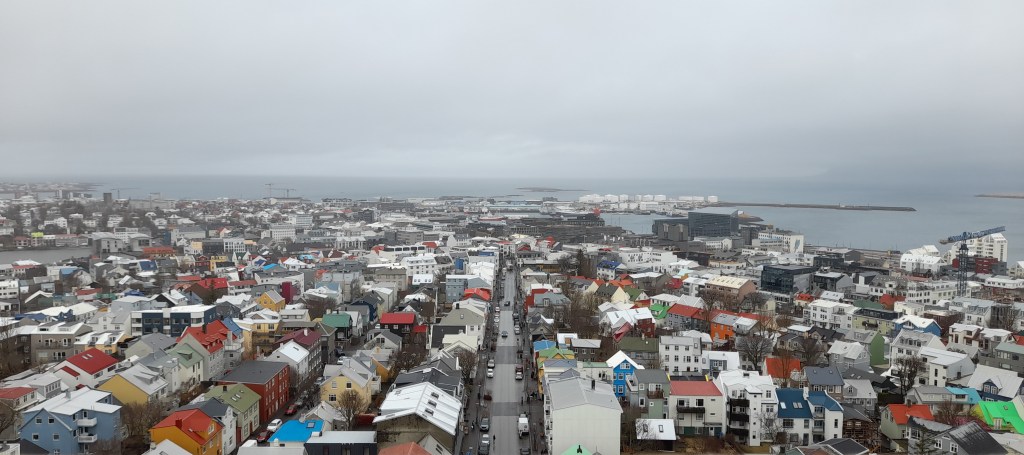
However, on arrival in Reykjavik, things start to feel less alien. It’s a small city, and two-thirds of Iceland’s population live in its vicinity, making it home to 240,000 people (roughly equal to Milton Keynes). The houses are typically detached from one another, rather than terraced, and their walls are painted in various bright colours to combat the persistent greyness. The sky is grey, the ground is grey, the sea is grey… Perhaps I was unlucky with the weather while I was there, but I doubt it. I had a few precious glimpses of blue sky throughout the week, but generally speaking, the rain only ever let up when it decided to hail instead.
Part one: Ice
As suggested by its name, large swathes of Iceland are covered in ice. Most of it lies within huge icecaps on the mountainous interior of the island, but narrower tongues of ice seep out around the edges, draining the higher elevations. One of the most accessible glaciers is Sólheimajökull, only a couple of hours from Reykjavik. It creeps down from the icecap over Katla – a huge volcano with a history of violence. Sadly, the scale of this glacier is lost on a tiny phone photo, and it’s the scale that really blows your mind. If you look closely, there are tiny people standing on the ice – but it’s still hard to convey.
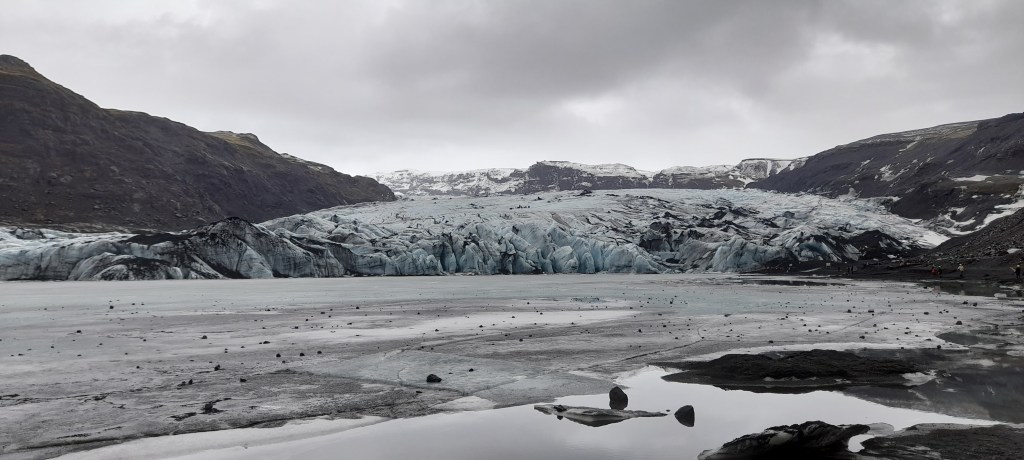
To me, it’s not just the sheer size of the glacier that’s astounding, but the time that it took to form, and the imperceptible speed at which it creeps along. Up close, the ice is striped with layers of dirt and bubbles that have accumulated over decades. These layers have been inching their way downhill as a solid mass, year by year, only to reach the glacier front and get melted under the fingertips of a gawping tourist.

Part two: Water
When glaciers melt, the water has to go somewhere – and in Iceland, vast volumes of it end up in churning rivers. At the end of the last ice age, these surges of meltwater were even larger, giving them enough power to carve deep gorges and towering waterfalls. One the most impressive is Gullfoss, where a frothing river tumbles into a narrow chasm to be lost beneath plumes of spiralling spray. It’s a spectacle that leaves your mind grappling for a sense of scale, having passed the limit where you could take a guess at its size.


Although there are certain waterfalls that are tourist hotspots (Gullfoss being one of them), there are hundreds of waterfalls along the southwest coast of Iceland, easily within reach of Reykjavik. Since the last ice age, the land has risen, and so huge sea cliffs can be found a few miles inland of the present-day coastline. These cliffs are littered with waterfalls of all shapes and sizes, and some are so high that they are dispersed by the wind before they hit the ground. Of all the waterfalls I visited, Íráfoss was the prettiest. Perhaps it was the fact that the sun came out for just a brief moment, or that there were no other tourists around. In any case, I stumbled on it entirely by accident, and that made it all the more special.

Part three: Lava
Having seen so many videos of Fagradalsfjall on YouTube, I had to pay it a visit in real life. I headed to the site of the 2021 eruption, where the lava flows are still steaming two years later. Although the flows have solidified, their scale and their texture are still an incredible spectacle – and with the flows being so thick, their interiors are hot even now.
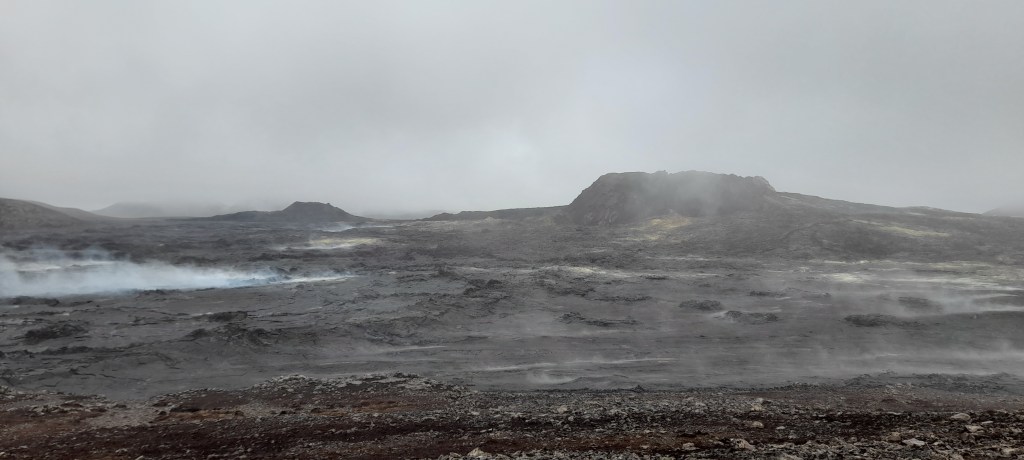
(Please excuse the photo quality: the weather was not on my side)
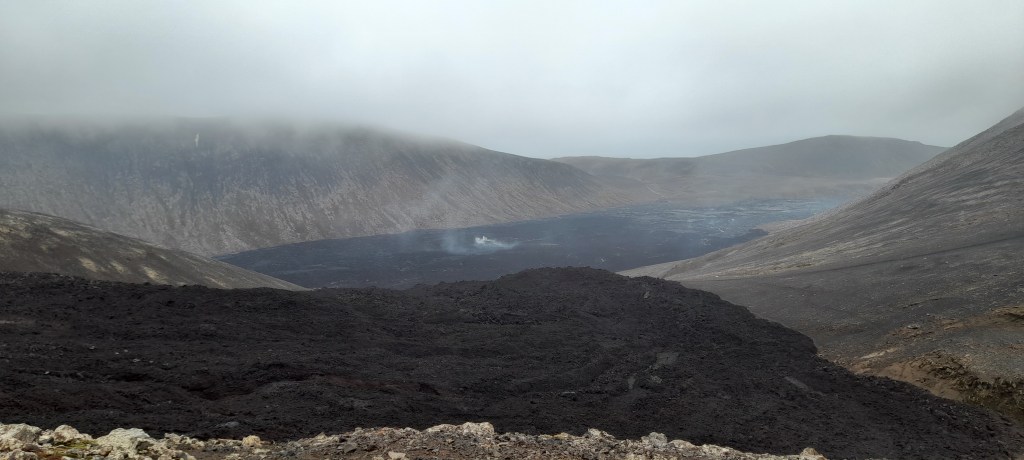
One of the most exciting features you can find in a solidified lava flow is a lava tube. Beneath the crust of an active flow, lava focusses into narrow conduits, and these can keep flowing for months or years. When the eruption ends and the lava drains away, the conduits are left behind as hollow tubes. They are often found hundreds of years later, when part of their roof falls in to reveal a long, tortuous cave.
The nearest lava tube to Reykjavik is called The Lava Tunnel, where you can part with a substantial chunk of your holiday money to go on a guided tour. Inside, you can see the streaks left on the wall by the lava draining out at the end of the eruption, and see the dribbles that ran down as the roof started to melt. However, the most striking feature in the lava tube isn’t its geology, but the natural ice sculptures that have grown up over the winter. These tall, ungainly blobs of transparent ice have formed by water dripping through holes in the roof, always landing and freezing in the same spot. They were already melting when I arrived – and by summer, they will be gone entirely.

A quick grumble about tourists
Iceland has no shortage of natural wonders. However, what none of the adverts in Keflavik airport want you to know is the ratio of wonders to tourists. The chances are, if you’ve seen it in a leaflet or on the airport wall, it will be swarming with hundreds of people. I’ve never seen so many tourist buses, and I soon realised that, although I’m all for enjoying the natural world, I enjoy it a lot more when I’m the only one there.
It’s hard to pinpoint the source of my disdain towards other tourists, but I have a few leading theories. Firstly, crowds are noisy, get in the way of my views, and pose an obstacle to my movement. Secondly, I always suspect that the crowds are a result of commercialism, meaning that somebody has made a lot of money out of something they had no hand in making. Finally, crowds are an indication of popularity, which suggests that people have fallen for airport advertising or TripAdvisor lists, thereby indicating a lack of free will and imagination which undermines my own decision to visit the same location. I don’t want to feel like a statistic, thank you very much. I don’t want to be the tourist stereotype. I just want to be left to be a snob in peace.
Luckily, most of the places I visited were impressive enough for me to ignore my niggling resentment towards the busloads of tourists. However, there is one place in particular that passed my tolerance threshold. It is the mother of all tourist traps. The most enviable money-maker in Iceland. The most environmentally-friendly farce in history:
The Blue Lagoon
I mean, it’s a glorified swimming pool. It’s blue. It’s hot. And according to its website, it has healing properties. How, you ask? Well, in the wise words of the website, the water is “endowed with silica, algae, and minerals” which can “undo the effects of time”. Quite how the water does this is not explained. The marketing materials bang on and on about the silica – like it’s something special, rather than a simple compound made from the two most abundant elements in the Earth’s crust. The algae doesn’t get mentioned quite so much, probably because of its unfortunate association with festering duckponds.
However, my deep loathing and everlasting respect for The Blue Lagoon stems from the true source of its powers: the fact that its water comes straight out the back of a geothermal power plant. It’s simple. It’s vile. It’s pure genius. There isn’t a single mention of it in their brochures or on their products, and yet the “lagoon” sits in the shadow of a roaring power station, so close that you are doused in the steam that pours from its chimneys. So, as much as I want to be cynical about The Blue Lagoon, I can’t help but respect whichever genius decided to monetise power plant wastewater. They’re literally rinsing the tourists.
In summary…
I enjoyed my trip to Iceland, and there is so much more to say (I never even mentioned the food). Perhaps, if I ever go back, I will go in the summer, when the waterfalls are bigger, the days are longer, and the weather is slightly more benign. As always, stay tuned for updates – and enjoy the improving weather!
Discover more from C. W. Clayton
Subscribe to get the latest posts sent to your email.

 C. W. Clayton
2 thoughts on “Clayton goes to Iceland”