Hello readers! This week I discovered the “Bing Image Creator” – an AI image generator which anyone can use for free (i.e., for the measly price of handing all your search data to Microsoft). I’m aware that you’ve probably heard enough about AI art by now, so I thought I’d try and approach this thorny topic from a more personal perspective. Today, I’m talking about AI art in the context of writing books.
A transfer of ideas
Books rely on imagination. Ideally, a book is a transfer of images and concepts from the head of the author to the head of the reader. However, it’s almost inevitable that things won’t quite arrive as the author intended.
The first difficulty in the imagination transfer is in the mind of the author. Imagination is a very personal thing; for example, some people will be able to imagine character traits in minute detail, while others will only have a vague outline with a height and hair colour. The next difficulty is putting this onto the page. However amazing your imagination is, you need a good understanding of how readers will interpret your descriptions in order for you to make the most effective word choices. The next step is for the reader to rebuild your description in their mind, and again, this will be very personal. Some people will only picture the key attributes, while others may even embellish your description based on their own preferences and experiences. As such, the original idea is unlikely to transfer from one mind to another without some level of corruption along the way.
This is where AI comes in. Unlike your readers, the imagination of the AI is right out in the open. If you throw in a description of your fantasy setting, the AI throws an interpretation right back – and this is a game-changer. You can see how someone might interpret your work, which provides a whole new perspective to the way you write.
Generating AI images of Highmoor
As soon as I started messing around with the Bing Image Creator, I realised how useful it could be for generating digital art for my books. I have tried drawing scenes from my work in the past, but they’re more of a tool for me to understand layouts and scales, rather than works of art. Using AI, however, I could generate high quality images without any physical artistic skill. Bing has a much better grasp of light and shadow than I do, and it is way better at drawing water, my age-old nemesis. Oh, and trees. It’s also really good at trees.
The first scene I tried to recreate was the Halls of Highmoor. I told Bing to generate an image of a castle on a moorland hill, overlooking a green valley. The results were staggering. I was impressed by the sunlight and colour choices, and by just how closely the moorland and the valley aligned with what had been inside my head. Bing did a far better job of these aspects than I could ever have done, because my painting skills are just not up to scratch (even if I can colour inside lines like a pro).
Still, I’m hesitant to use an AI generated image as promotional material. It just feels a bit cheap, because it isn’t really my work. Yes, the words in the prompt were mine, and the image relates to a book which is very much mine – but the picture itself is just an interpretation of my words. Bing is essentially the “reader” in this scenario, and I’m stealing the results of its imagination.
How “accurate” is an AI drawing?
This is an interesting question. Bing interprets descriptions in its own weird way, and when it spews out an image that looks nothing like the one you envisaged, you can’t really blame the AI. It usually produces something that fits the prompt, but in a way you didn’t expect. You can’t accuse the AI of being inaccurate. It’s more likely that your prompt had too many potential interpretations.
The only time when I would accuse the AI of inaccuracy is when it makes genuine mistakes. Most commonly, this occurs with drawing limbs. For example, it might place a tail and two legs in the wrong order, or draw too many fingers. Similarly, it can get confused between roofs and streets in distant cities, leading to impossible Escher-like structures.
Using AI to improve communication
From an author’s perspective, AI can be a tool for judging the efficacy of your descriptions. If you write “a deep valley”, it is up to the AI to judge how deep this valley should be, just as it would be up to the judgement of a reader. However, this is where the AI is at a disadvantage: a reader can create links between prompts to strengthen their mental picture. The depth of the valley may relate to the flow rate of the river, which can be gauged from accompanying descriptions of spray and noise. It could be gauged from the length of the shadows and from the time of day. It may even relate to the geological setting, picked up from a description of the rocks. All of these disparate descriptions and inferences work together to create a much more comprehensive picture – something the AI can’t do.
Of course, this might not be true for long. Currently, freebie AI image generators are nowhere close to being this intuitive, but I can envisage a scenario where you could feed an AI your entire book, then ask it to draw scenes based on all manner of interrelated descriptions. This would be great for people who struggle to imagine things, and could even help authors communicate ideas for graphic novel or film adaptations of their work.
Some AI interpretations of scenes from my books
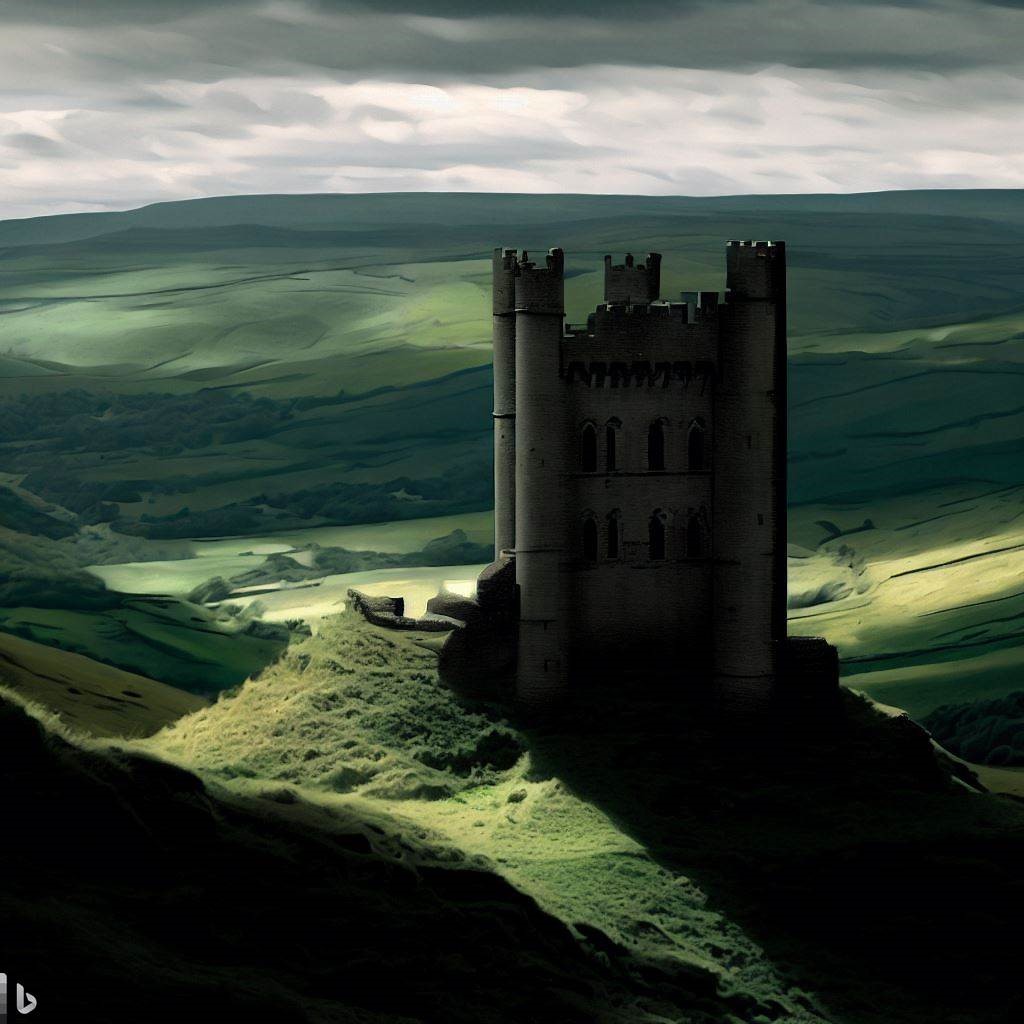
This image of the Halls of Highmoor gets some things exactly right. The placement of the castle on the moors overlooking the green valley aligns eerily well with the scene inside my head. However, the castle is completely wrong. This isn’t the fault of the AI, of course, because I only told it “medieval castle”. I didn’t see any straightforward way of specifying huge stone walls with four corner towers, enclosing a cobbled courtyard and several buildings. The halls are more of a motte-and-bailey situation, really – and perhaps I should have given Bing more credit and put its castle architecture knowledge to the test.
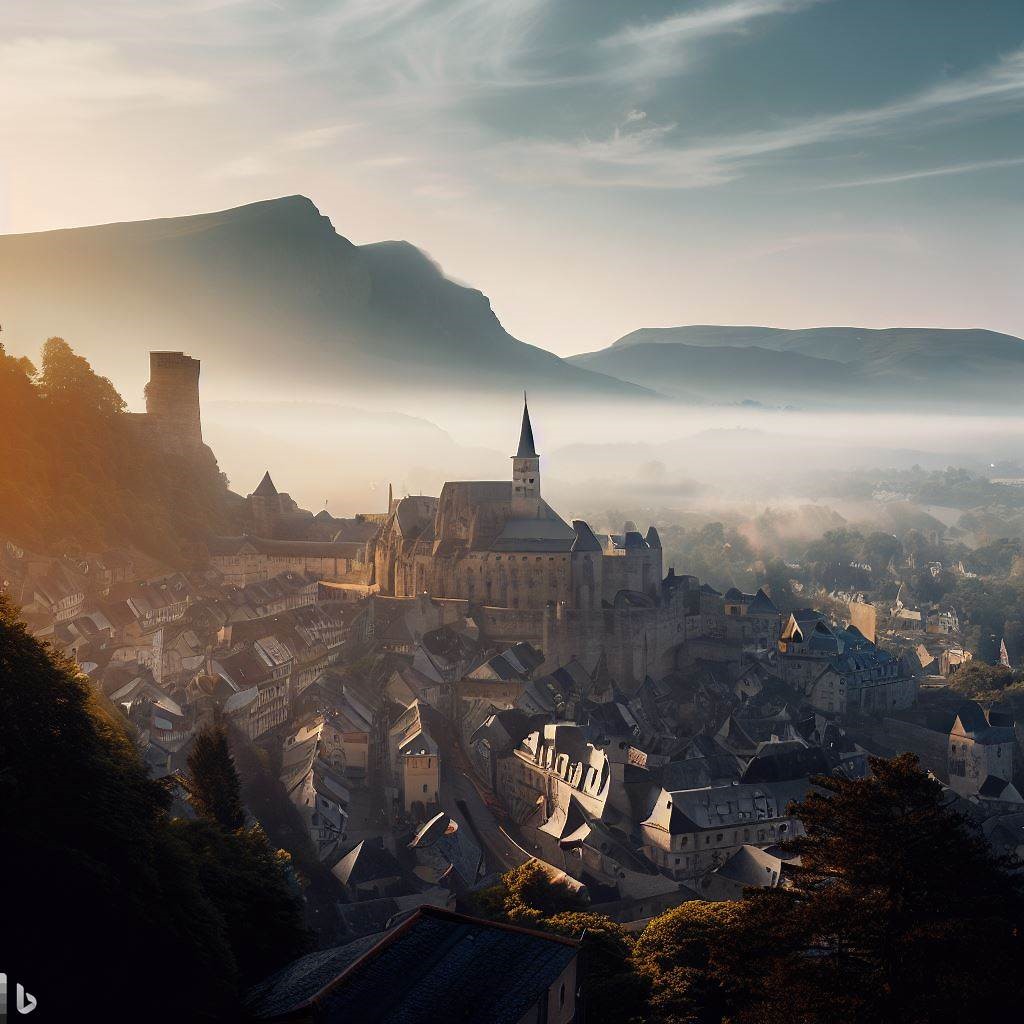
I then tried giving it a brief description of Aberfenntag, and was again quite pleased with the result. The building designs are very close to how I imagined (excluding the Escher shenanigans), and the flat-topped hills in the background are almost right. There are a few too many trees, but overall, I’d say it did a good job. Maybe next time I could specify that the flat-topped hill contains a sill of columnar basalt, and that it has a walled fortress on top accessible only by a single, giant staircase? Or maybe Bing would be overwhelmed.
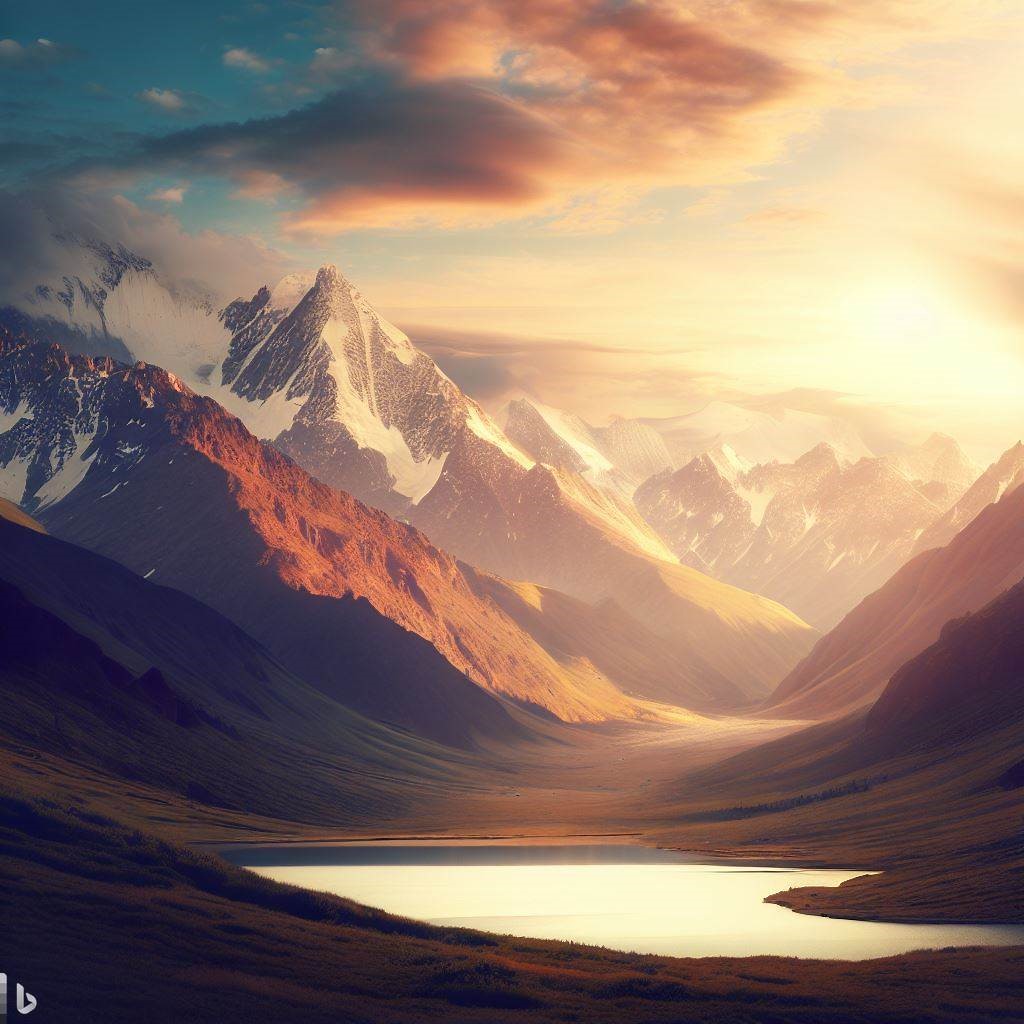
After that, I tried a mountain setting from the second book, Sylvre. This one is very pretty, and it actually looks even better than it did in my head (an interesting point which I will revisit in a minute). I wish I could be more specific with the geology, but Bing doesn’t seem too clued-up on rocks.
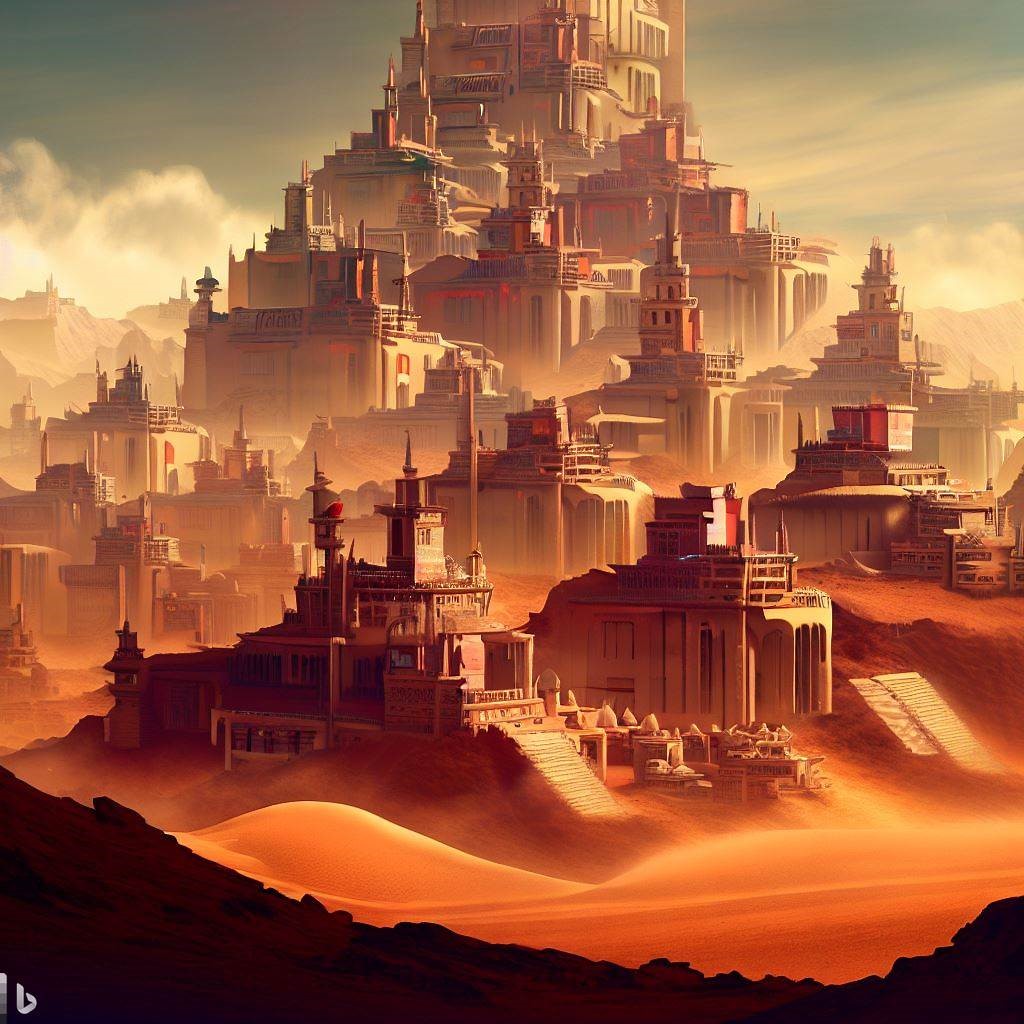
My final attempt at a location was describing Kaldarr, again from Sylvre, and this time Bing threw up something that looked nothing like I expected. I asked for a desert city with several tiers on the flanks of a volcano, and ended up with a small settlement with the top half missing and no volcano in sight. The “desert” part dominates the image, and although I appreciate the colour palette, this is nothing like I imagined. And where is the volcano I asked for, Bing? Why did you cut off the top of the city? Disappointing.

Finally, I dared to ask Bing to draw me a character. I’m too scared to give it the descriptions of any humans, because photo-realistic AI people are terrifying. However, I thought I would give it a description of Gradfyd the dragon. Overall, it’s not terrible… But Bing is clearly of the opinion that dragons only have four limbs: two legs and two wings. I have always imagined dragons to have four legs and two wings, and before now I thought this was the majority view on dragon anatomy. However, based on Bing’s response, I now wonder if the majority of dragon images online are of the four-limb variety. In any case, Bing chose a nice colour for Gradfyd’s scales, and while the spines are asymmetric and the tail gets a bit funky near the edge of the image, I am reasonably happy with this interpretation. Well done, Bing.
AI as a tool to broaden the imagination
I mentioned earlier that the mountains looked even better in Bing’s interpretation than they did in my head. This highlights another potential use for AI. Not only can it provide an indication of how a reader may interpret your words, but it can offer improvements to scenes you had already created. For example, you might have imagined a city in your head, but Bing could come up with a building style that fits your theme even more closely than your current vision. Out of the blue, it could throw in a load of needless obelisks – and upon seeing these, you might realise just how well they work, and decide to include them.
Again, this might start feeling a bit cheap. Even if you aren’t using the AI art or claiming it as your own, you could easily draw heavy inspiration from it – and nobody would ever need to know. In a way, this is similar to visiting an art gallery or museum to get inspired, only AI can create something entirely unique, to your specifications. Is it cheating, borrowing aspects of these unique creations? No idea is truly original. Everything we imagine is based on our experiences, and seeing a piece of AI art is just another facet of that. This could be viewed as yet another writer’s tool, and yet it does feel a little bit devious.
I’ll end with a note of warning. I have often found that while reading a book, I’ll imagine the characters one way, but if I then see a TV or film adaptation of that book, the characters I imagined are replaced by the actors chosen to play them. Even if I go back and read the book again, I’ll imagine the actors instead. Clearly, seeing is believing – and this makes AI renditions a little more risky. For most locations in my book, I can look at the AI art and scoff at how “wrong” it is. However, I can well imagine there being cases where once I’ve seen the AI version, I can’t unsee it. Original ideas could be overwritten by stronger, firmer AI renderings, and this is an unsettling thought.
In summary…
There have been thousands of articles published on AI art generation in the last year or so, and I apologise if none of this was news to you. However, using AI to prod your imagination seems a more benign pursuit than using it to replace artists and graphic designers. All of us lie on a spectrum between vivid imagination and aphantasia, often excelling in some areas more than others (e.g., objects vs. people). AI can help nurture our ideas, and can also help us communicate those ideas by acting as a guineapig to see how words may be construed. I don’t think I’ll be using AI art to promote my books any time soon, but I may well use it to help me create art of my own.
If these AI atrocities did spark an interest in my books, they can be found on Amazon:
- Highmoor series page: https://www.amazon.co.uk/dp/B0C7LVW79B
- My author page: https://www.amazon.co.uk/C-W-Clayton/e/B09YZXSQ3D
Happy reading, and have a great week!
Discover more from C. W. Clayton
Subscribe to get the latest posts sent to your email.

 C. W. Clayton