
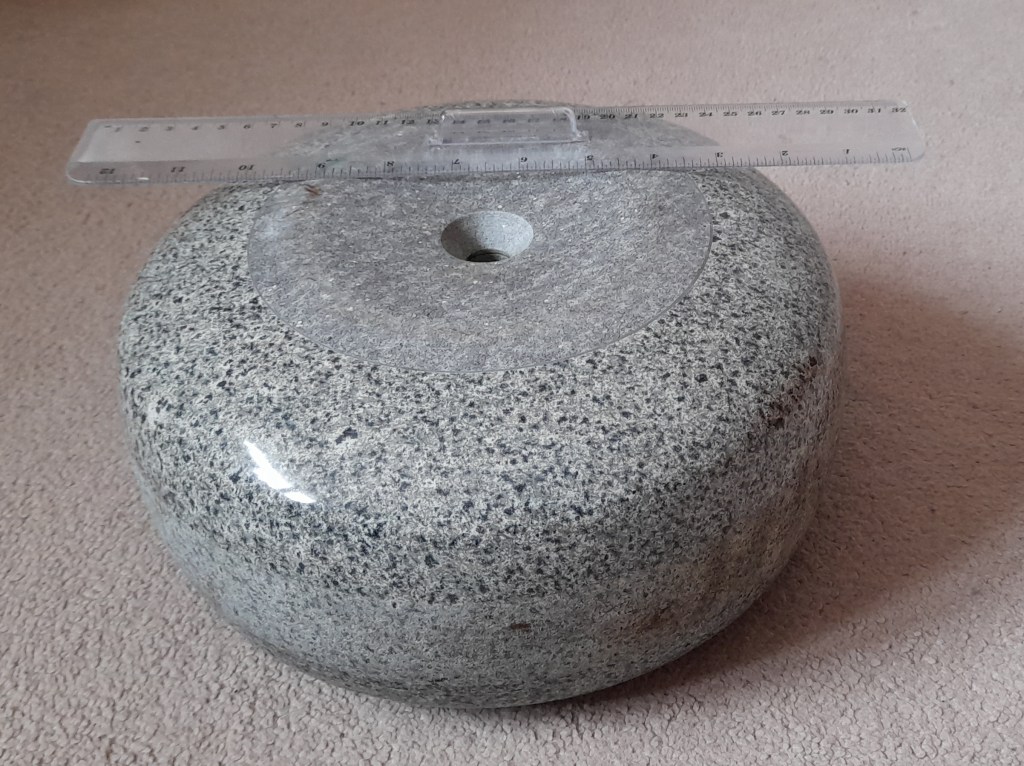
Hello readers! Last weekend I received the most astonishing gift: a huge lump of polished stone, perfectly cylindrical and shiny, with a conspicuous hole drilled into the top. This is a curling stone, used in the strange, slippery sport of curling – a sort of halfway house between ice hockey and pétanque. The history of this rock is fascinating on multiple levels, from its igneous origins to its use in one of the strangest winter sports. And now, somehow, it has ended up sitting on my bedroom floor like a petrified Roomba.
First, an explanation of curling (from a non-curler)
Like archery, darts and tiddlywinks, curling is one of those sports where the aim is to get an object to the centre of a target. In this case, the object is a tornado-proof paperweight: a rock with a diameter of 29 cm and a mass of 17-20 kg. The target is at the end of a long patch of ice, and teams take it in turns to push their stones towards it.
The game commences after a coin toss decides who goes first. Onto the ice there slides a frowning Scotsman, pushing a large rock with a simple handle on the top (it looks a bit like someone suffered a fundamental misunderstanding when tasked with making a clothes iron). The player glides forwards, moving like a Skyrim NPC who has lost contact with the physics engine, and then the rock is released. It departs the mothership and sails off across the ice, spinning – like the Interstellar docking scene in reverse.
It is at this point that things get very strange. Figures in flat-bottomed shoes slide out onto the ice to pursue the spinning stone. They carry brooms – not the witchy kind, but the sort you might use to mop the kitchen floor after a particularly misjudged attempt to carry a bowl of Weetabix on top of your cup of tea (don’t judge me – it’s efficient when it works). As the rock continues to slide, the broom-wielders start scrubbing the ice with a manic fervour. The ice is already so clean that you could eat your dinner off it – if you didn’t mind it getting cold incredibly quickly – but it’s not cleanliness but friction that the scrubbers are after. The brooms melt the surface, allowing the rock to slide faster and further, with its path deflected towards smoother ground.
The two teams take it in turns to slide stones. It isn’t just about getting your stones as close to the target as possible, but about knocking your opponents’ stones further away. Honestly, it looks like quite a lot of fun, which probably explains how such a quirky sport has stood the test of time. It was invented in Scotland in the 16th century, when people would play with any old rock that took their fancy. These days, however, curling stones must fit specific dimensions, weights and compositions, and they only come from two locations: Ailsa Craig in Scotland, or Trefor Quarry in Wales.
Ailsa Craig curling stones
My new pet rock is a curling stone of the Scottish variety, from the island of Ailsa Craig in the Firth of Clyde. Only one company has permission to quarry the rocks there, and this is Kays, founded in 1851. They have made all the curling stones used in the last five Winter Olympics, and every one of those stones came from the same quarry on one tiny island.
Each Kays curling stone contains two types of rock. Most of the stone is made from the “Common Green Granite”, but the top and bottom sections, which make contact with the ice, contain inserts made from “Blue Hone Granite”. Kays refer to their quarrying as “harvesting”, which certainly sounds a lot more whimsical than if they admitted to stuffing the island full of dynamite every few years.
Geological backstory
Ailsa Craig is made up of microgranite, which is essentially a granite with smaller crystals. Granite is an igneous rock, formed when a large pocket of magma, deep underground, cools and crystallises. Ailsa Craig’s magma was emplaced around 60 million years ago, in a time when Scotland and North America were joined, but were beginning to split apart. The region was volcanically active, and eruptions around this time led to widespread basalt lava flows, and to the creation of better-known landforms such as The Giant’s Causeway and Fingal’s Cave. However, not all the magma went straight to the surface; some of it stalled in big chambers known as plutons, at many kilometres depth. These have only been revealed after millions of years of erosion, now that all the rocks above them have worn away.
Anatomy of a curling stone
As mentioned earlier, the curling stone contains two types of rock. The “Blue Hone” variety of microgranite is denser and finer grained, while the “Common Green” has larger grains and a higher abundance of ferromagnesian minerals, which form dark clumps. You might also spot white, tabular crystals a few millimetres long, which are feldspar phenocrysts. If you’re very lucky, you might find a xenolith, which is a fragment of another rock that got incorporated into the granite without completely melting.
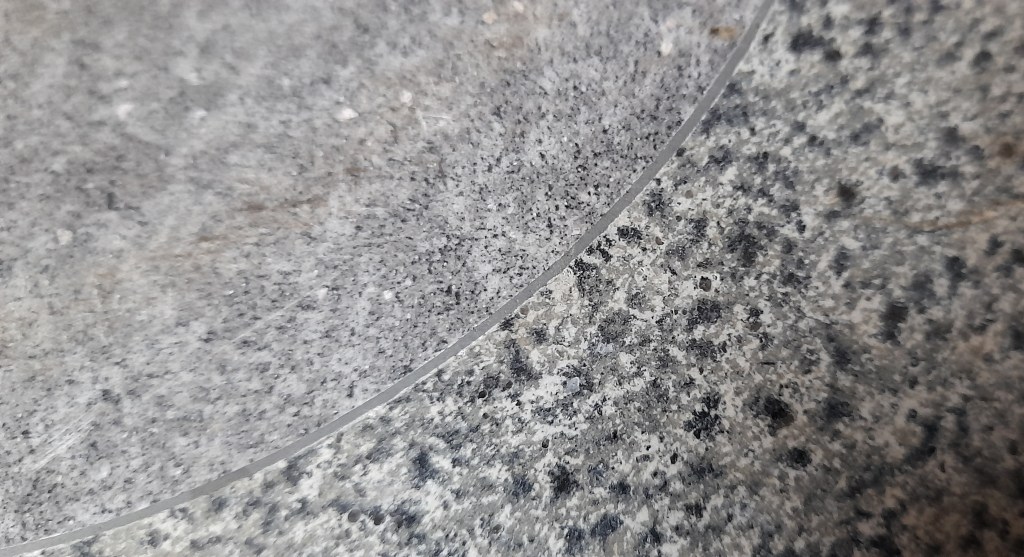
The reason the “Blue Hone” is better suited to being on the bottom of the stone is because smaller, similarly sized crystals will keep the surface smoother as it erodes. If some crystals were much larger than others, these might erode first and leave pits that would affect the way the stone slides. For the bulk of the stone, however, the “Common Green” is better, because when the stones collide, the fractures that develop between the larger crystals are more randomly distributed, leading to more even wear and tear. If you smacked two fine-grained rocks together, the fractures would form regular crescent shapes, which are undesirable on the surface of the curling stone.
Kays would have you believe that the Ailsa Craig microgranite is the best rock on the planet for making curling stones, thanks to its unique, alkali-rich composition. There is no denying that this rock is very resistant to erosion, as lumps of it were carried within glaciers for hundreds of miles during the last ice age, with some boulders even reaching Pembrokeshire. In fact, looking at a map of glacial erratics from the BGS, it’s possible that you might find lumps of Ailsa Craig microgranite at the curling stone quarry in Trefor (which is the kind of niche discovery that would interest approximately no one). However, a recent paper in the Canadian Mineralogist questions whether these rocks are really so special. The authors state that the Ailsa Craig microgranite has no properties that make it better than any other microgranite for making curling stones. Still, given the fierce curling rivalry between Canada and Scotland, and the terrible pun in the paper title, I’m taking this result with a pinch of salt. Nobody tells my pet rock that it isn’t special.
Recent history
My pet rock has come quite a long way to be sitting on my bedroom floor. It started life deep underground, 60 million years ago, then ended up being exposed by ice, wind and waves on a desolate Scottish island, only to be blasted out of the ground with explosives and then shipped to a workshop near Glasgow. I’m not sure how long ago my rock was turned into a curling stone. At a guess, it was the mid to late 20th century, because my rock fits the recent specifications for competition stones (older ones tend to be a range of different shapes).
My stone has scrapes along the top and bottom, implying that it has been used extensively, with the handle changing sides once one face wore down. This probably means it was in use for a couple of decades, maybe longer. I have no idea where it would have been used, or in what level of competition. The handle is missing, and it doesn’t carry any identifying features. There is a chance that this stone might have been used at the Olympics, but I would never know. It could have been involved in all sorts of scandals.
Buying curling stones
If you want a pet rock of your own, I have some sad news. Curling stones are expensive. This one has only made it into my possession because it was sold by someone who didn’t do their research, and bought by someone who had no idea what a good deal they were getting. Online, second-hand curling stones sell between £75 and £250, depending on their age and condition. A full-size decorative curling stone from Kays costs £125, and these are only the rejects, with flaws that mean they can’t be used in competitions. Kays also sell miniature stones for upwards of £30 – but prices for competition-standard stones are not given. You have to email them for a quote, so I’m assuming they must be rather pricey.
Given how resistant the curling stones are, it’s amazing that Kays are still in business. There can’t be many people out there looking for brand new curling stones, because the ones that exist today will still be useable in several decades. To my knowledge, there hasn’t been a boom in the numbers of people taking up curling, so I can’t imagine that the market for these stones is particularly large – which goes some way towards explaining the eye-watering prices on Ebay.
In summary…
Owning a pet rock is much like owning a tortoise, in that it is often a dull shade of brown-grey, it is very hard, and it will almost certainly outlive you. However, a pet rock is much lower maintenance, and brings its own unique joys. My pet rock has a murky past, having emerged from the dark underworld after years of hiding, only to be conscripted into an icy war where it was forced to attack other rocks on the whims of broom-wielding masters. Somehow, it ended up being stripped of its handle and sold in a little shop, and now it has started an era of peaceful retirement on my bedroom floor. Its only job is to start discussions about the quirkiness of curling and the genesis of microgranites, and this is a job it does very well.
Further reading for those interested:
If you want to learn more about Kays curling stones, the Guardian has a gallery of photos showing the island, the workshop, and even the stones in use at the 1924 Winter Olympics: https://www.theguardian.com/sport/gallery/2022/feb/02/hurry-hard-from-ailsa-craig-to-beijing-the-birth-of-a-curling-stone)
You can also take a look at the Ailsa Craig microgranite under the microscope: https://www.virtualmicroscope.org/content/riebeckite-microgranite.
Then there is the paper with the terrible pun in its title: Leung, D.D. and McDonald, A.M. (2022) Taking Rocks for Granite: An Integrated Geological, Mineralogical, and Textural Study of Curling Stones Used in International Competition. The Canadian Mineralogist, 60, 171-199. https://doi.org/10.3749/canmin.2100052.
Discover more from C. W. Clayton
Subscribe to get the latest posts sent to your email.

 C. W. Clayton