Hello readers! If you wondered why there was no blog post last week, it was because I was in North Wales, enjoying two days of torrential rain, board games and fish and chips. This jaunt to the back of beyond has become an annual event for my friends from university, and we have already established a set of traditions. First and foremost, at some point over the weekend we require a mountain of fish and chips. Second and secondmost, we require an actual mountain for us to climb.
Croesco i Gymru
Wherever you go in North Wales, you see a lot of Welsh. Every road sign is twice as big as usual, because it is written in both Welsh and English, and up north, the Welsh always comes first. The language is closely tied with the sense of national identity, and in recent years there has been a push towards using traditional Welsh names rather than anglicisations. For example, Snowdonia National Park has been rebranded as Eryri National Park, and Snowdon is increasingly referred to as Yr Wyddfa.
Of course, these changes have prompted a backlash from exactly the people you would expect. I’ve seen all sorts of complaints, including “I can’t pronounce that”, “what’s the point”, “nobody even speaks Welsh”, “mae pobl saesneg yn drewllyd”, “it’s just a mountain, get over it” and “I can’t get over this mountain, my map changed all the names”. Personally, I quite like the Welsh versions. To my ignorant ears, they just sound much cooler – although that could be because they sound like something from Lord of the Rings, and that could be because Tolkien appropriated the Welsh language… Hmm. Nobody escapes the culture wars unscathed.
There are plenty of reasons to put Welsh first on signs and roads, beyond expressing national pride and deterring the English. In the county of Gwynedd, where we stayed, 74.2% of the population can speak Welsh, which is the highest percentage in Wales. Of these, most will be bilingual, and while some may prefer Welsh over English, a small proportion might speak no English at all. However, I struggled to find data on this. The census hasn’t asked for information on “Welsh only” speakers since 1991 – possibly because there were so few of them even then. Therefore, putting Welsh first on signs has limited logistical advantages. The main reason is to give the region a stronger sense of identity, and to act as a quiet reminder about its history. This, in my ignorant outsider’s opinion, is something to be celebrated.
Eryri/Snowdonia National Park
As mentioned in the opening paragraph, our weekend was plagued by wet weather. Saturday brought a stonking 23.6 mm, and then Sunday trumped this with 25.6 mm. Not record-breaking, true, but it was certainly gloomy enough to limit our outdoor exploits. So, instead of aiming for the lofty heights of Snowdon/Yr Wyddfa, we stuck to the valleys along the route of the Ffestiniog Railway.
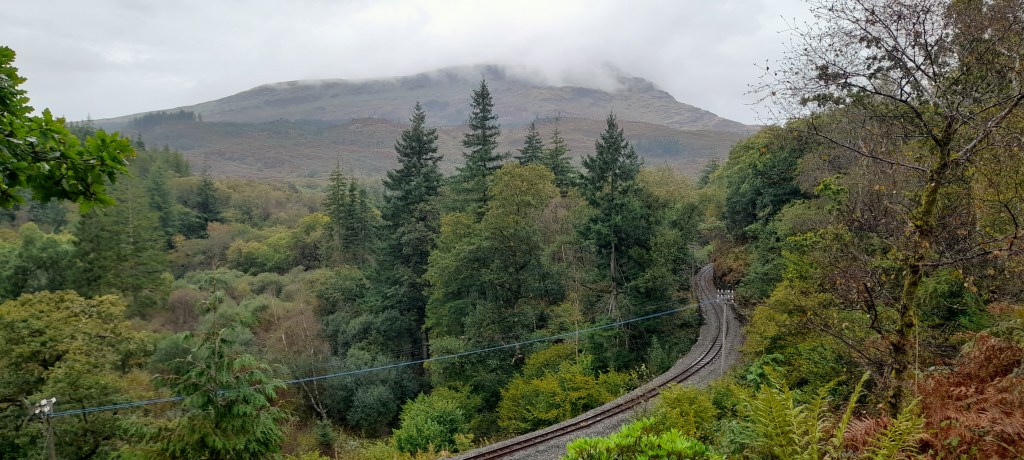
We managed to finish our walk before the heaviest rain arrived. It was a small loop from Tan-y-bwlch railway station, past a small lake called Llyn Mair, then up through the forestry plantations to the top of Y Gysgfa. This little hill might be only 234 m high, but it provides lovely views back towards the mountains, and out towards the sea.


The Ffestiniog Railway is the world’s oldest narrow-gauge railway, but sadly, we did not see any steam trains. We heard one chugging past, but the rain and the trees worked against us. The rails follow incredibly twisty routes around the hillsides, and our path crossed the line twice, but our timing was just unfortunate. No steam trains for us today.
Autumn is here
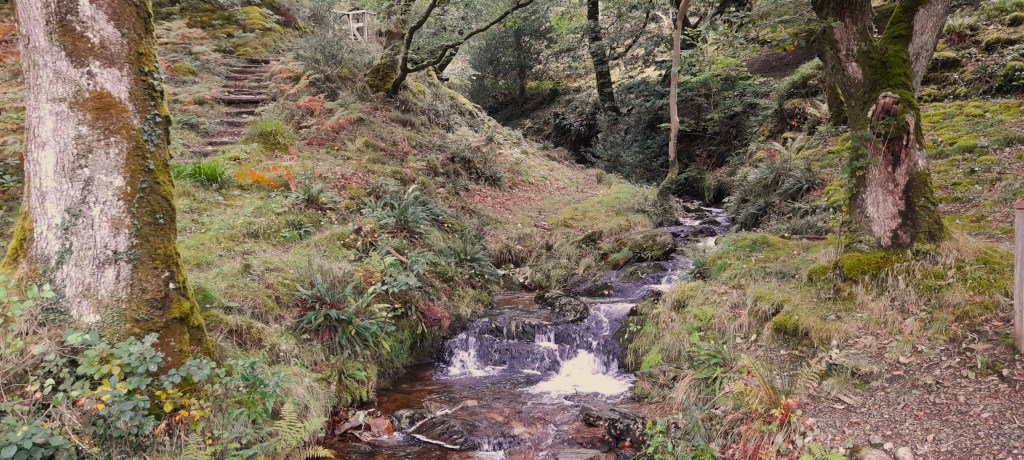
Last weekend felt like the tipping point from summer into autumn. Although the trees were mostly green, every leaf was on the cusp of turning brown. The forests had gained a golden-red hue, the bracken had died back to form a prickly, russet blanket across the hillsides, and the hedgerows were heavy with scarlet hawthorn berries. Hundreds of mushrooms seemed to have risen overnight, presenting us with an array of intriguing shapes and colours – and the explosive puffball varieties provided endless fun to certain members of our party.
However, autumn often carries a certain sadness and nostalgia. I think this is partly a result of the British education system insisting that the new year rolls around in September (which is true for many PhD students too), but autumn naturally exudes a sense of finality. With the nights arriving earlier and the days growing colder, the end of the year suddenly feels a lot closer, and this inevitably prompts some reflection on how we have spent our days. This isn’t necessarily a bad thing, but such introspection can sometimes leave you feeling vulnerable to the passage of time.
Of course, 2023 is far from over. The shops are already gearing up for the most consumerist time of the year, and I’m readying myself for several bouts of illness brought into my workplace by germ-riddled undergraduates. This might have been my last big trip for a while, but I still have plenty of things to write about. Next month, this blog will have its first birthday, so brace yourselves for some self-indulgent retrospection.
In summary…
I highly recommend a long weekend to North Wales. It’s a beautiful part of the world, and if you get the timing right (like we did), it can feel like you’re the only people there. I’ll definitely be going back to climb some bigger mountains, to see some more steam trains, and to eat some more fish and chips.
Also, a disclaimer: I must apologise for my Google Translate attempt at Welsh earlier. It was only a joke. Welsh-speakers, please forgive me.
Discover more from C. W. Clayton
Subscribe to get the latest posts sent to your email.

 C. W. Clayton