
Hello readers! A few weeks ago I took a quick trip to Ayrshire, on the west coast of Scotland. It’s a lovely part of the world, and the drive through the Galloway Hills to get there was an adventure in itself. The rolling fells of the Southern Uplands might not be as imposing as the mountains further north, but they are still wild and desolate, and have a bleak sort of beauty. At this time of year, the landscape is bursting with vibrant autumn colours even under the greyest skies, with trees glowing amber and gold on the hillsides and rivers churning white through the valleys. However, the weather was far too dreary for me to head out onto the fells – so instead, I went to explore Ayrshire coast.
Ailsa Craig
My route through the Galloway Hills took me north past Loch Doon, then west from Dalmellington on a single-track lane with numerous cattlegrids and innumerable potholes that has no business being designated a B-road. It cuts across the most northerly reaches of the Galloway Forest Park, and as you crest the top of the hill, you are greeted with a strange and unexpected sight. In the distance there rises a craggy, dome-shaped mountain that is clearly much larger than anything around it. It looks awfully out of place, with sheer walls and a rounded summit, hundreds of metres high. From this vantage point, however, its base is concealed. Anyone unfamiliar with the landscape would have no way of knowing that this mountain is, in fact, an island, a good 16 km out to sea.
The island is Ailsa Craig, and once you finally reach the coast, it is unmistakable. Nobody lives there now besides a few thousand gannets and puffins, but the island is famous for its prominence in the Firth of Clyde, and for its beautiful rock, used to make curling stones for the Olympic Games. By pure coincidence, I happen to own one of these curling stones, so if you want to learn more about the geology of the island, take a look here. The island itself is an impressive feature, visible from all along the Ayrshire coast. In fact, while I was there, the air was so clear that we could see the coast of Northern Ireland in the far distance.

Culzean Castle
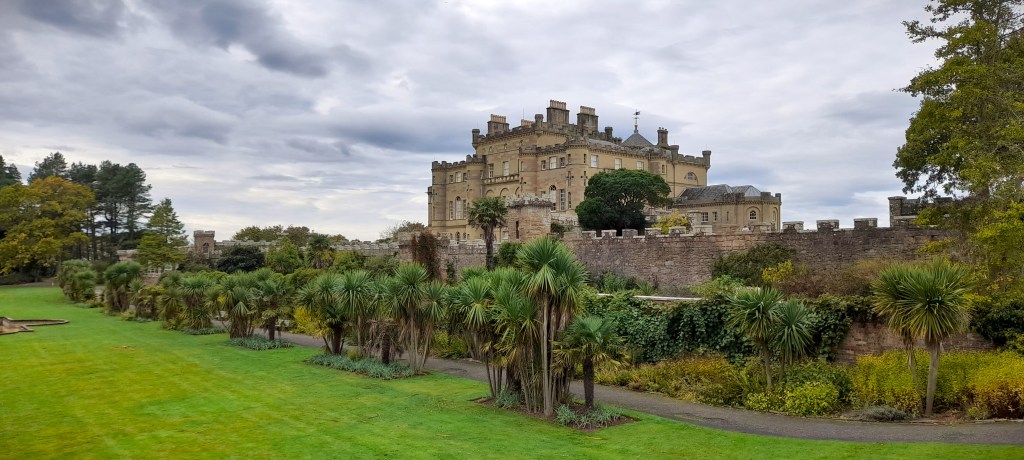
Facing the Firth of Clyde from the top of a sheer basalt cliff is Culzean Castle, built in the eighteenth century for the Kennedy family. This was the seat of the Marquess of Ailsa – and for those wondering, a “marquess” is someone who ranks below a duke but above an earl, and a “seat” is not for sitting in but for living in during those few months of the year not spent galivanting around Europe. Clearly, the Kennedy family had a bit of spare cash sloshing around in 1777, and the only logical cure for this financial affliction was a shiny new abode.
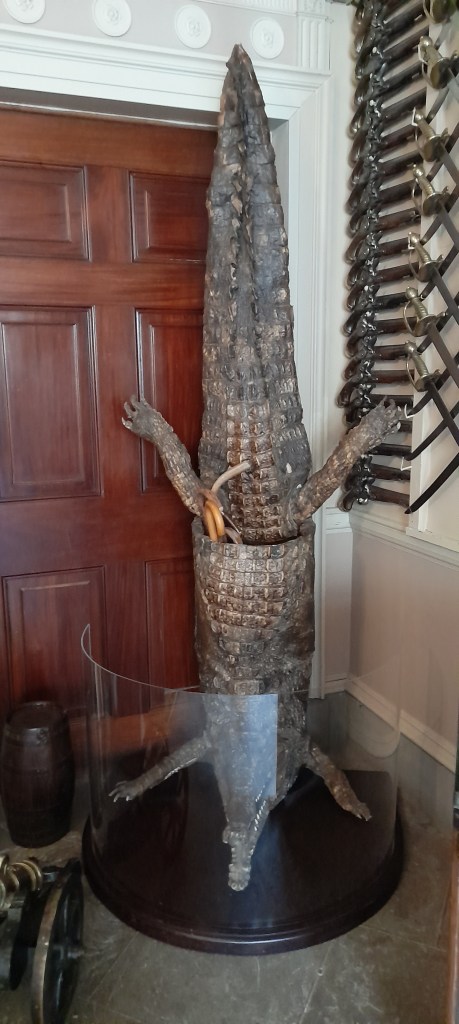
The Kennedy family summoned the architect Robert Adam, who leapt at the chance to alleviate the pressure on their family coffers. After all, he was a specialist in designing romantic, pseudo-medieval country houses for the upper classes. Not only did he design the outside, but the inside, too, including carpets and plasterwork and furniture. He knew that his customers had an insatiable appetite for the ostentatious, but he tried to sate it anyway, going above and beyond what was necessary. You want the walls to be curved? Done. You want curved furniture and doors with that? Obviously, obviously… And cherubs, you want cherubs? More cherubs, you say… Ha – indeed, my lord, it’s the height of tasteful! But the crocodile umbrella stand… Could I – ah, forgive me – could I perhaps convince you to-? No. No, alright, the crocodile umbrella stand will stay. You are right, my lord, of course – it really does tie the place together.
From the outside, the castle is certainly an impressive show of wealth. It clearly isn’t a real castle, but it doesn’t try to pretend otherwise. This is a mansion dressing up as a fortress – a stately home at a masquerade ball. It’s flashy and extravagant, and wants everyone to know it. The only way in is across a winding raised carriageway through needless gatehouses, which are perfectly aligned to frame the house at a variety of flattering angles. Everything about it screams pretentious, but this was the intended reaction. The old Kennedy family would probably have been satisfied by your accusations of ostentatiousness, if they had only valued your opinion in the slightest.

Home sweet home
On stepping through the front door, you are greeted with the armoury. First impressions are everything, and the 12th Earl (in the time before the family levelled up to Marquessdom) was clearly very aware of this. The weapon collection, which is displayed across every wall of the room, is one of the largest in the UK – second only to that of the royal family. It was bought in 1812 from the Tower of London, and comprises hundreds of guns and swords that had been made obsolete by advances in technology. These are laid out in a manner that is half Bond film intro, half tartan – but what really ties it all together is, of course, the crocodile umbrella stand. No words can do it justice.

Other highlights
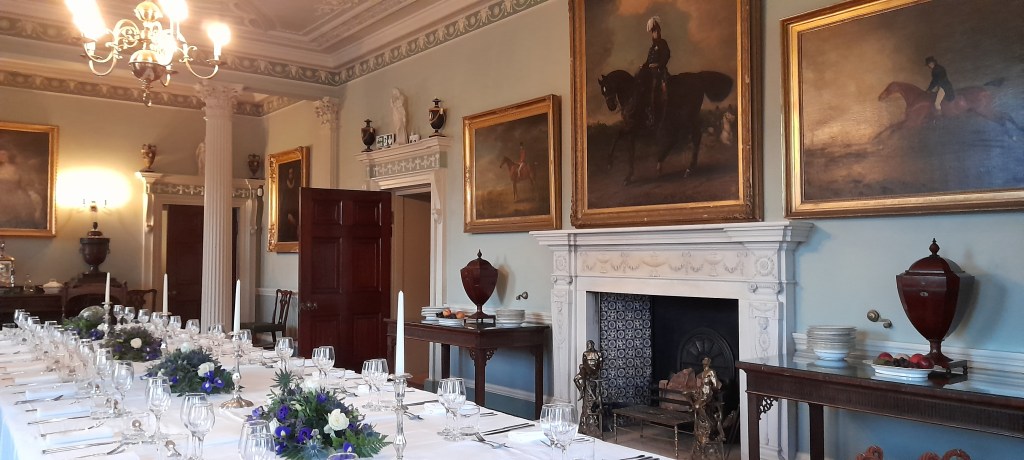
The dining room feels like a step back to normality after the entrance hall, which is saying a lot. I can’t imagine living in a place where you might sit down to eat beans on toast under the watchful gazes of great-granddaddy Kennedy and great-great-great granddaddy Kennedy as they prance around on funny-looking horses (one of the portraits is a genuine Stubbs).
Of course, the enormous paintings aren’t limited to the dining room. There are life-size portraits hanging in the hallway, including one of Napoleon for some reason, and in one of the drawing rooms are two striking paintings of Venice canals. I was assured by the National Trust volunteer that these were “not genuine Cannellonis” – which I had a good chuckle about later, because I, too, can be a snob sometimes.
Towards the back of the house are the kitchens and storerooms where the servants worked. Here, the ceilings are low and the corridors are narrow, designed to keep the peasants out of sight from their masters. There is even a copy of the rules they had to follow, which include “no singing or whistling”, “never use the main stairs unless cleaning them”, and “do not smile at droll stories” – which made me wonder if modern-day servants are treated any better. These rich families still exist, and they still have people doing their housework and menial tasks. It’s strange to realise that the most outdated thing in those rules was the use of the word “droll”.

Obsession with the upper class
I have often heard it said that the British care too much about the class system. We cling to a hierarchy that should be consigned to history, and continue to perpetuate prejudices based on categories which are nowadays mostly defunct. But is this true? I’m not sure that the people who care about “class” even use the same definitions – and is the class system truly gone?
In the eighteenth century, when Culzean Castle was built, the wealth hoarded by the upper class meant that they were better educated, better travelled, and in better health than those who had to work for a living. Two hundred years later, and times have changed. These days, everyone in the UK is entitled to free education (up to a point) and free healthcare (for the most part), and although wealth can buy you better education and better healthcare, the balance of wealth has shifted. So-called “social mobility” has led to many working class people ending up with a lot of money, either through hard work, savvy investments, or unprecedented fortune in a booming housing market. Nowadays, rich people are not necessarily posh people, and the boundaries between “working class” and “middle class” are becoming blurred. However, through all this social change and wealth rebalancing, the “upper class” has remained intact.
Why? The answer is a simple matter of birth. To be “upper class” in Britain requires inherited status and titles, rather than wealth. Often, the two go hand-in-hand, but even with all the money in the world, you can’t just become a marquess. You could only achieve this by marrying your way in to the inner circle – having pushed past a forest of social barriers in the process. Many of these families can trace their roots back to the barons of William the Conqueror, and they have kept their seat at the top of the feudal pyramid ever since.
Power from the past
Our system of inherited power has only lasted so long due to its unshakeable simplicity. There is always someone next in line, which limits the scope of any arguments over leadership. Obviously, there have been quibbles, plots, and sometimes wars – but imagine the additional complexity and chaos if leadership roles had been open to anyone. The feudal system might be miserable for most, but the British upper classes are the proof of its stability. These families are still here. Still wielding power.
Of course, some of their power has been eroded. Britain never managed a French-style revolution, but the wealth and influence of our feudal overlords has been greatly reduced from what it was. After the second world war, the government brought in huge inheritance taxes to pay for rebuilding our infrastructure, and to fund public services like the NHS. These taxes are the reason that Culzean Castle is open to the public. The Kennedy family couldn’t afford to keep all their houses, and so they gifted their castle (complete with its gun collection, non-genuine Cannellonis and crocodile umbrella stand) to the National Trust. But don’t worry – they still have their other stately home.
A quick side note regarding epic fantasy novels
Epic fantasy novels nearly always romanticise inherited status. This is partly a result of fantasy novels romanticising every aspect of our feudal past, including lords and kings – and following from this, if a story wants to include any political intrigue, it must focus on the nobility, which leads to an exclusion of ordinary people. Visiting Culzean Castle made me consider these fantasy tropes, and how they perpetuate or even glorify a feudal hierarchy. This could be a blog post in its own right, of course – but it made me wonder why we obsess so much over the concept of inherited power. Why do we find it so alluring?
In summary…
The Ayrshire coast is a lovely place to be, and despite the dreadful weather this autumn, the forests are looking spectacular. Culzean Castle is well worth a visit, either to enjoy the quirky architecture and beautiful gardens, or to confront your personal beliefs on the British class system. I got to see the birthplace of my pet rock, and I decided that at some point, I should come back to this part of the world and visit to the Isle of Arran. As ever, thank you for reading – and have a lovely week!
Discover more from C. W. Clayton
Subscribe to get the latest posts sent to your email.

 C. W. Clayton