
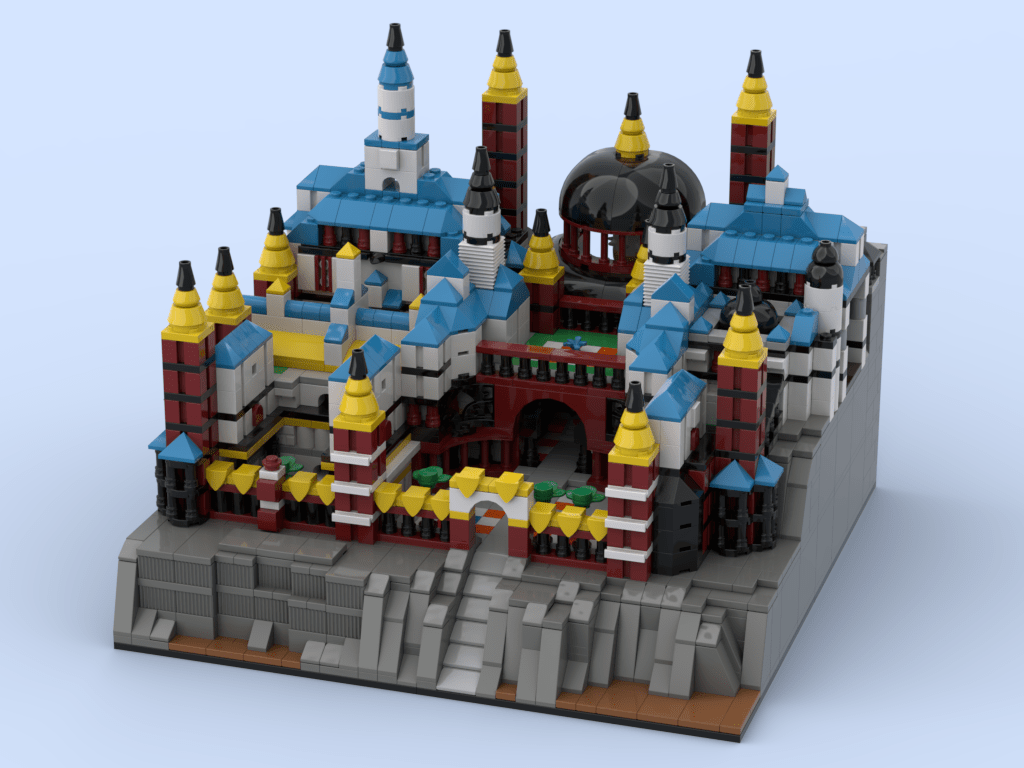
Hello readers! Just a short post from me today. You might remember that back in May I shared a Lego castle from my Highmoor series. Well, today I’m sharing another! A second castle has been added to the collection, and this one is a lot more intricate. Those familiar with the second book might recognise it as the Imperial Palace in Kaldarr – not that this is a story spoiler in any way. I doubt that the Lego model bears much resemblance to descriptions in the books… It has far too many right-angles.
Micro-scale constructions
This is a “micro-scale” model, where a Lego minifigure would stand four storeys tall. Building at this scale means that doors, windows, steering wheels and chairs appear comically large, unless you can disguise them as something else. I’m not particularly adept at this yet, but there are pieces hidden in here that were originally intended to be iron railings and fences, which I have adopted as rows of towering pillars. The technical pieces provided the most versatility, with tiny cogs standing in as giant chandeliers, and cylindrical connectors forming sturdy pillars.
The joy of micro-scale building is that you can make sprawling structures, such as palaces, without requiring thousands of pieces or a cathedral’s-worth of space. I’m not sure that Lego ever intended their bricks to be used this way, because there is no feasible way to “play” with such detailed, tiny structures. No ordinary child would ever construct something like this. Instead, the micro-scale building community consists of adults looking for an easy, tactile way to merge art and engineering.
I think part of the fun of working with Lego is being forced to adhere to its rules. Modelling and 3D printing using software like Blender provides more flexibility, but the rigidity of Lego makes it a puzzle as well as an artistic venture. Creating tiny buildings from a relatively small pool of pieces, which can only connect in limited ways, adds a problem-solving aspect that keeps bringing me back.

What you’re looking at…
For some reason, I decided to make my life harder this time around by giving the palace an interior. You can actually look down the long corridor from the entrance all the way through to the throne room – although this is much more impressive on the model itself than in any images I managed to render. I also added a ballroom on the northern side, with a golden chandelier (a technical cog) hanging from the ceiling. Looking at it now, I think the cliffs need more texture, but at the time I thought it made sense to keep them flat, as they are meant to be seen as a cross-section… Oh well. I’m sure the next one will be better.
In other news
I have reorganised the Highmoor series page! It is now much easier to find maps and view the art collection, as they have their own dedicated pages.
There is also a free book weekend ongoing! Until midnight on Sunday, all my books are free on Amazon. If you already have a copy, remember to leave a star rating, or even better, a short review.
Finally, the blog’s second birthday is coming up on the 27th November. I’ll endeavour to write a short post summarising everything that has happened in the last year, and highlight some of my favourite posts. Also coming up is another six-minute summary of a scientist, because we haven’t had one of those in a while…
Happy reading, and have a lovely week!
Discover more from C. W. Clayton
Subscribe to get the latest posts sent to your email.

 C. W. Clayton
2 thoughts on “Another Lego model for the collection”