Hello readers! In my last post, I recounted my hike down the Samaria Gorge on the island of Crete, Greece. It was an incredible experience, and certainly the highlight of the holiday – but I wanted to share a few of my other Crete adventures, too. For the most part, this wasn’t an adrenalin-fuelled, up-at-the-crack-of-dawn, escape-the-crowds kind of holiday (which is what I would usually go for). Instead, I was invited along as part of a bigger group, so most of our activities were low-energy, and close to where we were staying. There was still plenty to do, though – and plenty to learn.
Exploring Chania
We stayed in a villa on the northwestern end of the island, just outside Chania (pronounced “Hania” – and sometimes spelt that way too). The city felt very busy, even late at night. We encountered all sorts of drastic manoeuvres from locals trying to find a place to park, including: knocking on car windows to ask drivers when they intended to leave; sending family members ahead to stand in parking spaces; forming queues of cars around carparks; and parking with bumpers touching, or even doors touching. These last two tactics led to some mind-melting logistical conundrums, reminiscent of the logic game “Rush Hour” – not that there was any logic involved here. I’ve never seen road etiquette like it.
Still, once we overcame the challenge of parking in Chania, the old town was a beautiful place to explore. The city has a long history of invasions and occupations, all the way back to when the Dorians arrived from mainland Greece in 1100 BC. In 69 BC it was conquered by the Romans, and it then became part of the Byzantine Empire when the Western Roman Empire fell. From 824-961 it was ruled by the Arabs, before being reclaimed by the Byzantines – and when the Byzantine Empire eventually crumbled, it was ruled by the Venetians (from Venice, Italy, like the blinds). It was then taken by the Ottomans in 1645, when new Turkish settlers arrived, and many civilians were killed. There followed a series of brutal wars and uprisings, until the Ottoman army departed in 1897. Crete became part of Greece in 1913, and in 1922, the last of the island’s Muslim residents were deported to Turkey. In the 1940s, it was captured by German forces in WWII, and many civilians were killed. Since the end of the war, the city has finally enjoyed some peace – and since 1970, it has become a booming tourist destination.

Chania’s complex history is evidenced by its hodgepodge of historical architecture. To the untrained eye, the most obvious historic landmarks are the Venetian fortifications, which include the city walls, the shipyards, and the harbour. However, the harbour lighthouse was actually rebuilt by the Egyptians in the 1830s, which is why it now looks a bit more like a minaret. You’ll also find the domes of an Ottoman-era mosque on the seafront, directly beneath a Venetian-era fortress (see the middle photo above). There are multiple cultures crammed in side-by-side, and many buildings have been repurposed and modified over the centuries, as various rulers came and went.
Chania Lighthouse
We walked along the harbour walls at night, when the lighthouse was all lit up (for decoration, rather than as an operational lighthouse). There were very few people out there, probably because it was dark, and the path along the ancient walls was very uneven. If it had been in the UK, the walls would have been closed after nightfall due to the risks – but the Greeks seemed a lot more relaxed about health and safety measures. It felt great to look back across the water at the jam-packed bars and buzzing crowds along the seafront, observing the noisy chaos from afar. And there is always something thrilling about hearing the sea crashing in the night, invisible in the darkness.
Chania Old Town
The old town of Chania, within its Venetian walls, is a fascinating place to wander. The streets are incredibly narrow, concealing secluded courtyards and tiny restaurants behind tight corners and beneath overhanging balconies.
However, we noticed a significant amount of anti-tourism graffiti in the area – and it made me feel guilty for being there, contributing to the over-tourism problem. It’s a tricky conundrum for all involved: visiting places teaches us about the world and broadens our horizons, and as tourists, we bring a lot of money to regions where other industries are dwindling. The problem is that Chania’s economy has become increasingly dependent on attracting visitors, to the point where sprawling beach resorts are expanding, giant cruise ships are filling the harbours, and local house prices have skyrocketed as wealthy people race to let properties on Airbnb.
I understand why locals would be frustrated: the hotels and cruise ships put strain on limited island resources, and a good number of tourists won’t treat the area with respect – particularly those that fit the “Brits abroad” stereotype. Still, I thought that Chania old town remained fairly untouched, retaining its historic culture. It certainly wasn’t the anglicised hellscape of gift shops, tattoo parlours and “pubs” that I found in Lanzarote or Tenerife. If that’s what the locals are afraid of, then that’s a reasonable fear: we can only hope that their government accepts that tourism can be damaging as well as profitable, and that they start to limit visitor numbers, rather than encouraging unsustainable growth.
Afrata
One of the most beautiful places we visited was the peninsula west of Chania. We drove along a winding coastal road with spectacular views over the bay, looking back towards the busy beach resorts at Maleme and Platanias. The peninsula was wonderfully quiet, and for the most part, we had the road all to ourselves.

However, one section of the road was crowded with people. The route had taken us past the “Mother of God Odigitria Gonia Monastery”, and from the number of people spilling out of the gates, you would think that it had just hosted a rock concert. We had known that it was a national holiday, but we hadn’t realised that it was the “Dormition of the Mother of God” day (apparently the most important celebration of the Virgin Mary in the Greek calendar), and we certainly hadn’t predicted that the locals would take it so seriously. The sheer number of people had brought traffic to a standstill.
Beyond the monastery, however, the road was empty. We didn’t see another car for miles – not until the route carried us up into the mountains, to the village of Afrata. Here, tucked away between the sea and the hills, were acres of ancient olive groves, and dusty fields full of goats. The road narrowed, then wound its way back down to the sea via a deep, narrow gorge. Here was Afrata’s best-kept secret: a small, rocky beach in a sheltered bay, with calm waters perfect for swimming. And when I say “secret”, I only mean that it hadn’t attracted many foreign tourists: there were plenty of locals there.

The waters were warm and peaceful, with hundreds of tiny fish swimming around underneath us. Most of the beaches further up the coast had red flags flying due to strong winds and crashing waves, meaning that swimming was prohibited – but here, there wasn’t a single breaking wave. The greatest disturbance came from the bow-waves of noisy yachts transporting gawping tourists around the peninsula. Whenever one of these went past, often accompanied by the sound of music booming across the water, I could very much sympathise with the local resentment towards certain visitors.
Luckily, we faced no resentment from the locals on Afrata beach. An elderly gentlemen asked where we had come from, and seemed pleased that we were visiting all the way from northern England. We told him how amazing the White Mountains were, and he was astounded to hear that the highest mountain in England wasn’t even 1000 m high. He then informed us, quite proudly, that the highest mountain on Crete was 2500 m. He was also deeply concerned when we told him that heatwaves were becoming more common in the UK, and that the temperatures in Crete and Cumbria were sometimes the same. This elicited a lot of head-shaking and despairing about climate change – and thankfully, he soon returned to telling us more about the island, and the best way to do the Samaria Gorge (go early, don’t rush, and drink the spring water!).
Cretan hospitality
Aside from the anti-tourism graffiti in Chania, most of the people we met in Crete seemed very happy to see us and to talk with us. Most restaurants provided small desserts and shots of Ouzo on the house, and the food itself was incredibly good value, often arriving in insurmountable portion sizes. Restaurant owners went out of their way to try and seat our large group – and the kindest hospitality I experienced was in Agia Roumeli, after the Samaria Gorge walk, where a restaurant owner offered to help when he noticed I had heat exhaustion (very embarrassing). You don’t tend to encounter such generosity in the UK, and I must say it was all very lovely.
However. The roads…
If I can make one small complaint about the Cretan locals, it is that they don’t follow any rules on the roads. Their highways (A-roads, if they were in the UK) have a “hard shoulder” kind of border that varies in width, either being non-existent, or wider than the carriageway itself. At first, we weren’t sure about the purpose of these borders. In western Europe, drivers stick to the carriageway, keeping between the white lines – but drivers in Crete never seemed to heed the road markings. Drivers sometimes straddled the edge of the road, half in the hard-shoulder, or they would drive in the hard-shoulder entirely, veering back out onto the main carriageway whenever the hard-shoulder vanished.
The general rule seemed to be that if someone drove up behind you and started tailgating, it was up to you to pull into the hard-shoulder to let them pass – and if you didn’t do this fast enough, they would flash their headlights at you. Now, I’m not sure if this if how Greek roads are meant to operate, or whether this is a local “rule” (I’m leaning towards the latter). In any case, the Cretan drivers were incredibly aggressive, and at first it was hard to understand their intentions. By the end of the week, we had a good feel for it, but it we were far from feeling safe on the Cretan roads.
Lake Kournas
The final visit worth mentioning here is Lake Kournas, which is just 40 minutes from Chania. It is the largest freshwater lake on Crete, and it is fed all year round by two huge springs that carry water from the White Mountains. From what I can tell, the lake exists in a naturally deep depression, eroded into the limestone bedrock, but it has a human-made dam that limits outflow in summer. During the summer months, the lake levels decline, revealing a sandy shore that is treated like a beach, with sun loungers and parasols. There are a few tacky gift shops along the waterfront, and several businesses renting pedalos – all the unfortunate hallmarks of a tourist trap.
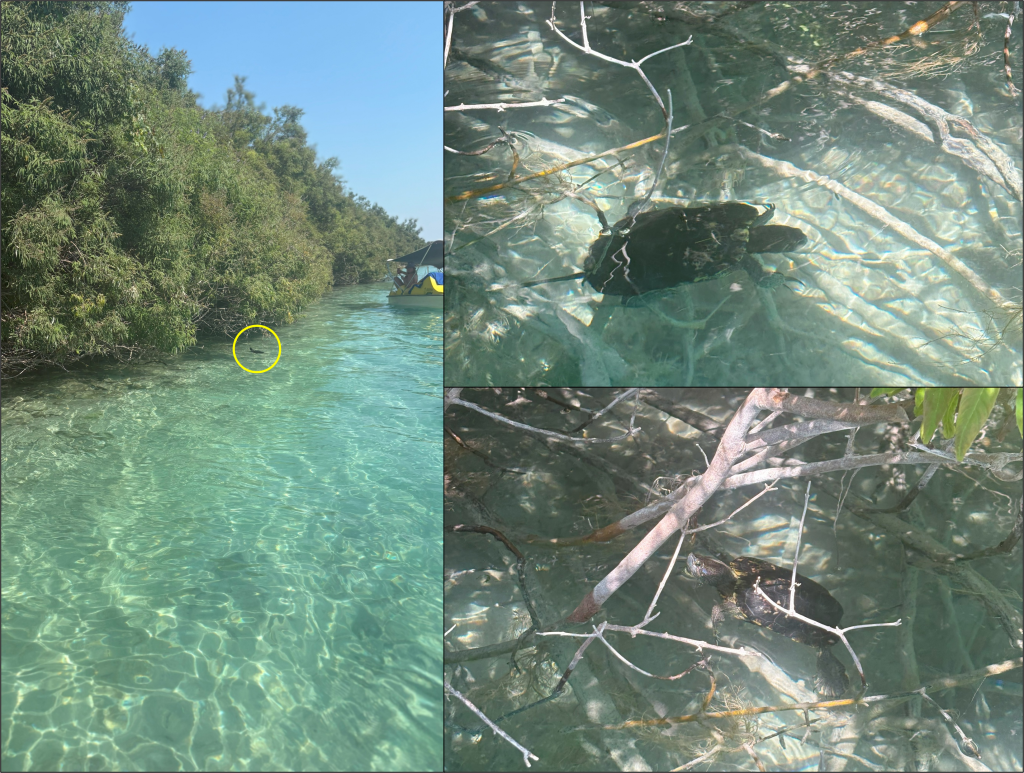
Lake Kournas is undoubtedly beautiful. It has deep blue waters and sits at the base of some impressive mountains. It is also a rare habitat, home to fish, terrapins and eels. However, I couldn’t help but feel as if its grandeur was corroded by the dozens of brightly-coloured pedalos clustered around the edges of the lake. The air was filled by the sounds of squeaking chains and bumping plastic, as red-faced tourists struggled to steer their ageing contraptions and catch a glimpse of the wildlife.
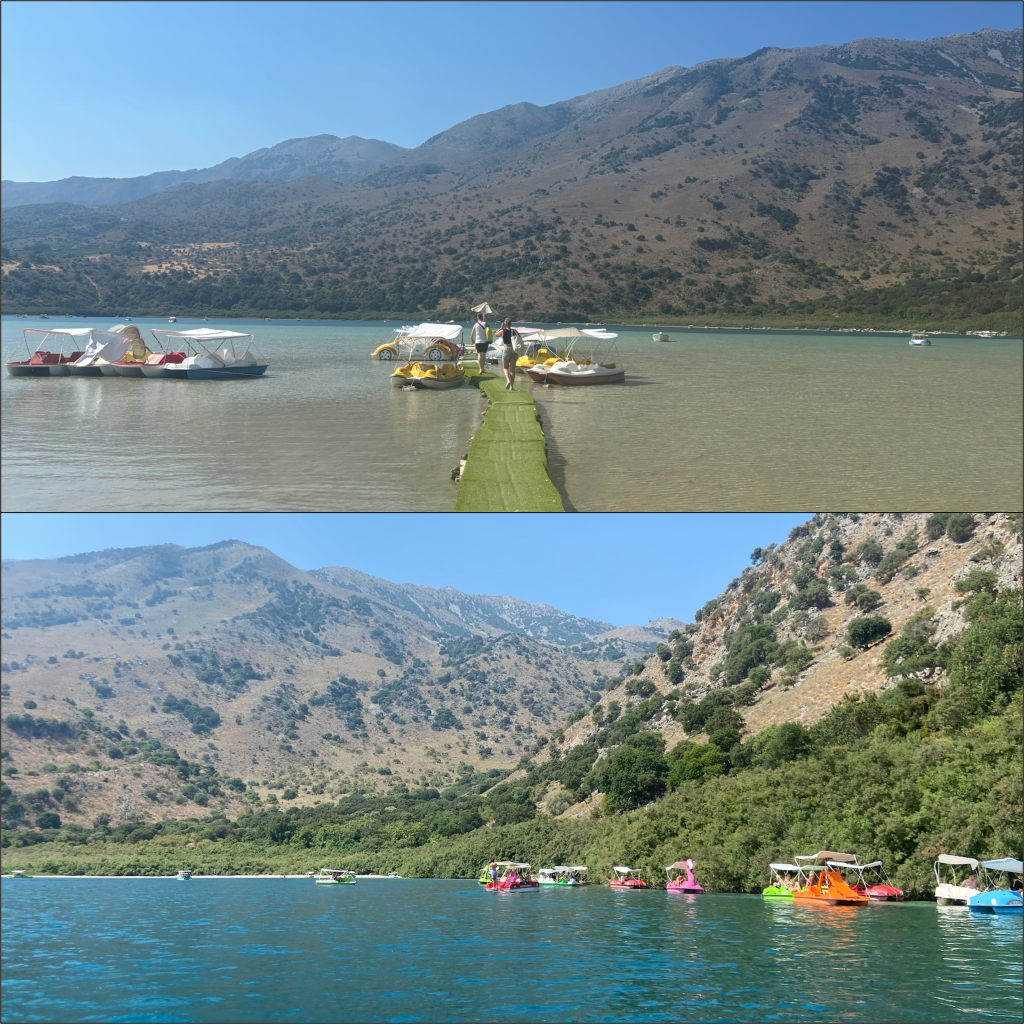
Again, I felt as if I was part of the problem here. I was yet another tourist contributing to an economy that brought questionable benefits to the local area. As I understand it, the terrapins in Lake Kournas are really rare – so it feels like they should be protected, rather than being subjected to flotillas of pedalos every afternoon. After a bit of digging online, I learnt that there have been plenty of calls to protect this place, but nothing has ever been done. I’m unsure whether the terrapins actually mind the tourists (for all I know, the pedalos might scare off predators like eagles), and I wish there was more information available. Are the terrapins at risk? Are they as affronted as I am by the sight of a crusty-looking unicorn-themed plastic pedalo squeaking its way towards them? What a life.
In the UK, this place would be looked after by the National Trust, RSPB, or some other wildlife charity. It wouldn’t be commercialised to this extent, and the number of visitors would be limited. I couldn’t help but compare Lake Kournas to places I visited in Iceland or Lanzarote, where environmental protections were so strict that tourists were prohibited from treading on moss and lichen. It just seems crazy that in Crete, hundreds of people are allowed to harass these terrapins every day. Maybe they don’t mind, of course… But some information and guidance would have been nice either way.
In summary…
I very much enjoyed my trip to Crete! I feel very lucky to have had this chance to explore another part of the world. As well as seeing landscapes, plants and animals that I had never encountered before, the trip prompted me to learn a bit more about Greek history and culture, too. I hope that the locals of Chania can find a sustainable way to allow tourists to keep visiting their beautiful area, without those tourists degrading the environment.
Happy reading, and have a lovely week!
Also, stay tuned for updates regarding Highmoor… New edition and more should be releasing soon.
(Many thanks to the Scotts for sharing some of the photos in this post! I wasn’t brave enough to take my phone out on the pedalo…)
Discover more from C. W. Clayton
Subscribe to get the latest posts sent to your email.

 C. W. Clayton