
Hello readers! Have you ever wondered where our modern concept of a “witch” comes from? I’m sure we all have a similar image in our heads: one of a woman with a pointy hat and a broomstick. The woman is probably wearing a black skirt, and she might also have accessories such as a cauldron and a black cat. Perhaps we picture women of different ages, or with a different level of superficial attractiveness – but the broomstick is always present. If we were playing Pictionary, it might have been the first thing that we drew.
But why do we associate witches with brooms? Cauldrons make sense, because that’s how a witch brews her potions (a vital part of the witch business model). But a broom (or “besom”, as I learnt this week) has no obvious magical purpose. We use them to sweep floors – so why would anyone imagine that they could fly?
I decided to look into this matter further, to try and find the earliest example of a witch flying on a broom. I had no idea how old the idea was, whether it stemmed from a particular story, or whether people ever truly believed that brooms were a viable mode of airborne transport. The search turned out to be trickier than I expected, and without spoiling the conclusion, I can tell you the headline: nobody really knows!
(Some disclaimers: I should mention that I’m talking about western European witches here. Obviously, other parts of the world have their own traditional stories about women with magic powers – but to my knowledge, they haven’t ever been associated with brooms. Please correct me if I’m wrong! Also, this post is going to contain a fair amount of innuendo as I dance around confronting the role of brooms in witch culture. And also some very old drawings of naked women. Apologies in advance.)
Examples of modern broom-riding witches…
Witches in modern fiction often own broomsticks, particularly in stories for children. Examples include Meg and Mog, written by Helen Nicoll and illustrated by Jan Pieńkowski in the 1970s. I also rediscovered The Jolly Witch by Dick King-Smith during my research, having not thought about it since I was a kid, which is about an old woman who chooses to ride a vacuum cleaner instead of a broom.
For older children and young adults, there is The Worst Witch series by Jill Murphy, first published in 1974, which features brooms and flying lessons at a magical school (I think there was another series that did this later, but the name escapes me…). The witches in Terry Pratchett’s Discworld series also fly on brooms, and their poor suitability for the task is a consistent source of amusement. In Philip Pullman’s His Dark Materials trilogy, the witches fly using branches of “cloud pine”, which aren’t strictly brooms but are definitely broom-adjacent. And the Wicked Witch of the West in L. Frank Baum’s The Wonderful Wizard of Oz also rides a broom, which is pivotal in her demise.
The European concept of broom-flying witches also appears to have taken root in Japan over the last few decades, as there are plenty of animes and mangas that include witches with brooms, including Beserk, Black Clover and Little Witch Academia (another school for witches… I could swear there was another example of this…). Studio Ghibli made Kiki’s Delivery Service in 1989, which is an absolute gem of a film. And there are also broom riding witches in Nintendo games, from Irene in the Legend of Zelda, to Kamek in various Mario titles.
The oldest example I could think of is The Wonderful Wizard of Oz, which was written in 1900. Clearly, the concept of a broom-riding witch was already established in the public imagination at this point. So where did the idea come from?
A concept older than recorded history
People have believed in magical flight for a long time. In the second century, there is an account by Apuleius, a writer and philosopher who was accused of using magic himself. He wrote a lengthy and humorous speech to defend himself in court, which has miraculously survived to the present day. His account suggests that witchcraft revolved around herbs, potion making and magical gemstones. Also fish. Particularly the fish named after unmentionable body parts (I probably read too much of the translation of this speech, and let me tell you: it is bizarre).
For the next thousand years, beliefs don’t seem to change very much: witches were always closely associated with potions and harvesting dangerous herbs. These potions could bestow all manner of magical powers, including shape-shifting as well as flying. However, the first specific account of a “flying ointment” used by witches comes from Johannes Harblieb in the 1440s. He wrote a book on “forbidden arts, superstition and sorcery” which included lists of some very toxic plants, apparently used to bestow the power of flight on objects and people.
So when did the brooms arrive?
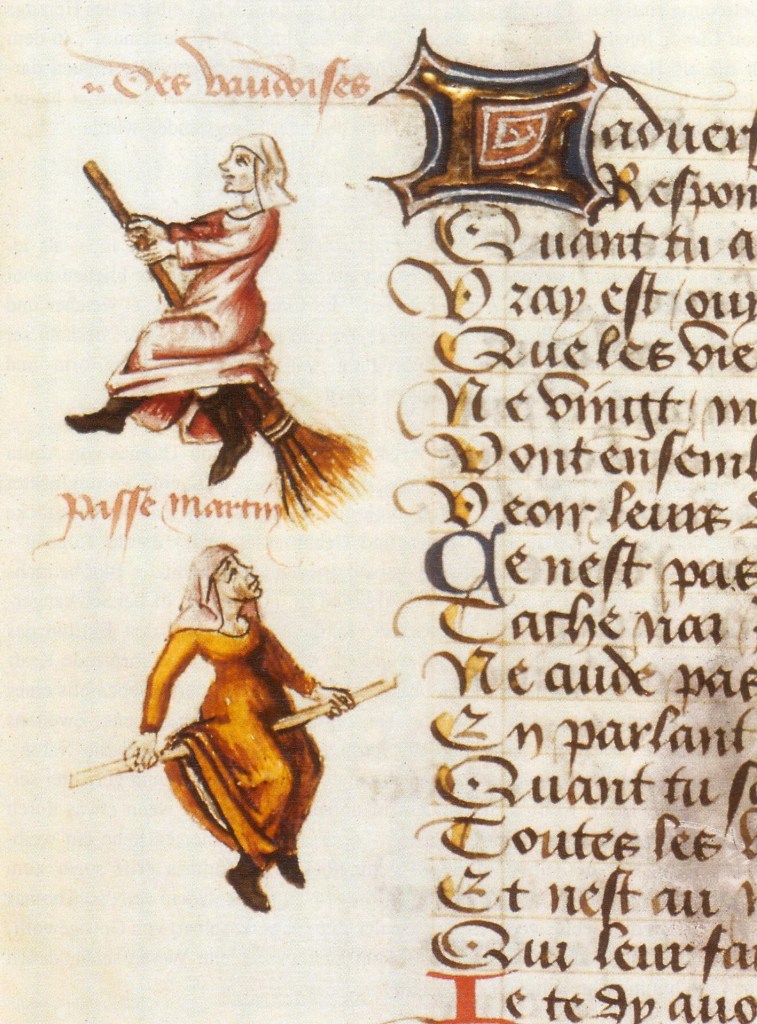
The oldest known depiction of a witch on a broom is an image from Martin Le Franc’s Le Champion des Dames (A Defence of Virtuous Women), written in 1451. The image shows two ordinary-looking women, one of whom is riding a broomstick, while the other rides a stick without any bristles. These women are Waldensians – from a breakaway, persecuted Christian sect that allowed female priests (the horror) and supposedly worshipped Satan.
Another early example of a woman flying on a broomstick is in the cathedral of Schleswig, Germany, although the age is disputed. It was thought to be from the 13th century, but may be from the 15th – nobody seems to know for certain.
And it wasn’t just brooms…
In the medieval and renaissance eras, witches were depicted flying on animals just as often as on brooms. The chosen animal was usually a goat, presumably due to the connection with Satan. However, there was apparently a case in Norway in the early 18th century of a grandmother taking her granddaughter flying on the back of a pig that she had smeared with ointment. This appears to be an isolated incident, however.
In the very early 1500s, multiple prints by Albrecht Dürer show witches flying on goats, usually riding them backwards. Bizarrely, one of his goat-flying witches is shown holding a broom, but not riding it. His protégé, Hans Baldung Grien, also made depictions of witches, typically presenting them naked and gathered around bubbling cauldrons. He also includes them flying on goats, riding backwards (no originality there).
A work from 1565 by Pieter Bruegel the Elder, called St. James and the Magician Hermogenes, shows some witches riding brooms, and some riding animals. But the idea of goats clearly stuck around, as they are also included in an engraving by Johannes Praetorius from 1668, showing witches travelling via flying goat to a Witches’ Sabbath.
The unfortunate context: witch trials and murder
The crude drawings of witches on brooms might seem funny at first glance, but they were included alongside texts that called for witches to be hunted down, tortured, and killed. The concept of a witch flying on an enchanted broom wasn’t an exciting story, but a calculated propaganda piece, trying to depict witches as defying the laws of nature and the will of God.
Across Europe, tens of thousands of people were killed after being found guilty of witchcraft, and the majority of them were women (estimates range from 80-90%). This wasn’t the case everywhere; in Iceland, more men were prosecuted than women. However, the most famous and widespread witch hunts happened in the 16th to 18th centuries in France, Germany, the UK and Ireland, where alleged witches were almost exclusively women. Scotland, in particular, had a much higher rate of witch prosecutions than elsewhere in Europe, with an estimated 4000-6000 prosecutions in the 16th to 18th centuries.
There is a common misconception that intelligent women, midwives or local healers were the ones most often singled out as witches. However, historians suggest that this was not the case. Medieval and Early Renaissance villages would often have a healer or “cunning person” who would use herbs and good magic to help people; indeed, these “good witches” were often involved in rooting out the “bad witches” accused of using magic to hurt the village. As such, they were popular with the villagers and rarely prosecuted.
Instead, the people most likely to be accused of witchcraft tended to be neighbours involved in disputes, or the disabled and elderly who were deemed to be a burden. Times were hard, and people wanted a scapegoat on whom to blame their problems. Of course, they couldn’t scapegoat people who were deemed to be integral to the society, so they scapegoated the weak, the vulnerable and those who were disliked.
Did people actually believe that witches could fly?
Beliefs changed over the centuries. In the early Middle Ages, it was heretical to believe that witches could fly, as this suggested that the laws of nature and the will of God could be circumvented. The Canon Episcopi, published in the year 900, stated that witchcraft was a delusion. However, this didn’t stop people believing in it, and the concept of witches remained embedded in the public imagination.
In 1324, Dame Alice Kyteler of Kilkenny, Ireland, was charged with witchcraft, and her accusers claimed to have found an ointment which she smeared on a staff in order to fly with it. Whether anyone truly believed this is another matter; as with many witch trials, the accusers had other motives (Kyteler had lots of husbands, had inherited and allegedly stolen a lot of money, and had stirred up a lot of local resentment in the process).
In 1487, German clergyman Heinrich Kramer published Malleus Maleficarum, a text which became a guidebook for witch hunts across western Europe. Kramer wrote that witches were “bodily transported from place to place to practise carnal connexion with incubus devils” and suggested that they did this by anointing chairs or broomsticks with flying potions. He also suggested that magicians and necromancers were “often carried through the air by devils for long distances” – so he, at least, appears to have believed that witches could really fly.
Kramer’s work was highly influential. Previously, it had been heretical to suggest that a witch could fly – but after Malleus Maleficarum, it was heretical to suggest that they couldn’t, as their flight was seen as proof of their connection with the devil. In 1597, King James VI of Scotland, who later became James I of England, wrote a dissertation about black magic titled Daemonologie, in which he described witches as slaves of the devil. However, he made no reference (that I could find) to witches flying, so I am unsure whether anyone in the UK ever believed this. Perhaps it was only believed in France and Germany?
Even at the time, there was debate among scholars as to whether witches physically flew, or whether their ointments allowed an out-of-body experience, whereby their souls flew to meet the devil while their bodies remained asleep. Some clergymen in the 16th century reported women in drug-induced stupors merely hallucinating that they had met with the devil. So, not everyone believed that witches could fly. In 1584, Reginald Scot wrote The Discoverie of Witchcraft, asserting that all witchcraft was nonsense or trickery.
But why brooms?!
We have identified that witches started to be associated with flying brooms in the Middle Ages, but we haven’t established why. The flying goats make more sense, as goats were often associated with Satan (not sure why – seems a bit harsh on the goats), but brooms have no obvious demonic links. Out of all the household objects, from chairs to beds to carpets, why did people settle on brooms as a credible mode of flight? To understand this, we need to look at how the European concept of witches changed over the centuries.
Witches as enchantresses
Back in the year 900, the Canon Episcopi suggested that women could use trickery and bodily seduction to enslave men. Women were seen as temptresses, trying to put men on a path of eternal damnation – so witches in the Middle Ages were typically presented as young and attractive, and inherently desirable. They were generally seen as being powerful, able to summon and command demons.
This concept of witches can be seen in the prints of Albrecht Dürer, which were made around the year 1500. He always depicted witches as naked, and his artworks are clearly intended to be erotic. One of his engravings from 1497, titled The Four Witches, shows four naked women standing in a room, with nothing to suggest that they are witches besides some skulls lying on the floor, and the devil peering at them from behind a door. If you ask me, this is just an erotic drawing, plain and simple – but the image has been the subject of intense scholarly analysis (and yes, it took effort for me not to put that phrase in quotation marks).
Witches as ordinary women and hags
There was a shift in the Early Renaissance towards depicting witches as ordinary housewives. People no longer viewed witches as purely mythical characters, and were starting to suspect their neighbours and mothers-in-law of witchcraft. This shift towards paranoia was accompanied by a shift in the way that witches’ powers were perceived: rather than believing that witches were powerful women with the ability to command demons, Malleus Maleficarum asserted that witches were inherently weak, allowing them to be used by the devil. According to Kramer’s doctrine, this meant that any woman could become a witch, unless she strived to remain a devout and upstanding Christian citizen.
Over time, the concept of witches being weak and corrupted led to them being presented as ugly and undesirable. Witches started to be drawn as hags and crones, enforcing the idea that they should be shunned, and reflecting the general, unspoken consensus that old women made the best scapegoats.
However, although the age and beauty of the depicted witches showed a pronounced shift, they still retained their brooms. A painting from David Teniers the Younger, from 1650-1690, called Incantation Scene, shows a witch applying ointment to the behind of another witch, who is seemingly about to take off on a broom. Some of the witches in this scene are shown to be old crones, and some are shown to be young – but the broom is still present, centuries after the earliest broom depiction.

Witches romanticised
By the eighteenth century, most people had stopped believing in magic, and European countries started to decriminalise witchcraft. In the UK, the witchcraft act of 1735 made it a crime to claim that anyone had magical powers – and anyone that claimed they could do magic, or speak to spirits, was viewed as a con artist, trying to extort people.
The concept of witches shifted yet again, and they became viewed as mythical, fictional beings, rather than a genuine perceived threat. Witches were heavily romanticised, as seen in paintings by John William Waterhouse from 1886, which show a very sanitised view of beautiful women with long dresses beside cauldrons. Alternatively, take a look at the many, many paintings by Luis Ricardo Falero from the late 1800s, which show lots of very naked women in very suggestive poses, often involving brooms (and occasional goats). I would show an example here, but they are, frankly, too indecent for this blog.

What’s with the nudity…?
Forgive the diversion. This isn’t strictly to do with witches riding brooms, but I think we should explore the matter for the sake of context. Nearly all depictions of witches show them in the nude – in fact, pre-19th century, witches are more commonly depicted naked than they are flying brooms. But why?
One reason is that witches were always viewed as heretics. And what could be more heretical than sneaking off in the middle of the night to prance around naked and get involved in some carnal naughtiness?
However. I can’t help but wonder if there was a secondary motive behind these depictions. The people crafting these stories, carving these engravings, and spending days on these paintings, were almost exclusively men. And most drawings of witches – even the ones in guidebooks on how to torture or kill them – are overly sexualised. Someone, somewhere, was getting a kick out of all this – although they never would have admitted it. The sexualised depictions probably weren’t entirely misogynistic, either; after all, the idea of running away and having a carnal good time was probably quite appealing to women, too. Throughout history, everyone seems to agree that witches are enjoying themselves (the word “pleasures” crops up a lot). And it seems that the general populace has always enjoyed hearing about witch antics. Maybe the concept of witches has survived for so long because it is such an effective trope for exploring lust, temptation and guilt?
But back the brooms. We’ve established that witches have always been hyper-sexualised, so perhaps this explains the whole “sitting on a long stick” schtick. Of all the common household items, the broom is a prime contender for being the most phallic (this is a common academic hypothesis, not a personal opinion). It is also not quite phallic enough to get called out immediately – which is presumably why we keep including witches and brooms in stories aimed at children. Still, if you think this hypothesis is unpalatable, brace yourself for the next one.
The drug hypothesis
This is a popular explanation that has spread online, despite there being very little evidence for it. Some clergymen in the 16th century reported that witches brewed potions to get high; however, many of the plants they might have used would have induced vomiting if ingested. So, a small number of modern scholars have suggested that witches must have got high by taking their drugs another way; specifically, by utilising the thin membranes located in their nether regions. And how did the witches apply their ointments? By broomstick, apparently. How truly awful.
To me, this hypothesis seems incredibly far-fetched. The only “evidence” comes from the trial of Dame Alice Kyteler in Kilkenny, whose accusers reported that witches “anoint a staff and ride on it to the appointed place, or anoint themselves under the arms and in other hairy places.” First of all, this tells us that western Europeans have always been prudish when it comes to describing the old privates. Secondly, it tells us nothing. This account, if it truly comes from Kyteler’s trial, was given by men trying to slander and indict a woman they wanted dead. Are we really going to take their word for this? Also, who in their right mind would shove a splintery old broomstick where the sun don’t shine?! This is all very silly.
That being said, there can be no denying that alkaloid hallucinogens can make you feel as if you are flying, as can the fungus that grows on rye. Witches would certainly have had access to plenty of mind-altering substances. Some people even tried a few of these old-timey plant drugs in the 1960s for “research purposes”. So, perhaps there is some truth in this. But the broom-handle bit? That seems unlikely.
The neo-pagan hypothesis
Wherever the drug hypothesis was mentioned online, I generally saw comments from tech-savvy neo-pagans calling it out as nonsense. The neo-pagans (often modern “witches” who craft their own dresses, make their own soap and cast curses in exchange for money on Etsy), claim that there was an ancient tradition where people danced with brooms around a bonfire after their crops had been sown, trying to see who could jump and “fly” the highest. The higher they jumped, the better the crops would grow. If this is true, then it is clear that riding brooms was deeply engrained in the public imagination in the Middle Ages, and it isn’t so surprising that it became associated with witches. The online neo-pagans suggest that Christians exaggerated this ceremony into stories of witches flying, and used this to persecute them. But who knows? Evidence is scant.
Is there a simpler explanation?
Maybe people just like the idea of riding sticks. Let’s face it: one of the most popular toys through the ages has been the hobby horse. Kids love running around pretending to ride something, and a long stick with a wooden head does the trick. But what if you can’t afford a hobby horse? The kids will probably grab the next best thing: a broomstick. Does this sound like a more innocent, more likely explanation for why riding broomsticks might have already been in the public imagination? Occam’s Razor and all that.
The modern fantasy witch
After my brief stint of online research, I have come to the conclusion that flying witches were not a UK invention. The earliest examples of witches on brooms come from France and Germany, and I can find little evidence to suggest that anyone in the UK, including King James I with his black-magic obsession, believed that witches could fly.
Perhaps the real mystery here is when the concept of broom-flying witches crossed the channel. It made it to the UK eventually. And it clearly made it to America in time for Frank L. Baum to write The Wonderful Wizard of Oz in 1900. Isn’t it strange how the concept of witches changed yet again, from being hyper-sexualised and shameful, to being cute and harmless enough to include in children’s stories?
Why am I suddenly writing about witches?
I started thinking about witches because I’m in the process of editing my novel Highmoor, preparing a second (and much improved) edition. The world of Highmoor happens to include a lot of witches, and although they aren’t conventional in the modern sense (in that they don’t have any innate magical powers), they do fly around on brooms; specifically, on tree branches that have been imbued with power by a fallen god locked in the underworld. If anything, the witches in Highmoor are closest to those of the early Renaissance era, rather than the powerful enchantresses that dominate modern media. But this is all an aside. If you’re interested in the new edition of Highmoor, stay tuned: it should be released very soon.
In summary…
Nobody knows why witches fly on brooms! The oldest surviving depictions come from the 15th century, but they appear without any accompanying explanation. There are plenty of hypotheses as to why people started associating witches with brooms, but none of them are particularly convincing. This seems like an area ripe for further research, if any of you readers feel up for it. Happy reading, and have a lovely week!
Discover more from C. W. Clayton
Subscribe to get the latest posts sent to your email.

 C. W. Clayton


