
Hello readers! I recently went on holiday to Lincolnshire. It’s a part of the UK not typically regarded as a holiday destination, except by those still loyal enough to visit the coastal metropolis of Skegness. However, my family and I resisted the allure of holidaying at a North-Sea-facing Butlins, and instead opted to spend a week in an unassuming pocket of English countryside closer to Grantham. On the surface, this part of the world seems very quiet and ordinary – almost a parody of Englishness – but the place has a heap of intriguing history, and with the late-autumn colours igniting the trees in shades of red and gold, it was very beautiful too.
A brief history of Lincolnshire…
Lincolnshire is the second largest county in England, located south of Yorkshire and north of Cambridgeshire, placing it in the somewhat nebulous region of “the East Midlands” (re-defined on a daily basis in pub-based arguments over the pronunciation of the word “grass”).
The city of Lincoln has a huge cathedral harking back to the days when it was a seat of great power and influence. In Roman times, one of their biggest roads, Ermine Street, ran straight through Lincoln on its way from London to York. You can still follow the arrow-straight path of Ermine Street on maps and satellite images today, because so many modern roads and settlements follow its course.
The next group of invaders to make their mark on Lincolnshire were the Danish Vikings, who arrived in 865 and made significant changes to the region’s culture (and I’m using “arrived” and “made” in the aggressive and murderous sense). Through a series of victories and compromises involving Alfred, memorable one-time loser of “Great Wessex Bake Off”, a treaty was signed that allowed the Danes to keep their stolen land and govern themselves. This region later became known as the Danelaw, with Lincoln as a principal city.
Then, in 1092, another group of invaders (this time of a Norman variety) made a major modification to the Lincolnshire skyline. The Normans built a cathedral right on top of the hill where the city stood, with a wooden spire that was, at the time, the highest man-made structure in the world – superseding the pyramids in Egypt.
Over time, however, Lincoln’s power waned. The dissolution of the monasteries in 1536 stripped the bishop of power and snuffed out the city’s main source of income (the diocese of Lincoln previously held more monasteries than the rest of England). The huge Norman spire rotted and collapsed, never to be replaced. Lincolnshire’s fortunes only started to pick up again in the 18th century, when wealthy landowners started draining the coastal marshes in order to grow crops. Lincolnshire soon became an agricultural powerhouse, and it remains so.
During WWII, Lincolnshire became the home for dozens of airfields, from which the Allied forces launched airborne attacks across Nazi-occupied Europe. Some of these old airfields remain – indeed, some are still operational military bases – but many had no purpose when the war ended, and were left to the clutches of nature. Still, all across Lincolnshire, traces of its wartime past remain in the form of war museums and memorials, and in the scars of crumbling concrete runways.
The city of Lincoln
My first impression of Lincoln is that it felt like a southern cousin of Durham. It is a small city overlooked by a castle and a huge cathedral, and has a high student population due to its university. The city centre is lively and looked-after by UK standards (at least from my northern perspective), and many of the buildings are old and well-preserved, ranging from prominent black-and-white Tudor coffee shops to towering Georgian terraces. Much of the old architecture is the same age as the cathedral, from the time immediately after the Norman conquest.
The city is split into upper and lower halves, with most of the older buildings at the top of the hill, and the town centre and university at the bottom, next to the River Witham. Connecting the two is a street known as “Steep Hill”, which certainly lives up to its name. It passes through the “Stonebow” – a Medieval building with a sizeable archway through the centre, which is still used by the City of Lincoln council. This was originally the southern gateway to the city, placed on Ermine Street in 211 AD, although the current archway and building were built in 1520.
It was my first time visiting Lincoln, despite it being the kind of place that my family and I are usually drawn to visit. However, on reflection, I suppose it isn’t so surprising that it had evaded us until now. These days, Lincoln isn’t on the way to anywhere: the major arterial transport links for the region (the A1 and the East Coast mainline) pass through Newark-on-Trent, which is about 15 miles away. This is because Ermine Street was usurped in medieval times by the Great North Road, which diverted London-to-Edinburgh traffic away from Lincoln, forever cutting off the city and its cathedral from travellers passing by.
Lincoln Cathedral
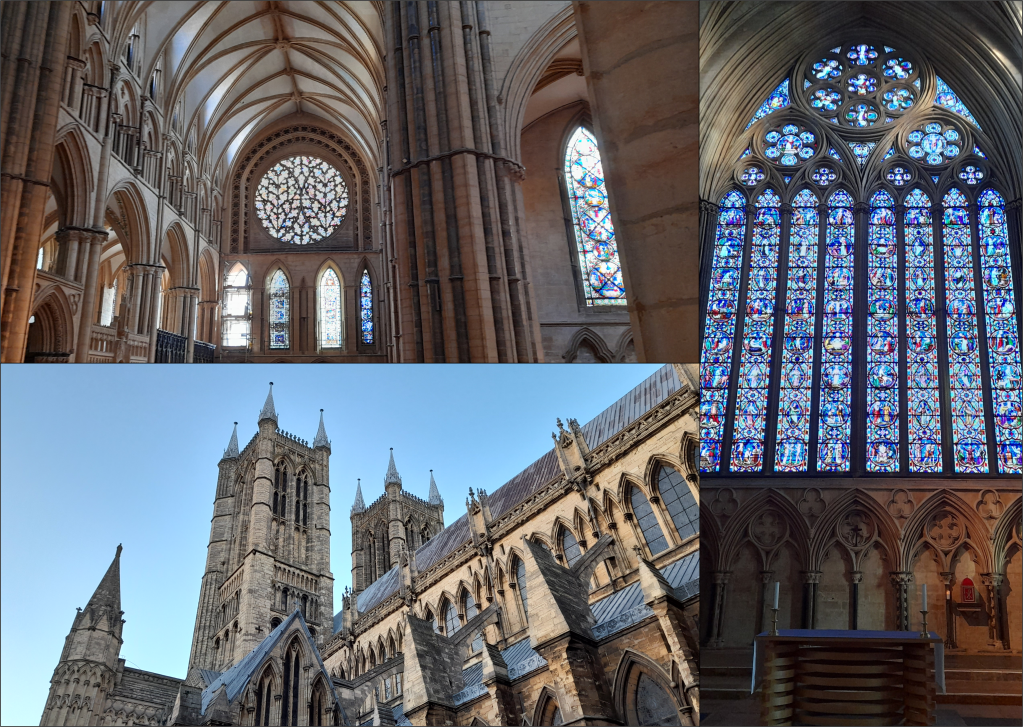
Any trip to Lincoln isn’t complete without visiting the cathedral, and you can at least step inside for a quick look without paying an entrance fee – even if it costs more to wander around. Still, the cathedral’s exterior is arguably more impressive than its interior. The western end, in particular, is hugely imposing, being an ornate, towering wall filled with decorative arches and dozens of carved figures. Whoever built this was on a mission to put the fear of God in people. It’s also a good place to stand and look out for the peregrine falcons that nest on the cathedral roof, which frequently swoop down to attack pigeons.
The cathedral interior is as awe-inspiring as you might expect, given its size – although it becomes all the more impressive when you consider how long it has been standing. Bits and pieces have been added or destroyed over the centuries, of course; I was surprised to read about extensive damage caused by an earthquake in 1185, which had an estimated magnitude of 5.0 and caused destruction throughout Lincolnshire. I can’t imagine that any of the stained glass would survive if such a quake were to strike again. Also, I can’t help but wonder what would have happened to the enormous wooden spire had Henry VIII not rinsed the monasteries of all their money – might it have remained standing to this day?
International Bomber Command Centre
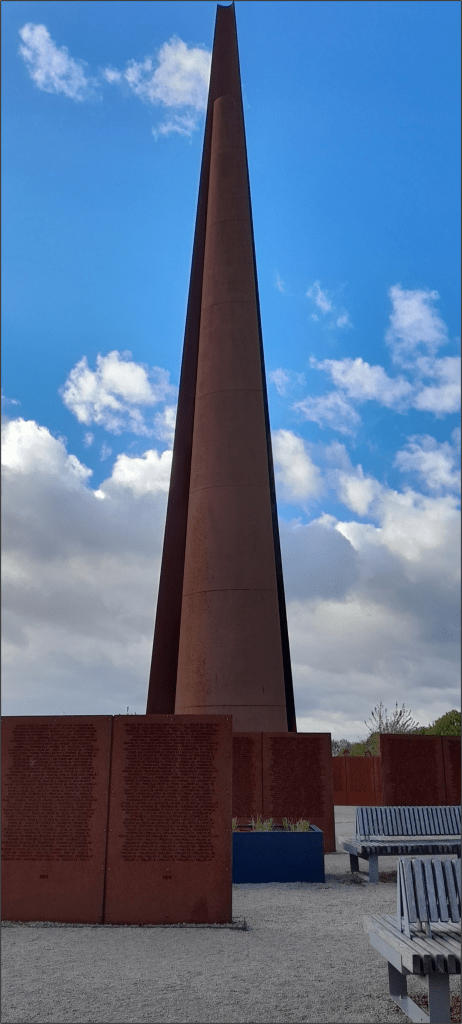
Another place well worth visiting in Lincoln is the International Bomber Command Centre. It serves as a memorial for the 58,000 people who died serving in bomber command in WWII, and as a museum that explains the horrific challenges they faced, and explores some very uncomfortable truths about the war. For decades, bomber command did not receive the same recognition as the other branches of the war operation, due to the guilt and shame surrounding the devastation they facilitated. Celebrating the success of a bombing mission is a thorny matter, to say the least. Bombing operations were used on all sides during WWII, and passing judgement on the morality of bombing towns and cities, 85 years on from the event, is all very well for those of us who didn’t live through it. Still, even for those who believe that the acts of the Allied bombers were inexcusable, there can be no denying the bravery of the ordinary men and women who died in the operation. The death rate for men flying in bombers during WWII was 44%, and the average age of death was only 23. Here, at the International Bomber Command Centre, they are finally receiving the recognition that was denied for so long.
Belton House
Most history can be treated as a thorny issue these days – although its sharpness dulls with age. A prime example of thorny history is Belton House, situated just outside Grantham. This country mansion was built in the late 17th century by Sir John Brownlow, who had inherited a huge amount of money on the death of his great uncle. He demolished the old manor house to build the new one – simply to flaunt his wealth. And where did the Brownlows get all this money from? It’s the usual story: the cycle of inherited wealth getting invested into morally dubious schemes. One branch of the family had definitive ties to the slave trade, and others to the East India company.
Volunteers at the house will tell you that it is actually small by Georgian standards, which just makes its grandeur all the more astonishing. The driveway is exactly one mile long, and perfectly straight. It has huge gardens which look beautiful in their autumn colours, and sprawling parklands roamed by dozens of deer – as well as an excellent adventure playground to keep children entertained (apparently this was a last-ditch attempt for the family to make some money, before they gave in and gifted the place to the National Trust in the 1980s). It’s everything a visitor would want from a stately home, hitting you with a sense of amazement and revulsion all at once.

Lincolnshire coast
Lincolnshire has an extensive coastline, with the sub-tropical beach resort of Skegness lying right at its centre (“sub-tropical” in the extreme sense, i.e., “arctic”). Skegness, locally known as “Skeggy” or “Skegvegas” has sprawling suburbs of static caravans, and the skeletal silhouettes of old rollercoasters loom for miles over the flat and featureless surroundings.
In fact, most of the land around here didn’t used to be land: hundreds of years ago, these fields were marshes, and the scattered hills were islands. Then, starting in the 16th century, wealthy landowners hired Dutch engineers to drain away the water, so that they could grow crops instead. They called it “reclamation”, as if the sea had taken something that was rightfully theirs. And now, with sea levels rising, I can’t help but wonder if the sea is about to set the record straight… Still, these environmental considerations are unlikely to bother most visitors to Skegvegas, who seek nothing more than icy winds, artery-clotting full English breakfasts, and long rants triggered by the £3.80 price tag of a 99 Flake.
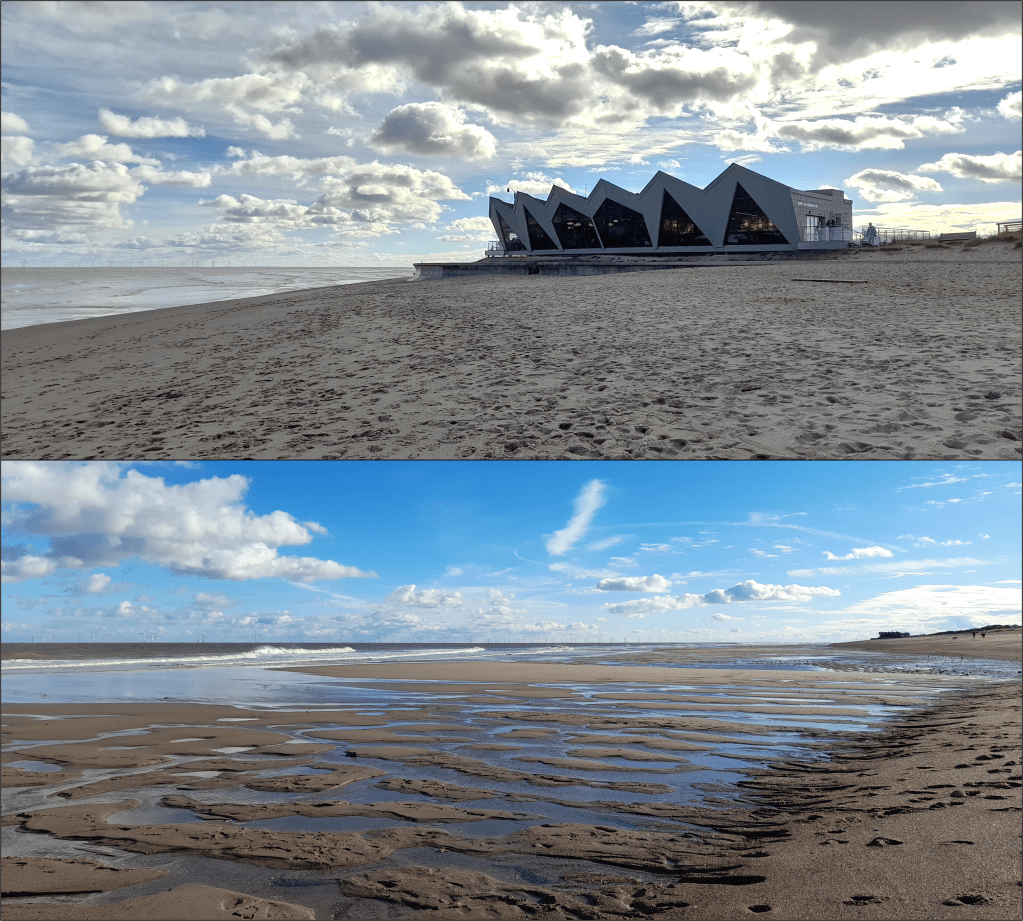
We ventured a little further north of Skegness to find a quiet stretch of coastline, and it was a beautiful day. The North Sea Observatory is a striking building, right on the beach, and it serves artery-clotting English breakfasts in both traditional and vegetarian varieties – showing that Skegness is slowly being dragged into the 21st century. It’s a lovely stretch of coastline, although you do feel as if you’re driving to the edge of the world.
Isaac Newton’s House
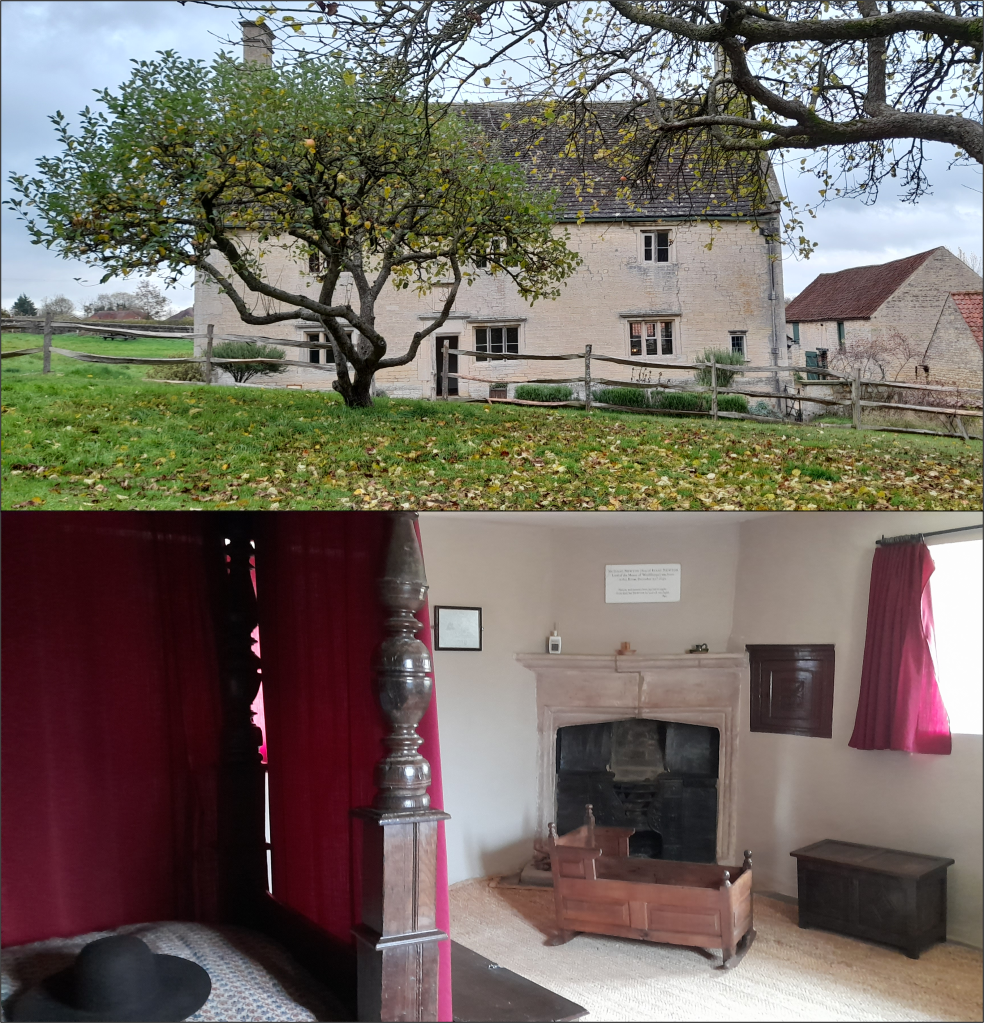
Last but certainly not least, we visited the home of Isaac Newton, which is now managed by the National Trust. This is a fantastic place, and deserves more than the brief summary I can provide here. There is so much that people don’t know about Isaac Newton: firstly, that he wasn’t especially wealthy. His family were farmers in Woolsthorpe, near Colsterworth, and they managed the farmland, tenants and labourers. His father died before he was born, so Newton owned the house from the moment he arrived. He was schooled in nearby Grantham, but only managed to go study at Cambridge by subsidising his fees through working as a servant or assistant – until he proved his worth and was given a scholarship to finish his MA. However, he was soon forced to return home to Woolsthorpe when the university closed due to the plague.
Here, in Woolsthorpe, he made his biggest contributions to science. You can go and stand in the room where he was born, and in his bedroom, in which he constructed a secluded office room to conduct his experiments with light. Seeing his little office, made from panels of wood reused from a packing crate, I was suddenly struck by the fact that Newton was quite down-to-Earth (no pun intended). He lived on a farm, and built things for himself – a far cry from many of the aristocratic scientists that fill our historical records.
Finally, Woolsthorpe Manor is home to the legendary apple tree, which is now thought to have been standing since Newton lived there. We will never know for certain whether a falling apple really inspired his ideas of gravitation, or whether this was just a nice anecdote he told later in life, but the apple tree serves as a tangible, living connection back to the time that he lived here. It felt fortuitous, too, that at the time of our visit, the tree was dropping its final apples of the season.
In summary…
I very much enjoyed my week in Lincolnshire. I tend to be drawn to places with awe-inspiring landscapes and extreme topography, but the rolling hills around Grantham and Lincoln were a lovely change of pace – and the county has much to offer in terms of history. If ever you are passing through the region, on the way to somewhere else, perhaps consider taking a minor detour to Lincoln, or to Woolsthorpe. It is well worth the time.
Happy reading, and have a lovely week!
Discover more from C. W. Clayton
Subscribe to get the latest posts sent to your email.

 C. W. Clayton