
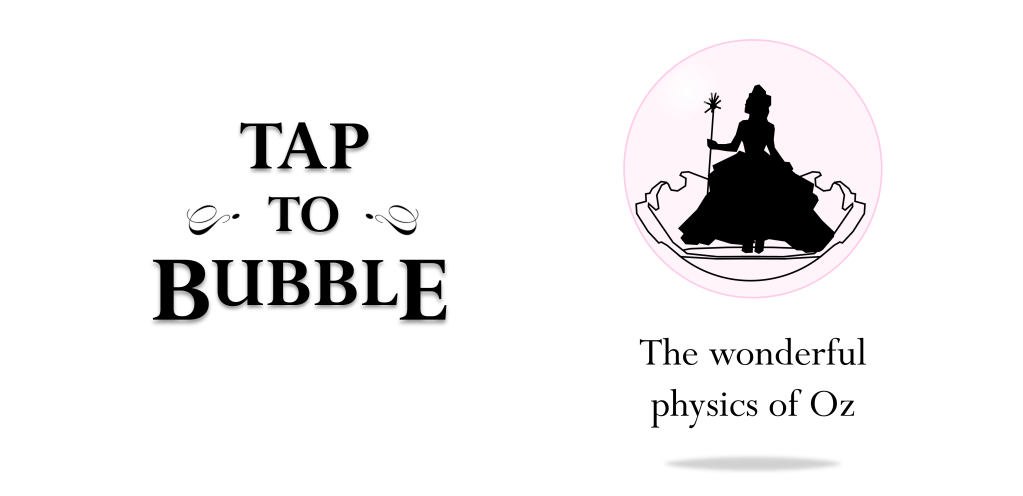
Hello readers! Wicked: For Good came out last week, and since then, I’ve been pondering the physics of Glinda’s bubble. For those of you that haven’t seen the film – don’t worry. I won’t spoil anything in this post that hasn’t already been spoiled in the trailers.
The reason that Glinda’s bubble has been bothering me is because it isn’t magic. In the land of Oz, animals can talk and brooms can be bewitched to fly – but Glinda’s bubble is revealed to be a mechanical contraption. We are led to believe that there is nothing magical about it whatsoever. She steps onto a platform and presses a button (labelled “tap to bubble”), causing the platform to be encased in a bright pink bubble, which she can use to fly through the sky.
I couldn’t resist trying to break this down. The film wants me to believe that this bubble is mechanically possible, yet it doesn’t provide any explanations. Call me a munchkin, but this bubble looks like magic… How can it not be? But we’re meant to believe that it’s some kind of ingenious engineering, similar to the puppets and optical illusions that the Wizard uses to fool the people of Oz. The one thing we do know is that the bubble is made from a liquid film, just like an ordinary bubble, because it pops when Glinda pokes it.
I have four questions. Firstly, could a bubble that big be created around a platform? Secondly, could the bubble last as long as it does (i.e., indefinitely)? Thirdly, would there be enough air in the bubble for Glinda to breathe? And finally, how does it float?
Question 1: Could you create a bubble that big?
Based on some rudimentary pixel measurements, using Ariana Grande as a scale (apparently she is 1.57 m), the bubble has a diameter of 2.6 m, and a volume of 9.2 m3. That’s an enormous bubble. Still, it’s not as big as the Guinness World Record for the largest outdoor free-floating soap bubble, which is 96.27 m3, set by Gary Pearlman in 2015. So, it is possible to make a bubble as big as Glinda’s. But is it possible to make this bubble in the manner shown in the film?
In Wicked: For Good, we see the bubble grow upwards around the platform into a perfect sphere. To understand whether this is feasible, it’s worth watching some videos of giant bubbles online. The best way to make bubbles this big (indeed, the only way that I have seen demonstrated) is to take a big hoop of string, dip it into soapy water, then move the hoop through the air. It’s the essentially the same process as blowing bubbles through a tiny bubble wand; air movement is critical for stretching the liquid film.
However, if Glinda’s bubble is created by a soapy hoop moving up and around the platform, the hoop must be small enough to be invisible. This isn’t an issue in itself, but it’s worth noting that the hoops used by bubble artists tend to be thick, porous ropes, which can absorb and release enough soapy water to sustain bubble films.
For me, the biggest issue with Glinda’s bubble is that it is so spherical. If you look at videos or photos of any size of bubbles, you’ll see that they usually don’t start out with a spherical shape. Rather, they start their life as wobbling tubes of soap films, which then break up into bubbles away from the hoop. The bubbles only attain their spherical shape once they are far from where they formed, because it takes time for the liquid surface tension to counteract the wobbling from the bubble’s formation. Creating a spherical bubble in the manner shown in the film would be very hard, if not impossible, to do.
This impossibility is compounded by the fact that giant bubbles are even less likely to be spherical. The bigger a bubble gets, the more disruption it experiences from air currents – yet the surface tension in the liquid film is still the same. So, as bubbles get bigger, surface tension becomes less effective at counteracting wobbling and deformation, which means that big bubbles are almost NEVER spherical.
The only way that Glinda’s bubble could survive as a sphere, with a diameter of 2.6 m, is if it was made of a liquid with some very special properties… And this leads us nicely onto our next question.
Question 2: How could a bubble last that long?
Another defining characteristic of giant bubbles is that they don’t last long at all: rarely more than 30 seconds, in fact. This is due to two processes. Firstly, the fluid in the bubble drains downwards under gravity, leaving the top surface much thinner. Secondly, the fluid evaporates into the air, leaving it thinner on all sides. Thinner surfaces are more vulnerable to bursting (which is intuitive, I know – but the physics of bubble bursting are unbelievably complicated).
The best way to increase the lifespan of a bubble is to change the liquid recipe. Most bubbles are made using soapy water. Soaps and detergents contain surfactants (surface active agents) which are molecules that collect on the surface of water and prevent it from rupturing when put under pressure. However, in order to make the water film even more resistant to rupture, bubble artists add guar gum or polyethylene oxide (PEO) to the soapy water. These chemicals are long-chain polymer molecules that make bubble films more “stretchy”, which allows bubbles to last for longer.
Still, there are other ways to increase bubble lifespan. A paper published in 2022 reported bubbles that had lasted more than one year, due to mixing glycerol and tiny plastic particles into the soapy water. The tiny plastic particles resisted the liquid draining under gravity, and the glycerol resisted evaporation – so the liquid films didn’t get thinner, and the bubbles didn’t burst!
However, these micro-plastic-infused bubbles were just a few millimetres in diameter. The recipe might not work with a bubble as big as Glinda’s… As we mentioned previously, big bubbles are vulnerable to disruption from air currents, making them more likely to burst. Besides, would Glinda really use micro-plastics?! (Yes, she would).
Question 3: Would the bubble contain enough air for Glinda to breathe?
Even if it was possible to make an everlasting 2.6-m-diameter bubble, how long could Glinda keep breathing inside it? This depends on how much gas can pass through the bubble walls. If the bubble film was airtight, like a plastic bag, then Glinda would be depleting a finite oxygen supply, and replacing it with carbon dioxide. For the following section, we’ll assume that each of Glinda’s breaths is about 500 ml, taking in 21% oxygen and 0.04% carbon dioxide, and breathing out 16% oxygen and 5% carbon dioxide.
In an airtight bubble, carbon dioxide poisoning would become an issue far faster than oxygen depletion. Carbon dioxide levels of 0.2% are problematic – anything higher than this and you would feel very unwell. We can run some rudimentary calculations with basic assumptions (breathing dynamics are far too complicated for a non-biologist such as myself, so these are only ballpark figures).
Let’s assume that the bubble has a volume of 9.2 m3, and that Glinda has a normal breathing rate of 12 breaths per minute. Under these conditions, the bubble will exceed 0.2% carbon dioxide within an hour. This would leave Glinda with an increased heart rate, dizziness and nausea (she certainly wouldn’t be singing). It would take two days for the carbon dioxide levels to reach instantly fatal levels of 10% – but Glinda would be unlikely to keep breathing for long enough to create such an environment.
However, the bubble is unlikely to be airtight! The bubble has a surface area of 21.2 m2, and if we assume that it is made from soapy water, the bubble film will be between 10 nanometres and 1 micrometre thick (1/20 of the width of a human hair). Because the film is so thin, gases can travel through it relatively easily, meaning that the bubble wouldn’t fill up with toxic levels of carbon dioxide. By my calculations, even if the bubble film was relatively thick, at 1 micrometre, Glinda could breathe as normal.
Of course, we made a lot of assumptions here. We established in our previous questions that the bubble is unlikely to be made purely of water – so the true permeability of the film to carbon dioxide (i.e., how airtight it is) remains unknown. Still, this appears to be the least problematic aspect of Glinda’s bubble…
Question 4: How does the bubble float?
We have established that it is possible (but very difficult) to create large, long-lasting bubbles, and that it is possible (but potentially uncomfortable) to breathe inside them. But how does the floating platform work? Bubbles are not inherently buoyant. The air on the outside is the same density as the air on the inside, so there is no reason for a bubble to float. And, as we established in the previous question, the bubble probably isn’t airtight, so it isn’t as if it could be filled with a low-density gas such as helium (which would also have adverse, if hilarious, effects on Glinda’s voice). Instead, we must assume that the platform floats through some other mechanism, and that the bubble is tethered to the platform.
However, there is no visible machinery on the platform. It doesn’t have propellers or any obvious propulsion mechanism, and it moves silently, without any whirring of engines. Maybe it has invisible strings? But it’s difficult to imagine how and where these would be attached without breaking the bubble, or how they would move platform without obvious propulsion.
I think, after all the effort we expended in considering the bubble physics, the floating platform is where the illusion crumbles. There can be no mechanical explanation. The platform, if not the bubble itself, can only be explained by magic – even though the film writers insist that there is no magic involved in its creation. Maybe I missed something, and maybe there is some other explanation. However, even if I can just about accept the physics of a 1.57-m-tall woman standing in a giant bubble, I can’t see how that bubble would fly.
In summary…
If Wicked and its sequel had presented Glinda’s bubble as being purely magical, I wouldn’t have explored its feasibility in such depth. However, the fact that it was presented as a mechanical contraption made me wonder how it might be made – and having done a bit of research, I see no reason that a giant bubble couldn’t exist. It would take a lot of trial and error to find the right recipe (potentially involving guar gum, glycerol and microplastics), and the bubble might not be perfectly spherical, or particularly long-lived, but I think a woman could stand inside a bubble for a short time. Unfortunately, though, I don’t see how the platform could float without a bit of magic. Was the film lying to us? Was the platform actually bewitched?!
In the end, I don’t suppose that this is a major plot hole. The audience probably isn’t expecting scientific accuracy in their fantasy film… But it was fun to consider nonetheless.
Happy reading, and have a lovely week!
Further reading:
If you want more calculations on the feasibility of fictional physics, see my Clayton Calculates series.
And if you want to read the papers that inspired this post, look here:
Frazier et al. (2020) How to make a giant bubble. Physical Review Fluids. (https://doi.org/10.1103/PhysRevFluids.5.013304).
Roux et al. (2022) Everlasting bubbles and liquid films resisting drainage, evaporation, and nuclei-induced bursting. Physical Review Fluids. (https://doi.org/10.1103/PhysRevFluids.7.L011601)
Falciani et al. (2020) A multi-scale perspective of gas transport through soap-film membranes. Molecular Systems Design and Engineering. (https://doi.org/10.1039/C9ME00186G).
Discover more from C. W. Clayton
Subscribe to get the latest posts sent to your email.

 C. W. Clayton

One thought on “The feasibility of floating in a bubble”