
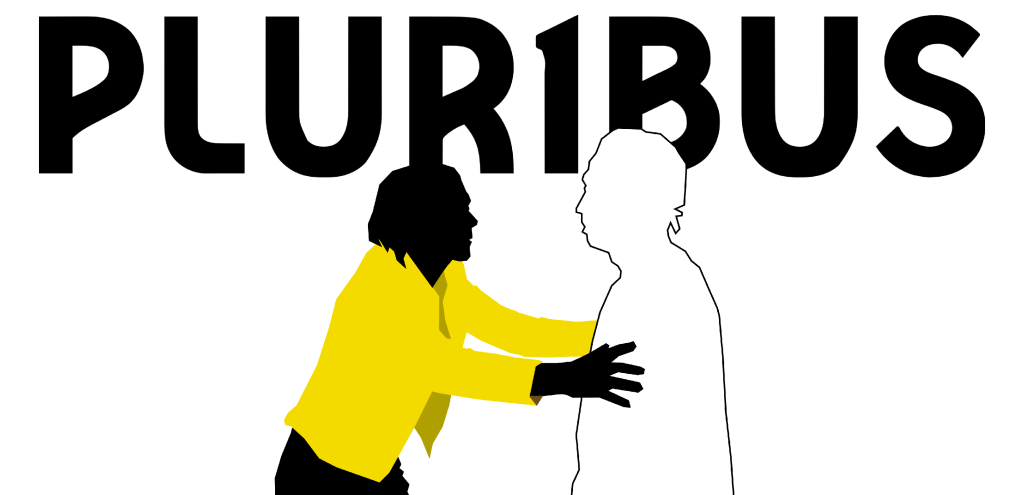
Hello readers! This review might seem a little late, given that the first episode of Pluribus released way back in November. But this is an Apple TV show, and I don’t have Apple TV – so I had to wait until one of my friends invited me to watch it with them. And I’m so glad they did! I might have been three months late to the party, but I enjoyed every minute of it. I knew very little about this series going in, and honestly, that was perfect. Pluribus hooked me almost instantly, and having now finished the series, I can say with confidence that it is one of my favourite TV dramas of recent years.
I am aware that this show might not be for everyone. It has received highly positive reviews from TV critics, but a more mixed response from general audiences. And by “mixed”, I mean that some people passionately hate it. However, if you are a fan of Vince Gilligan’s previous work (Breaking Bad and Better Call Saul – particularly the latter), I doubt that you will be disappointed by Pluribus. Indeed, you will probably relish the deliberate slow pacing and gradual drip-feeding of information, designed to keep you second-guessing.
I will break this review into two parts. The first part will include minor spoilers, for those who would like the bare minimum of information (e.g., what genre are we talking about, who is the main character); and the second part will include major spoilers, for those who want a little more detail (e.g., where is the plot leading, does the show evolve beyond its initial premise). If you haven’t seen the show, I would strongly recommend avoiding the major spoilers. But if you have already watched it, why not go ahead and see if your thoughts match mine? No pun intended.
My brief review (minor spoilers)
The protagonist of Pluribus is Carol Sturka, a romantasy author who lives with her wife in Albuquerque, New Mexico. Despite the popularity of her books, she is bitter and miserable – and, as many disgruntled viewers have pointed out, distinctly unlikeable. When an extraterrestrial virus spreads around the world, Carol is one of only twelve people to be immune to its power, which combines the thoughts of every infected individual into a single hivemind of eternal happiness. She suddenly finds herself isolated as the only individual in a population of calm and compliant drones.
This premise is all set up in the first episode. The rest of the show follows Carol as she learns to survive alongside the seemingly peaceful hivemind, trying to understand what it is and what it wants, and what it means to be one of the last free-thinking beings on the planet.
Perhaps the first thing to understand about this show is that it is an outlier. Online reviews cannot pin down its genre; the general feeling is that this is science fiction (which is why I feel justified in reviewing it on a science fiction blog), but I’ve also seen it described as a thriller, a comedy, psychological (whatever that means) and post-apocalyptic. And it is all and none of the above.
For me, the uniqueness and audacity of this series is something to savour, and the lack of familiar tropes adds to its persistently unsettling atmosphere. However, I can appreciate that this bold approach might alienate many viewers. Personally, I enjoy struggling to locate any reference point to contextualise the events on-screen. Is this science fiction? There isn’t too much science. Is it post-apocalyptic? It isn’t quite an apocalypse. But it was nice to be untethered and adrift for a change, rather than being spoon-fed every looming plot twist and character motivation. For me, the sense of being lost at sea is why the series benefits from being excruciatingly slow at times. It makes the sudden swells hit harder. I never considered the slow pacing of this show to be a downside – but I suppose that this is a matter of personal taste (and patience).
The show is also very funny at times, albeit in a dark way. Or just in a Vince Gilligan way. Some of the more slapstick humour would feel right at home in Breaking Bad. However, the show is more thought-provoking than funny. Given that I watched it with friends, we could share our thoughts as we went along, and a frequently occurring question was “what are they doing now?” – usually as a character started collecting random bits of and pieces in preparation for some harebrained scheme. We loved it; plenty of angry people on Reddit seem to hate it. Chalk it up to personal preference.
If you have Apple TV, and want something novel to reinvigorate your roster of TV shows, I’d recommend giving Pluribus a watch. After all, what else are you using that subscription for? Season three of Severance isn’t releasing for a while yet.
My detailed review (major spoilers)
While the first two episodes are arguably the most action-packed, the rest of the series holds up well, even if there is a tonal shift. The first episode centres around a global catastrophe, but by the third and fourth, we’re focusing on mundanities such as visiting supermarkets and preparing breakfast. Still, these mundanities aren’t so mundane when you realise the extent to which we take them for granted, and how quickly these day-to-day tasks can break down.
With the hive mind, there is no societal structure. People just pitch in to help with tasks when they’re nearby. There is no supermarket, because there is no buying food, and there is no earning money. Food is simply distributed to everyone who needs it. But Carol, as the only individual left in the USA, is deeply unnerved by being unable to visit her local greengrocer. She doesn’t want the hivemind to bring her any meal she chooses, like the Deliveroo of dreams. The world is suddenly very different and she doesn’t like it – although she can’t quite pin down the reason why.
This is a key theme of the show as it progresses. The hivemind seems eager to please and is desperate to avoid confrontation – and it has arguably improved the lives of many, as well as the state of the environment. For example, everyone sleeps in large rooms to save on energy costs, and they switch off all the street lighting at night to help the local wildlife. There is no homelessness any more; no haves and have-nots. So why does Carol (and why do we, the viewer) find the hivemind so offensive?
We get to explore alternative attitudes towards the hivemind through the other eleven (or as it turns out, twelve) characters who find themselves immune. This is arguably the most under-developed part of the show, with only two (maybe three) of these people receiving adequate time to explain their views. Koumba seems happy to live alongside the hivemind because it is eager to make all of his hedonistic desires a reality. Laxmi is desperate not to upset the hivemind, because she refuses to believe that her son is no longer the child she knew and still loves. Kusimayu, who lives in an isolated village, wants to join the hivemind because she feels so lonely. And Manousos… Well, he gets almost an entire episode dedicated to his struggle against the hivemind and his steadfast refusal to interact with it. The other immune don’t really get utilised – but honestly, this show has enough to work with as it is. Its primary focus is on Carol, and on using her churlish personality as a lens to explore the meaning of humanity.
As the nine episodes progress, we see Carol’s attitude towards the hivemind oscillating. Her first reaction is to hate it, given the chaotic and deadly nature of its arrival, but she then wavers towards trying to reason with it and understand it. This then flips back to hatred when she learns about a staple of their diet: human-derived protein. But after they give her the cold shoulder for forty days, refusing to speak with her, she ends up in a depressive spiral, and begs them to come back. In the final few episodes, she almost seems to enjoy living alongside them – which infuriates Manousos when he finally reaches Albuquerque – but after the hivemind suggests that they might infect her with the virus and incorporate her against her will, she quickly returns to resenting them.
Some viewers seem to think that this endless flip-flopping is an indication of poor character writing, or that Carol is a stupid protagonist not worth watching. I strongly disagree – and I wonder if these comments might result from certain societal expectations regarding female protagonists. Vince Gilligan has never written likeable characters, but I didn’t see people whinging about Walter White or Saul Goodman in the way they whinge about Carol. She is majorly flawed, yes – but all of her questioning, backtracking and surrendering is entirely believable. She is trying to make sense of this terrifying reality, all while processing the grief from the death of her partner, and being forced to confront the troubling definition of what it means to be human. Personally, I found her to be a very compelling protagonist.
In summary…
I love this show because of and despite of all its quirks. As a final note, I’ll mention that Rhea Seehorn is fantastic. Also, the cinematography is a work of art, and every shot looks gorgeous. Some of the places we get to see are extraordinary, and I’m glad that the Apple TV budget was put to such good use. Pluribus might be too much of a slow burn for some people (and for heaven’s sake don’t try binging it), but for some of you readers, this could be the best TV you see this year. Or last year, if you actually watched it when it released…
Happy reading, and have a lovely week!
Some other posts of mine that you might like:
Attempting to understand “romantasy”: https://cwclaytonauthor.co.uk/2025/08/24/attempting-to-understand-romantasy/
What is science fiction? https://cwclaytonauthor.co.uk/2024/01/14/what-is-science-fiction-part-one-a-history/
Reading into ratings: what do they mean? https://cwclaytonauthor.co.uk/2024/09/08/reading-into-ratings-what-do-they-mean/
Discover more from C. W. Clayton
Subscribe to get the latest posts sent to your email.

 C. W. Clayton