
Hello readers! Today’s post will be a little more introspective than usual. I’d like to discuss the way that creators perceive their own work (be they writers, artists, musicians, game developers, you name it). Specifically, I was wondering whether anyone else can relate to a concept that I have dubbed the “cringe window” – a period of time in which you created works that now make you cringe with embarrassment.
Let me explain…
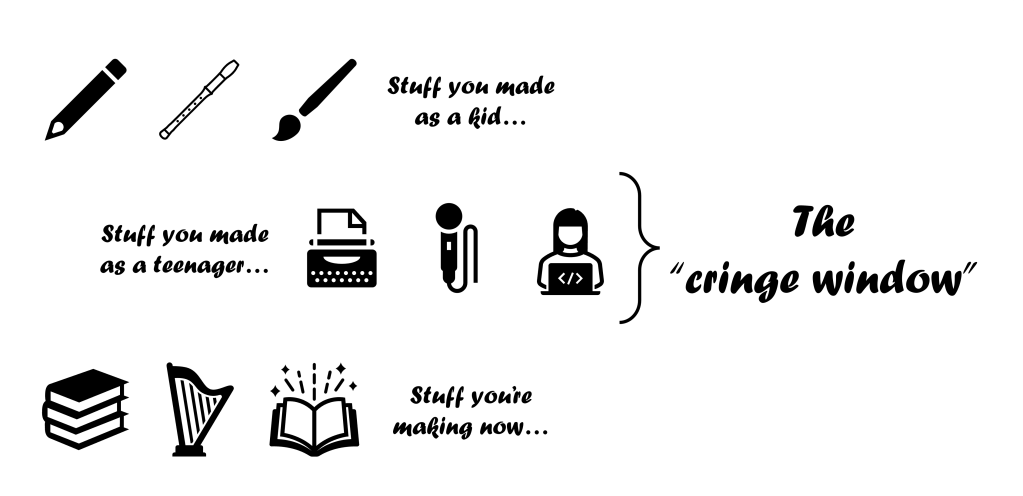
The cringe window exists somewhere between your childhood and the present day. Think of the most embarrassing song, short story, or poem you ever wrote, and that will probably fall within a cringe window which contains other questionable works. If you don’t have any embarrassing work, then great! I wish I had your self-confidence. Just humour me as I try to explain myself.
It is highly unlikely that the works you made as a child would elicit any sort of retrospective shame or embarrassment, because we don’t expect them to be flawless masterpieces. The work we make as children is, objectively, pretty rubbish. And that’s fine. Our childhood creations are a record of the learning process through which we discovered how to hold a paintbrush, how to play an instrument, or how to structure sentences. There is no shame in having humble beginnings. Or there certainly shouldn’t be…
However, as we move out of childhood and into adolescence, we start producing works of more complexity. This is where we find our first attempts at novels, screenplays and songs, depending on your artistic inclinations, and at first glance, these often look like finished products. Still, because these were first attempts, they are likely to be a bit rough around the edges (to put it kindly). And you might find some of these works a little embarrassing. This defines the lower boundary of the cringe window.
Moving on through adolescence towards adulthood, creative works get more ambitious and complex. Your next attempts at novellas, rock operas and video essays might start dealing with adult themes and complicated emotions – and although these felt advanced and enlightened at the time, in retrospect, they don’t feel very enlightened at all. This is the centre of the cringe window: the time when you produced work so embarrassing that you hope none of your work colleagues ever find out about it.
We then move into the present day. The work you are producing now feels relevant and interesting, and you feel as if you’re at the top of your game – the best you’ve ever been. This is the upper boundary of the cringe window.
Why do we cringe?
I wish I could feel proud of everything I’ve ever made, but I just can’t. Some of it is, quite simply, too awful. But when I started to write this post, I was forced to consider why it makes me cringe so much, and I realised that there were multiple layers to unpack. We have established that work from childhood is nothing to be embarrassed about, because it represents a learning phase – but why can’t I look back on works from my older teenage years and see them as just another step towards improvement? Aren’t we always learning?
I think the embarrassment arises from the level of connection we have with our past selves. The further back we go, the less familiar we seem. The person you were as a five-year-old is very different to the person you were as a twenty-five-year-old, let alone as a forty-five-year-old. Looking at your childhood work is almost like looking at someone else’s work. You don’t feel a strong sense of ownership over it.
Move to your teenage years, however, and you will start to see traces of your adult self coming through. This work is recognisably yours. You created that alt-rock concept album – and you might even remember the thought process that went into it. So, if the work doesn’t live up to your present-day standards, it is easy to start feeling ashamed.
But the cringe window moves…
Until now, I have been describing the cringe window as if it was fixed in time – as if you could pinpoint the start and end to the ages of 14 and 22. But this isn’t the case. I have been aware of the cringe window so long as I can remember, and it has followed me as I have grown older. When I was in my early teens, I cringed at the work I made as a child. When I was in my late teens, I cringed at the work I made as an early teen. When I was in my early twenties, I cringed at the work I made in my late teens… And so on.
Throughout my life, the cringe window has moved, and work has flowed in and out of its boundaries. As I get older, I am more forgiving towards the work I made when I was younger. The first novels that I wrote, which I once regarded as amateurish and feeble, I now regard as childish but extraordinary. It doesn’t matter that they are objectively terrible – how many kids have the hyper-focus necessary to write full-length novels? Please forgive me for blowing my own trumpet here; as I say, these early books were terrible. But I am now old enough to appreciate them for what they are.
Similarly, works that I remember creating during my time at university, which I was initially very happy with, I now find quite sub-par. My drawings from this period, in particular, are nowhere near as good as I thought they were. The same is true of my novels; in fact, I am now considering taking my first trilogy of books off Amazon because I perceive them to be of low standard (some of you may agree). Much to my disappointment, The Starlit Ship is entering the cringe window.
Will all works pass through the cringe window eventually?
This is the question that has been troubling me lately. I might be happy enough to publish my work now – but how will I perceive the same work in five years? I thought I would leave the cringe window behind as I aged, but it keeps following me. My fear is that all the work I produce, whether it’s novels, drawings or Lego models, will eventually pass through the cringe window, and I will look back upon it with shame, albeit temporarily. Paradoxically, this blog post will also enter the cringe window one day – and what happens then?!
The issue isn’t that I’m always being rushed into producing and publishing low-quality work. This isn’t the problem faced by directors who have their films decimated by production companies, only to feel compelled to create their director’s cuts decades later. Instead, this is a personal transition from being very happy with a piece of work, to looking back and wishing that I’d done it differently – or not made it at all. It’s a strange, time-dependent form of perfectionism and self-loathing.
But I’m not the only one – right?
I refuse to believe that I’m the only person in the world with a cringe window following me through life. I’d love to hear from other people who make things – especially people who have lived a bit longer than I have! When I’m in my thirties, will I cringe at the work from my twenties? Or will the cringe window cease to exist once my brain stagnates and the learning curve finally plateaus? I’m looking forward to being able to appreciate the creations of my adolescent years again. Even the stuff that was shamelessly derivative…
But let’s end on a more positive note! I’m not convinced that the “cringe window” is wholly problematic. Yes, it might lower my self-esteem – but it also allows for valuable introspection. I am constantly evaluating and critiquing the steps I have taken to be where I am today, and I suspect that this enables me to make more informed choices moving forward (not that I have any way of proving this). Perhaps the cringe window is just another way of learning from mistakes?
In summary…
This exploration of self-perception is going straight in the miscellaneous waffle archive. I doubt that “cringe window” will catch on as a phrase – but it was the best I could come up with at the time. There may well be a word for this already; if you know it, please tell me!
Happy reading, and have a lovely week!
Discover more from C. W. Clayton
Subscribe to get the latest posts sent to your email.

 C. W. Clayton