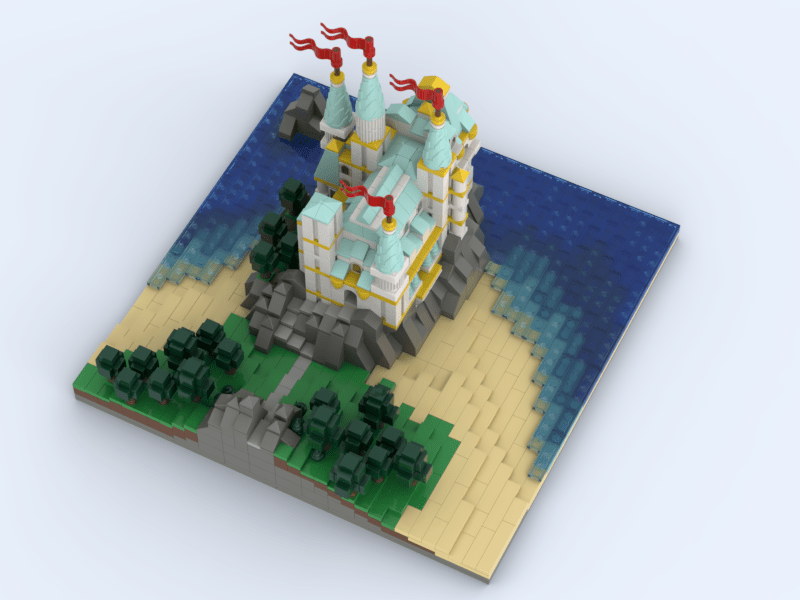
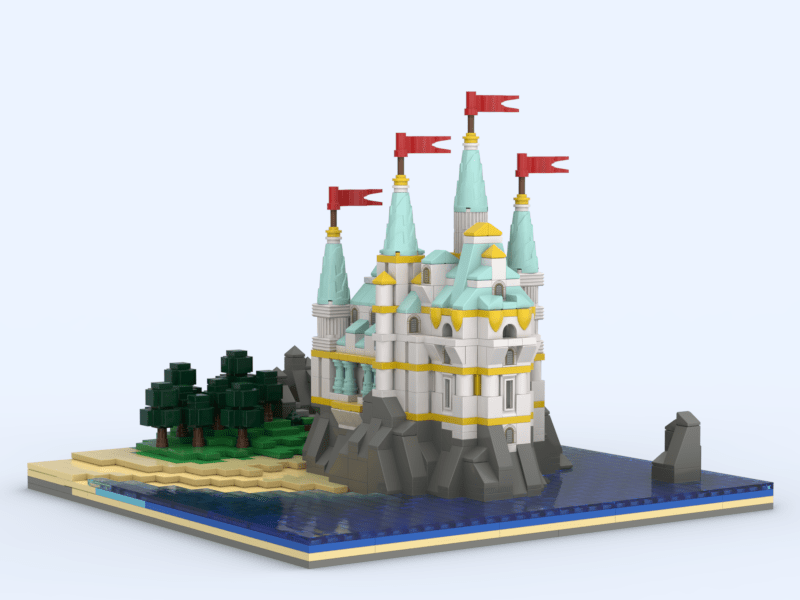
Hello readers! My analysis of the The Voyage of the Dawn Treader is taking longer than expected, so I’m pushing it back to next weekend. In the meantime, I’ll share this micro-scale Lego model I made of Cair Paravel, the castle from the first two Narnia books.
For those that don’t know, I’m currently re-reading the Narnia series by C. S. Lewis, which I originally read when I was about ten years old. I want to see if the books still hold up as exciting adventures over seventy years after they were written, or whether they are starting to show their age. In the first two books, I uncovered gender stereotyping, casual racism, unhealthy attitudes towards masculinity, and heavy-handed Christian teachings – all of which I expected. However, I think the fantasy magic of these books has survived the ageing process, and the stories have become valuable historical documents. My conclusion, for the first two books at least, is that children could enjoy them if they have some level of adult supervision, prompting them to ponder the cultural attitudes of the 1950s.
Still, some of my biggest issues with the Narnia books have nothing to do with Lewis’ questionable beliefs. Instead, it is often the world-building that leaves me disappointed, and Cair Paravel is a case in point.
In The Lion, the Witch and the Wardrobe, Narnia is inhabited only by mythical creatures and talking beasts, not humans. Who built the castle? Was it constructed by the creatures (some of whom don’t have opposable thumbs) in anticipation of four humans arriving to rule over them? If this is the case, it seems odd that the White Witch didn’t flatten it. Who was maintaining the castle during her reign?
We actually learn more about Cair Paravel in the second book, Prince Caspian. At the end of The Lion, the Witch and the Wardrobe, it is explained that the children live in the castle for years, growing into adults, but we don’t learn much about their lives in this period. In the second book, having reverted to children, they arrive back in Narnia hundreds of years later to find their castle in ruins. Only then do we get snippets of information about what they got up to as adults, but these scant details are only provided in the form of brief anecdotes.
However, even if we aren’t told much about life in the castle, we do learn more about the building itself. Cair Paravel is situated on a peninsula, which becomes an island hundreds of years later. It has a banquet hall, a treasury and an orchard. Beyond this, the appearance of Cair Paravel is largely left up to the reader’s imagination – for example, we don’t know what type of stone was used to build it. I think the most thorough description is that it glitters with lots of glass windows, so it certainly isn’t a medieval-style castle. It’s more of a palace than a fortress.
This being the case, there weren’t too many descriptive constraints for my Lego model, and I had a lot of fun with it. Let me know what you think!
Happy reading, and have a lovely week!
My Narnia posts so far:
Some of my other Lego models:
Discover more from C. W. Clayton
Subscribe to get the latest posts sent to your email.

 C. W. Clayton