
Hello readers! It is time for the third deep-dive into the Narnia series. This week I will be over-analysing The Voyage of the Dawn Treader, having picked it up for the first time since I was a kid. Is this sea-faring adventure as exciting and engaging as I remember? Does it contain deep philosophies that I overlooked when I was younger? If you have read my previous two posts on The Lion, the Witch and the Wardrobe and Prince Caspian, you know what to expect.
SPOILER WARNING!
There will, of course, be major spoilers ahead.
Plot summary
The youngest Pevensie children, Lucy and Edmund, have been sent to stay with their objectionable cousin, Eustace Scrubb, over the summer holidays. Their parents have gone to America and could only afford to take Susan with them, and Peter has gone to stay with the old professor from the first book, who now lives in a small cottage and doesn’t have enough space for the others (I guess he no longer has the wardrobe).
Eustace spends every available moment tormenting Edmund and Lucy – but when he starts teasing Lucy about liking a painting of a ship in the spare bedroom, the painting comes to life. When Eustace tries to tear it off the wall, it engulfs him, and the three children find themselves tumbling into the Narnian sea.
They are immediately rescued by Caspian. He was a young teen in the previous book, but is now three years older, and king of Narnia. He is sailing east to find seven lords who were banished by his uncle when he usurped the throne. Most people believe they are dead, but Caspian thinks they may still be alive on undiscovered islands. He is joined in his search by Reepicheep, the talking mouse, who wants to sail all the way to Aslan’s country, beyond the edge of the world.
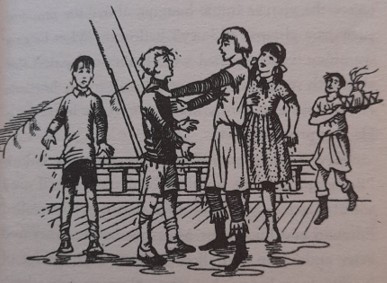
The ship is called the Dawn Treader, and they are currently 400 leagues from Narnia, heading for the Lone Islands. These islands belong to Narnia, but they haven’t made contact in hundreds of years. When they arrive, Caspian, Edmund, Lucy and Eustace are captured by pirates who try to sell them as slaves, not believing (and not caring) that they are kings and queens. Caspian is bought by a local lord, but when he explains that he is the king of Narnia, the lord kneels before him. He introduces himself as Lord Bern – one of the seven that Caspian was looking for. Together, they hatch a plan to rescue the three children.
They march up to the governor’s castle, tricking him into believing that there are more soldiers on the way, and Caspian strips him of all authority for allowing slaves to be traded on the islands. He installs Lord Bern as leader, and having rescued the children and liberated the islanders, he restocks the Dawn Treader’s supplies and continues sailing east.
Days later, they are caught in a storm which nearly destroys the ship. They manage to find another island, which is bleak and seemingly uninhabited, and they try to repair the damaged mast. This is where the book gets good – where I finally started recognising scenes that enthralled me as a child.
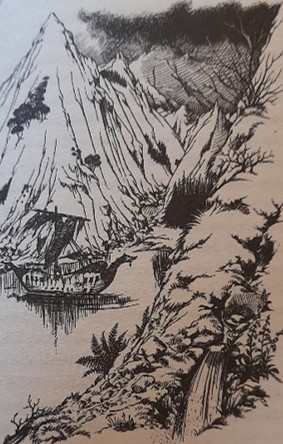
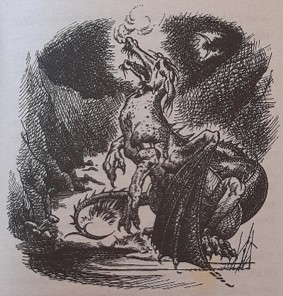
While the others are repairing the ship, Eustace wanders off. He climbs a mountain and is enjoying the view when fog rolls in, causing him to lose his way. He finds himself trapped in a rocky valley, and his terror only increases when he sees a dragon is emerging from a cave. Rather than attacking him, however, the dragon collapses and dies of old age. Eustace is too terrified to move, but when it starts to rain, he has no option but to seek shelter in the cave. He falls asleep when night draws in – and while he sleeps, he turns into a dragon himself. Distraught, he returns to the others, and manages to convey to them what has happened, despite being unable to speak.
Caspian sees that Eustace has a gold bracelet stuck on his arm, and recognises it as belonging to one of the lost lords, who they assume must have perished here. Eustace tries to help the others repair the ship, lending them his strength, but it is clear that he cannot come with them while he remains a dragon – the ship cannot take his weight. He realises how lonely he has always been, and how mean he is to the others.
One night, Eustace wakes up to see Aslan, who guides him to a garden at the top of a mountain. Here, Aslan tears the dragon skin away from Eustace, turning him back into a boy (we’ll come back to this bit later – it is utterly bizarre). He goes back to the others, and has a lovely heart-to-heart with Edmund, who assures him that he also used to be horrible (as well we know), and that Aslan helped him become a better person.
When they sail away from the island, the ship is caught by a giant sea serpent. It tries to crush the ship in a loop of its body, but they break free with only the carved stern taking damage. They soon reach another island, where they find the armour of one of the lost lords besides a beautiful lake. There is no trace of a body – but they spy a golden statue of a man on the lake bed. When they reach a spear into the water to see how deep it is, the spear turns to gold, and they realise what has happened; the lord threw off his clothes and went for a swim, only to turn to gold himself. They agree to keep the island a secret, and sail away as fast as they can.
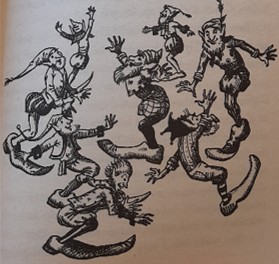
The next island they find is a well-kept as an English country garden. As they walk up the path to a large manor, Lucy hears a strange thumping noise and disembodied voices. The island has invisible inhabitants, and when questioned, they introduce themselves as servants of the magician who lives in the manor. They explain that the magician made them “ugly”, so they tried to undo his magic – only to end up turning themselves invisible. They demand that Lucy goes into the house to read from the spellbook (apparently, the spells only work when read by girls).
Lucy sneaks into the house and reads the book. One of the spells promises to make her the most beautiful woman in existence, and she is sorely tempted to read it – but she holds back when she envisages Aslan growling at her. Instead, she reads the spell to make invisible things visible, and turns around to find Aslan standing behind her. He takes her to meet the magician, Coriakin, who explains that Aslan instructed him to look after the strange people on the island. They are inherently stupid, and can’t keep themselves alive without being instructed. Coriakin admits that he cast a spell on them, giving them all one leg instead of two, because he finds it funny. Nobody questions this (we’ll get to that later) and the ship continues its voyage.
They soon find a patch of impenetrable darkness where there is no wind. A man calls for help, and they pull him aboard – only to find that he is one of their missing lords. He tells them that the darkness makes dreams a reality: not just good dreams, but nightmares too. They try to escape, but the darkness clings to them. In the end, an albatross appears, and Lucy knows that it is Aslan. They follow him to safety, and the darkness vanishes.
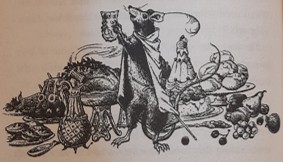
On the next island, they discover the last three lords. The island is beautiful but otherwise uninhabited; the lords are sitting at a lonely banquet table laden with food, and they are deep in an enchanted sleep. At midnight, a door appears in the air, and a young woman with golden hair steps out to greet them. She explains that this is the beginning of the end of the world; the banquet table is the resting place for the knife that White Witch used to kill Aslan, and is also an opportunity for people to eat and rest before turning back the way they came.
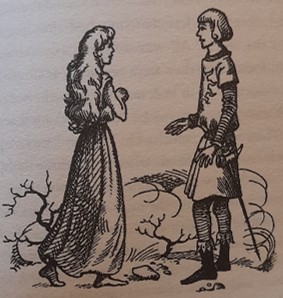
The woman’s father comes out to greet them, and introduces himself as Ramandu, a retired star from the night sky. He explains that the only way to wake the three lords is for one of their party to go east to Aslan’s country, never to return. Reepicheep is happy to do this – it has been his goal from the start.
They sail towards the edge of the world, and the water becomes perfectly clear. They can see the seabed three fathoms down, where sea-people live in a parallel underwater world. The sun is larger, and the water is sweet instead of salty. Soon, the water surface is covered in white lilies, even though it is as deep as an ocean.
Eventually, Caspian announces that he must turn around. Aslan has spoken with him, and decreed that only Edmund, Lucy, Eustace and Reepicheep can continue east in the rowing boat. They part ways with Caspian and the Dawn Treader, and as they row through the lilies, they see a huge wall of water, a stationary wave, at the edge of the world. Beyond the wave, and beyond the rising sun, they see enormous mountains. Reepicheep gets into a tiny coracle, bids goodbye to the others, and is swept into the east – never to be seen again.
Edmund, Lucy and Eustace keep rowing and reach a huge sandbar, where a lamb walks up to them and invites them for breakfast (yes, it’s bizarre – we’ll come back to it later). The lamb explains that they can’t reach Aslan’s country from Narnia: they must reach it from their own world. Of course, the lamb then turns into Aslan (he can shape-shift now).
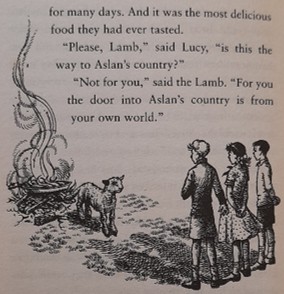
Aslan tells Edmund and Lucy that they will never come to Narnia again, and they are both very upset. In the final paragraph of the book, we are told that Caspian and his men all make it back to Ramandu’s island, where Caspian marries the beautiful young woman, and then all of them return safely to Narnia. The book ends with Aslan sending the three children back to our world, where everyone remarks that Eustace has become a much more agreeable boy – everyone except his mother, who is upset that he has become “commonplace and tiresome” under the influence of the Pevensie children.
Where to begin with this one…?
I liked The Voyage of the Dawn Treader – possibly even more than I liked Prince Caspian on my revisit. As a child, I’m sure I liked Prince Caspian more, but as an adult, I can appreciate that Dawn Treader provided C. S. Lewis with a greater opportunity to explore ideas, because he wasn’t tied to one location. I also feel like Edmund and Lucy were the most interesting Pevensie children, and Eustace’s redemption arc is very engaging – so I didn’t miss Peter and Susan at all. The plot device is simple but effective: our protagonists travel from island to island in a series of discrete sub-adventures, finding the lost lords as they go, and this gives the book a much clearer end-goal than the previous two.
Of course, Dawn Treader still has plenty of quirks. But that’s pretty much the only reason you would read it as an adult.
What were they thinking with the cover?!
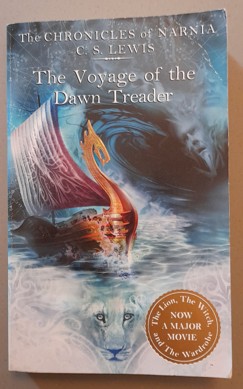
The covers of my early-2000s editions of The Chronicles of Narnia are downright bizarre, but The Voyage of the Dawn Treader is the strangest one yet. It has a boat on it, certainly, so they got the theme right – but what’s going on with the deformed, tormented faces of old men? Are they the missing lords? I don’t understand. It’s very strange, and I remember thinking so as a child. There is no Narnian whimsy to be found here.
It has a map, but…
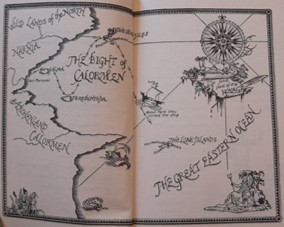
I was happy to see that the book starts with another map, but unfortunately it doesn’t give the reader much to work with. We get to see the other nations around Narnia, but there are no borders, only rivers. In truth, the map doesn’t lend much to the story at all. Most adventures take place on islands that aren’t even shown!
Unpopular opinion? Eustace is treated unfairly.
I did not enjoy the first chapter of Dawn Treader. This is because the book opens with a series of paragraphs eviscerating the new protagonist. The book begins:
“There was a boy called Eustance Clarence Scrubb, and he almost deserved it.”
We know nothing about this kid, and already his name is the butt of the joke.
“His parents called him Eustace Clarence and masters called him Scrubb. I can’t tell you how his friends spoke to him because he had none.”
I mean, it’s funny in the cruellest way possible. But we have been given no reason to hate this character yet; all we know is that Lewis thinks he should be hated, and that he has no friends. I also have to assume that “masters” means school masters (i.e., teachers), so the novel is already unbearably upper middle-class. Within three sentences, C. S. Lewis has presented himself as more hateful than the character he is trying to convince us to hate.
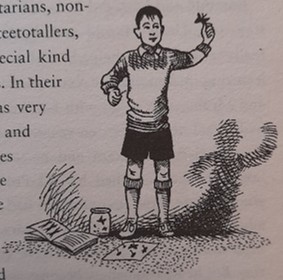
After a long paragraph explaining that Eustace likes to collect beetles and read non-fiction, Lewis finally reveals that he also likes “bossing and bullying”. Why didn’t we lead with this?!
This author-led bullying of Eustace pervades the first half of the book. For example, when Eustace first arrives in Narnia, Lewis states that he starts crying “much harder than any boy his age has a right to cry”. Leave the kid alone, Lewis! He was just sucked into a parallel dimension and almost drowned!
Later, after Eustace swings Reepicheep around by the tail (admittedly horrible behaviour), Reepicheep smacks him with the flat edge of his blade to teach him a lesson. Lewis explains that Eustace is upset by this because “Eustace (of course) was at a school where they didn’t have corporal punishment”. I could swear that Lewis was complaining about boarding schools in the last book… He even suggested that their foul influence was the cause of Edmund’s treacherous behaviour. Can we pick a lane, please? Are we for or against beating children?
Lewis even uses the slavery arc to belittle Eustace. Nobody at the slave market will buy him because he is so pathetic; in fact, nobody will take him when he is offered for free. It feels wrong to use slavery, which is already a contentious inclusion in a children’s book, to bully a kid. Lewis invented this character and seems to take great amusement in ridiculing him.
The Christian overtones left me with tinnitus
I talked at length about the Christian overtones in The Lion, the Witch and the Wardrobe, and they are back at full volume in The Voyage of the Dawn Treader. Lewis always insisted that he wasn’t writing an allegory but a “supposal”, asking how Christ would appear in another world. And in this book, he explains his working quite explicitly.
When Aslan tells Lucy that she will never come back to Narnia, she says she will be very upset to never see him again. Aslan assures her that he exists in her world, but has “another name” there – confirming, beyond doubt, that he is furry Jesus. You know, in case you missed the blatant “lamb of God” allegory.
Aslan explains that “by knowing me here for a little, you will know me better there” – and I can’t quite work out what Lewis was trying to do with this. Did he think that children would be more receptive to Jesus when he was presented in a furry form in a fantasy world? If so, this would appear to be an attempt to indoctrinate young minds. Or perhaps he was trying to get children to think about the meaning of Jesus in the context of parallel universes? Given that Lewis was an academic, I might lean towards the latter explanation – but putting such abstract philosophical concepts in a children’s book is odd. This is beyond the mental capacity of most children. And most adults…
The dragon skin chapter is very uncomfortable.
The strangest chapter in the book, and in the Chronicles so far, is when Aslan helps Eustace to turn back from a dragon into a human. I said we’d discuss it in more detail, so here we go…
Eustace follows Aslan to the garden with a pool in which Eustace desperately wants to bathe, but Aslan tells him he must “undress” first. And yes, the suggestion that a dragon, who is a child, must “undress” before a lion, who is Jesus, is already quite odd.
Obviously, Eustace isn’t wearing any clothes, because he is a dragon. So he starts scratching off his scales, and then scratching off his skin, until he steps out of his dragon carapace. But no – he isn’t human yet. He realises that he is still a dragon, and so he returns to scratching, peeling off another layer of skin. Again, he thinks he has freed himself, only to realise that he is still a dragon… And so on.
Eventually, when Eustace sees that he will never be free of the dragon skin through his own efforts, Aslan tells him “you’ll have to let me undress you” (yes – child, dragon, lion, Jesus – weird) at which point Aslan digs in his claws and tears the dragon skin away, then throws Eustace into the pool. How does he throw Eustace? Maybe he is walking on his hind legs again like a man. Who knows.
This scene had me baffled. How could Lewis claim that this wasn’t an allegory? Letting the light of god into your heart sounds a lot more benign than letting the claws of furry Jesus tear into your soul – but this was unequivocally a baptism, right?
You can’t redeem yourself – Aslan has to be involved
Perhaps one of my biggest issues with Aslan, besides the Christian allegory allegations, is that all character growth must occur through him. In the first book, Edmund didn’t see the error of his ways until Aslan forced him to. In this book, Eustace can’t shed his dragon skin and repent his ways on his own – Aslan must do it for him. From a narrative standpoint, this rids the characters of agency and makes their redemption less believable. Any child reading this is going to see that self-improvement and learning from mistakes is impossible without the intervention of a magical lion. And I’m not sure that this is the message we should be giving to children.
The dubious dufflepuds
Coriakin the magician appears to be an original character from Lewis, rather than one lifted from Greek or Roman mythology (if I’m wrong, please let me know – I’ll admit to not having the pre-requisite degree in classics before starting this series). He refers to the simple inhabitants of his island as “duffers” (i.e., fools) while Lucy favours the name “monopods”, and they soon end up muddling the names and calling themselves “dufflepuds”. They are presented as being inherently stupid, unable to look after themselves. Ramandu later explains that Coriakin was also a star, and that he was sent to govern the “duffers” as punishment for some mysterious crime. The “duffers” were therefore created by some higher power with the sole intention of antagonising Coriakin.
However, the “duffers” are sentient beings – something which Lewis glosses over. Their very existence suggests that the higher power (i.e., God) has a sick sense of humour. They were deliberately created to suffer, and to cause suffering, but their lives are treated as a joke. Coriakin curses them to have only one leg, seemingly just to amuse himself, and the morals of his actions are never explored beyond Lucy asking some innocent questions.
There is also a considerable plot hole in this section of the story. The dufflepuds admit that they made themselves invisible by getting a young girl to read a spell from Coriakin’s book; in fact, they suggest that this young girl was the daughter of a dufflepud. However, they then claim that there have been no girls on the island for a very long time. What happened? Why are there only male dufflepuds left? I won’t question why only girls and magicians can read the spellbook – it is clear that Lewis needed a plot device to get Lucy inside the manor. But I will question what happened to the dufflepuds, who appear to have been grossly mistreated.
A lovely insight into Lewis’ prejudices
In Dawn Treader, more than any of the books so far, we get an insight into Lewis’ views on the world, mostly through his opinionated descriptions of Eustace. He describes Eustace’s parents as being “very up-to-date and advanced” in that they are “vegetarians, non-smokers and teetotallers” – traits which Lewis presents as being unreasonable and ridiculous. I’ll admit to feeling a little called-out by this, being two out of three of the above. But why would you dislike someone just for being a non-smoker? This is a simple, small-minded prejudice, reflecting a worldview that insists on people conforming to an arbitrary archetype. Lewis is entitled to his conservative values, of course, but denigrating those who choose not to smoke is downright illogical – especially from someone who would style themselves as an open-minded thinker.
At the start of the book, it is revealed that Edmund and Lucy’s father has a job “lecturing in America”, implying that he is an academic, much like Lewis himself. Is this character meant to represent Lewis, do we think? We also learn that Eustace and his parents live in Cambridge, which is again presented as a negative trait. Given that Lewis was an Oxford professor, this is probably a less-than-serious jibe, but it is petty nonetheless.
We also get our first taste of Narnian racism. Early in the book, we meet the first non-white characters in the series so far. They are slave traders from the nation of Calormen, which is presented as being a country with no morals. Oh dear.
Even when Susan isn’t in the book, Lewis continues to belittle her
The Pevensie parents could only afford to take one child to America with them, and they chose Susan. Their reasoning (in other words, Lewis’ reasoning) is that Susan is “the pretty one of the family” and is “no good at school work”, so this means she will get more out of America than the rest of them. So, not only does Lewis perpetuate the classic myth that beautiful women can’t be intelligent (and vice versa), he also manages to suggest that no intelligent person could ever benefit from visiting America.
Sexism is a staple of this series
When Eustace demands why Lucy should be given the biggest, nicest cabin on the ship, Caspian tells him that it is because she is a girl. Eustace insists that this is unfair, and that treating girls differently enforces a lower status on them. However, his protests are presented as foolish and are quickly dismissed. Caspian, it turns out, has just turned down a marriage proposal from a Duke’s daughter because she “squints and has freckles”. Still, Lewis presents him as a model of chivalry, and Eustace as a fool.
A classic example of women being sidelined occurs on Ramandu’s island. Ramandu’s daughter greets them and invites them to enjoy the feast, but when her father shows up, he is the one to provide the detailed explanations of Aslan’s country. His daughter isn’t even given a name. Her sole purpose is to be a wife for Caspian, and in the last paragraph of the book, Lewis states that after marrying and returning to Narnia, she “became a great queen and the mother and grandmother of great kings”. Why is this presented as valuable information? We know nothing about this woman except that she is an object of desire for Caspian. Great news that they could reproduce, I guess?
Was Caspian blond in the last book?
I just don’t remember this being mentioned last time, and I’m sure Pauline Baynes gave him dark hair in her illustrations. But suddenly, Lewis is describing Caspian as having golden-blond hair.
Was Reepicheep black in the last book?
On a similar thread, I don’t remember Reepicheep’s fur being black in the last book. I always imagined him as a brown mouse (like most mice). Again, the illustrations didn’t depict him with black fur either. This time around, however, Lewis has decided that Reepicheep is a black mouse, and now all my mental images are wrong. Oh well.
Narnian imperialism
In the last book, the children mentioned visiting the Lone Islands. This time, it is confirmed that these lands actually belong to Narnia – and I’m pretty sure this is an oversight. In the first book, it was stated that no humans were ever seen in Narnia. In the second book, it was implied that the children met humans on the Lone Islands while they were kings and queens. In the third book, it is stated that the Lone Islands are part of the nation of Narnia since before the children became monarchs. There are far too many contradictions!
The Lone Islands have been part of Narnia for so long that nobody can remember how or why they were acquired. Caspian says that nobody has visited them in hundreds of years, so it’s incredible that anyone on the islands even remembers that Narnia exists. Why haven’t they been claimed by Calormen, if they host Calormen slave traders? The islands are reportedly happy to see Caspian arriving as King of Narnia, and are happy to be governed by Lord Bern – but why? There is no reason that these islanders would respect Caspian or his lords. If anything, they should be furious that Narnia abandoned them.
Throughout the Narnia series, the commoners never question the credentials of their rulers. When Caspian returns to the Lone Islands, they welcome the return of their Narnian overlords. Caspian then removes their governor and replaces him with Lord Bern, whom he promotes as a duke. At every opportunity, Lewis is keen to insist that Duke Bern is a good person – despite him having bought Caspian as a slave. When Bern first arrived on the islands with the other lords, he managed to buy an estate and set up “a happy and prosperous fief” with “freemen” rather than slaves. Lewis presents him as an inherently good person, but a fief is hardly an equal society. Bern, like Caspian, is an outsider and a coloniser – but their royal entitlement is never questioned.
In summary…
I enjoyed The Voyage of the Dawn Treader more than I expected, especially after Prince Caspian was something of a let-down. Peter and Susan were never particularly interesting characters, so Eustace was a refreshing replacement, and it’s always nice to see characters grow throughout a story. Using a voyage as a plot device allowed Lewis to explore a series of interesting, vivid locations and play with strange ideas, and although the religious allegories were more blatant, this gave me more to ponder.
Happy reading, and have a lovely week!
Discover more from C. W. Clayton
Subscribe to get the latest posts sent to your email.

 C. W. Clayton
My family has read that book through probably five times but I’ve never read it on my own. It’s been probably fifteen years since anyone has opened it. Maybe I should move it to the TBR shelf!
I had the same feeling reading about Eustace so I’m happy to see someone out there shared my reaction.
LikeLike
It’s a very quick read if you have the time, and I’ve enjoyed revisiting these stories from a more critical perspective. Still, it’s strange to read a children’s book in which the author constantly bullies one of the protagonists – it just wouldn’t happen nowadays! I’m keen to see how Eustace is treated in the next book.
LikeLike