Hello readers! It is time for the fourth instalment in our Chronicles of Narnia analysis series. The Silver Chair was written by C. S. Lewis in 1951, and published in 1953, the year after The Voyage of the Dawn Treader (I am reading the books in the order they were published). This is the first book in the series to feature none of the four Pevensie children (Lucy, Edmund, Susan and Peter), and instead it is Eustace who is brought back to Narnia, with Jill, one of his classmates from school.
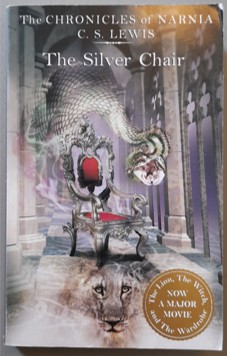
As a child, I read and loved the entire Chronicles of Narnia. However, I couldn’t remember a great deal about this instalment. I certainly couldn’t remember why it was called The Silver Chair, and although the uncanny CGI cover of my early-noughties edition was familiar to me, I found the snake bemusing, because I couldn’t remember there being a snake in the story. I was also surprised when I discovered that the girl was called Jill, because I had it in my head that she was called Polly (turns out that this is the girl in The Magician’s Nephew, which we’ll be reading in two months). The only other thing that I recalled about this book is that it contained one of my favourite characters in the series: Puddleglum.
SPOILER WARNING!
It should go without saying (although I will say it anyway) that there will be major plot spoilers ahead.
Plot summary
“It was a dull autumn day and Jill Pole was crying behind the gym.”
The book starts with Eustace trying to console Jill, who is being bullied at school. They are classmates rather than friends – but in an effort to cheer her up, Eustace tells her about Narnia. When the bullies chase them through the undergrowth to the wall at the edge of school, they reach a door which is usually locked. Today, however, it opens, revealing a forest filled with sunshine beneath a bright blue sky.
They run into the other world, and find themselves surrounded by towering trees and tiny, musical birds. At the edge of the forest is an enormous cliff, and they look down to see clouds far below, with the world impossibly far away. Eustace is worried that Jill is standing too close to the edge, and when he tries to pull her back, he loses his footing and falls. Aslan runs forward and blows a huge breath, slowing his descent – but Eustace is soon out of sight.
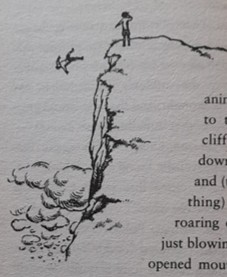
Aslan explains to Jill that he summoned her and Eustace to Narnia because the king is dying, and his son is missing and must be found. Aslan tells her to go north to the ruined city of ancient giants, where they will recognise the prince as the only person to use Aslan’s name. He then blows Jill off the cliff and into the Narnia, after Eustace.
Jill flies west, across the sea, past the islands that Eustace visited in the last book. She lands outside Cair Paravel, just as an old king sails away. An owl demands to know why the children are here, and Jill explains that they must find the missing prince, on Aslan’s orders. The owl informs them that the king is Caspian – and this makes Eustace very upset. Seventy years have passed since he was last in Narnia, and Caspian is now an old man.
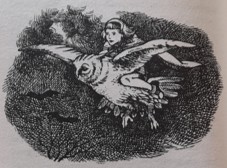
The owl flies Jill and Eustace to the Parliament of Owls (a joke which, as a kid, flew right over my head; a “parliament” is the official name for a group of owls). Here, it is explained that Prince Rilian has been missing for ten years. He was out with his mother when an emerald serpent attacked and killed her. In his grief, Rilian kept riding back to the place where she died, and one day, he met a woman dressed in green. Days later, he vanished without trace – and many knights and heroes have died trying to find him. The owls agree to fly the children north, but only as far as Ettinsmoor. Here, they hand the children over to Puddleglum.
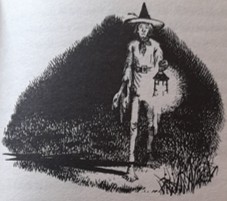
Puddleglum is a marsh-wiggle. The marsh-wiggles are solitary beings, living in wigwams and fishing eels from the bog. The other marsh-wiggles view Puddleglum as being too happy and optimistic, but to the children, he seems very gloomy. He guides them north, through the realm of giants, and over an enormous arched bridge, tall as a mountain.
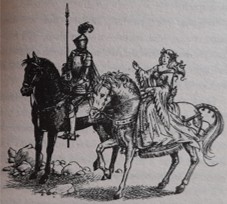
On the other side, they meet a lady in a dazzling green dress, accompanied by a knight in black armour. The lady tells them to follow the road to the giants of Harfang, who she promises will provide shelter. They thank her and move on – but they are soon caught in a snowstorm. With the blizzard raging, they traverse a tabletop mountain filled with angular pits and ridges, and they hasten to reach Harfang before nightfall.
The giants invite them in once they explain that the lady sent them, and they lead the children to rooms designed for humans, with food, furniture and clothes intended for human guests. The next morning, the snow is washed away by rain, and the children see the ruins of an ancient city on the tabletop hill. Across the paving slabs are the giant letters “UNDER ME”, which they realise is a less-than-subtle hint from Aslan, pointing them the way to go. However, the giants insist that they stay for the Autumn Feast.
At lunchtime, the giants feed their guests venison. None of them think anything of it – until Puddleglum overhears the giants recalling how the deer pleaded with them before they killed it. They realise that they have eaten a talking animal, one of the residents of Narnia. Jill then discovers a cookery book with recipes for “man” and “marsh-wiggle” – and they make their escape at the first opportunity, sneaking out while the giant cook is sleeping.
When the giants chase them down, they run to a tiny cave in the mountains. Here, they lose themselves in the dark, and end up tumbling down a scree slope into the depths of the earth.
They are greeted by dozens of pale-skinned gnomes and giants, all armed to the teeth. These are the Earthmen, and they all look incredibly sad. The Earthmen lead the children and Puddleglum to an enormous cave illuminated by glowing moss, and littered with sleeping, malformed animals that once fell down from the lands above. In one cavern lies a giant man (not a giant – just a big man) that the Earthmen call old Father Time. They explain that these beings will all awake at the end of the world.
They sail across a huge underground lake to a city full of Earthmen with a mighty castle. However, their Queen is apparently away. She has left a prince to rule in her stead, and he summons the children and Puddleglum immediately.
The prince is a young man with fair hair (Lewis describes as looking like Hamlet – good luck finding a 10-year-old who knows what Hamlet looks like), who reveals himself to be the knight in black armour they saw on the bridge. Jill finds him most annoying; he laughs almost constantly and knows nothing of the world.
The prince has no memory of how he arrived here. However, he feels indebted to the Queen, because she has apparently saved him from a cruel enchantment. Every night, he becomes a vicious serpent, and must be bound to a silver chair to stop him attacking his friends (there we go – that’s where the name of the novel comes from!). One day soon, the Queen will invade the overworld and make him king, then marry him. She has set the Earthmen tunnelling under Narnia, and their armies are ready to break out and take the country by force.
The children and Puddleglum sense that all is not as it seems. They hide until the prince has been bound to the silver chair, and then they sneak back to see him. He implores them not to untie him, even if he asks – apparently, the “enchantment” makes him turn mad.
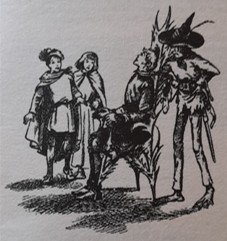
Of course, the moment the “enchantment” takes hold, the prince starts muttering about living in the overworld and being held here against his will. He begs them to set him free, but they aren’t sure – not until he asks them in the name of Aslan. They finally cut him loose, and as soon as they do, he takes his sword and slices the chair to pieces. He then reveals himself to be Prince Rilian of Narnia.
The Queen comes back and is furious. She tries to bewitch them into forgetting about Narnia and about the sun. Puddleglum is the most resilient, but even he falls under the spell eventually. The witch tells them that they only dreamed of the sun’s existence after seeing a lamp. When Jill remembers Aslan, the witch tries to convince them that lions don’t exist, and that they are only big housecats – but Puddleglum is having none of it. He stamps out her magical fire and destroys her spell.
Incensed, the witch turns into a serpent. Rilian, Eustace and Puddleglum all draw their swords (Jill doesn’t have one) and hack off her head.
With the witch slain, the underworld starts falling apart. The lake rises, and a fissure opens to an even deeper, magma-filled world below. They learn that the Earthmen were enchanted too, and that they are now returning to their fiery homeland, the Land of Bism.
They follow the road that the Earthmen had dug and appear on a hillside in Narnia. Some centaurs offer them a lift, and they arrive at Cair Paravel just in time for King Caspian to return home. He disembarks his ship and embraces his son – but as soon as he does so, he dies. Aslan appears behind Eustace and Jill, and they are suddenly transported back to his mountain beyond the sea. Here, they find Caspian lying dead in the stream – but a drop of Aslan’s blood causes him to awaken and become youthful again.
Caspian hasn’t come back to life, of course. He is alive in Aslan’s realm, i.e., the afterlife, but he would be a ghost if he returned to Narnia. Still, he is overjoyed to see Eustace.
Aslan opens the doorway to the real world, where the sky is grey and the bullies are still chasing them through the undergrowth. He tells Jill to pick up a long stick from the forest, and tells Eustace and Caspian to ready their swords. When the bullies reach them, they are terrified by the sight of Aslan, and Eustace, Caspian and Jill set upon them with swords and sticks. The headteacher calls the police, but of course there is no trace of a lion or sword-wielding maniacs when they arrive. Aslan has closed the portal, an Eustace and Jill are safely home.
My thoughts overall
I liked The Silver Chair a lot more than I was expecting. The nuts and bolts of the story are much stronger here than in any of the previous books: the plot has a clear trajectory from the start, and the characters are more believable and engaging. It’s a linear narrative, but it feels much more cohesive than Lewis’ previous Narnia offerings. Speaking personally, I also find the setting more interesting; I just love wind-blasted moors and dark caves for some reason.
How old is Rilian?
Rilian is a central character of this book (indeed, he is the one who sits on the titular Silver Chair), but we learn relatively little about him. C. S. Lewis treats Rilian much like Caspian by allowing the reader to assume that he is an inherently good person. This is how princes are treated in most fairy tales, of course, but these days, most fantasy readers don’t automatically associate princes with goodness. Possibly the opposite.
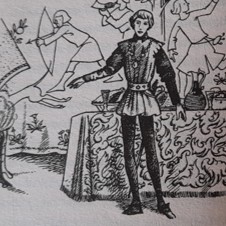
My main confusion surrounds Rilian’s age. He is described as a young man, but this raises timeline issues. If it is 70 years since Eustace saw Caspian, then Caspian is now in his 80s. Rilian has been missing for ten years, and ten years ago, he was old enough to be riding to the northern lands unaccompanied. Therefore, the youngest Rilian could be is about 25. But this suggests that Caspian was about 50 when he first had children. This isn’t impossible, obviously – but what about Caspian’s wife? We met her in the last book, and we know that she was a young woman when they married – possibly even older than he was!
Are we to believe that Rilian’s mother bore her first child when she was 50? Does this mean that there is no menopause in Narnia?
The more likely scenario is that she give birth when she was in her 20s – which would make Prince Rilian at least 50 years old. To me, this is not a young man. But who knows how C. S. Lewis perceived age?
I wish to start the Puddleglum appreciation society
Puddleglum is wonderful and I won’t hear otherwise. He is so delightfully miserable that I can’t help but read his dialogue in the same voice I use for Marvin in Douglas Adams’ Hitchhiker’s series.
“It stands to reason we’re not likely to get very far on a journey to the North, not at this time of the year, with winter coming on soon and all. And an early winter too, by the look of things. But you mustn’t let that make you down-hearted. Very likely, what with enemies, and mountains, and rivers to cross, and losing our way, and next to nothing to eat, and sore feet, we’ll hardly notice the weather.”
The difference with Puddleglum, though, is that he is brave, resilient, and supportive. His pessimism is so imaginative that he can foresee most potential obstacles, which makes him an invaluable guide. The children might tire of his constant negativity, but he is so steadfast and trustworthy that they both come to rely on him. He is also the first genuinely funny character that Lewis has written for this series. These books have had plenty of whimsy, but not much humour – and Puddleglum makes all the difference.
The world of Narnia expands yet again
Each book in the Narnia series explores somewhere new; the last one went east, and this one goes north – but this one also goes down! The concept of an underworld is fantastic. A world which was beneath your feet the whole time, and you didn’t realise? To me, this is more exciting than sailing a ship across the sea, although I can’t explain why… And when Lewis describes a fissure opening in the underworld, revealing an even deeper underworld filled with lava – that’s just awesome. I love that stuff. Reminds me of when I picked up Tears of the Kingdom and discovered The Depths for the first time.
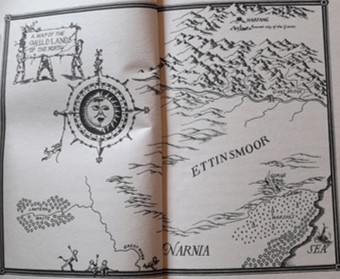
Unfortunately, none of this incredible world-building is conveyed in the map at the start of the book. I understand that it would be a spoiler to include too much, but the map is very bare-bones, just like the previous two.
Jill is the best girl protagonist yet
A running theme of my Narnia analyses is that Lewis’ approach to female protagonists has aged very badly. However, Jill is a big improvement. Some of the same issues persist; for example, when Puddleglum and Eustace get swords, Jill is left with a knife. Considering that the children are around 11-13 years old, this seems to be a pretty stupid decision; Jill would have a greater stature and muscle mass than Eustace. Unlike Lucy and Susan, however, Jill is aware of the gender imbalance. She argues with Eustace and Puddleglum about having a sword – and they ignore her. Still, at least she tried!
Jill is, in general, a more proactive protagonist than Lucy ever was (and certainly more proactive than Susan). She is the one to notice the giant bridge and point out that it must lead to the ancient giant city. She also takes the lead when they are trapped in Harfang, using her acting skills to convince the giants that she is childish and innocent, in order for them to trust her. When they are escaping the underworld, Jill saves the day by knowing how to ride a horse; Eustace and Puddleglum have no idea. If not for her, they wouldn’t have escaped before the underworld fell apart.
That being said… Lewis still manages to make Jill useless on occasion. For example, while the three male protagonists are hacking off the serpent’s head, Jill sits on the floor thinking “I do hope I don’t faint – or blub – or do anything idiotic.” That’s the spirit, Lewis. That’s exactly what a girl would be thinking.
Lewis’ views on women
As usual, Lewis’ conversational narration style gives us a clear insight into his views on many things – including women. He still seems convinced that women can’t possess a sense of direction. In the first chapter of the book, Eustace states that “it’s an extraordinary thing about girls that they never know the points of a compass”, which echoes something similar said by Edmund in Prince Caspian. Both Eustace and Edmund were described as reformed, good-hearted, Aslan-loving boys when they made these comments – which proves that Lewis believed such views to be perfectly acceptable.
Later, Lewis returns to the issue of navigational gender imbalance by clarifying “Scrubb was quite right in saying that Jill (I don’t know about girls in general) didn’t think much about points of the compass.” With that parenthesised comment, he almost gets himself off the hook – but not quite. Is he suggesting that Jill is an exceptional case? It seems insincere, given that he has a track record of writing girls as being useless for anything besides cooking, healing, and comforting men. But I’ll take Lewis admitting “I don’t know about girls in general”.
My final point on this matter regards Lewis’ views on violence against women. Having killed the green lady, Prince Rilian declares, “I am glad, gentleman, that the foul Witch took to her serpent form at the last. It would not have suited either my heart or my honour to have slain a woman.” It’s a strange sentiment. Rilian knows that the snake was the witch, so he has, in fact, “slain a woman”, however he spins it.
I can only assume that Lewis wrote this dialogue in an attempt to redeem the three male protagonists, but it’s an odd way of doing so. They killed the witch because she was evil. That should be enough. The fact that she is a woman – who had temporarily turned into a snake – should have nothing to do with it, unless we want a deeper exploration of Rilian’s psyche (honestly, I’d be up for that). I guess this is a children’s book; Lewis is reminding little boys not to hurt little girls. But really, he should just remind all children not to hurt each other. Besides, this is a sudden change of heart; Aslan didn’t have any qualms when he tore the White Witch to shreds in the first book.
I guess talking deer tastes the same as non-talking deer?
In The Silver Chair, Lewis once again explores the ethics of eating animals in a world where animals can talk. We’ve been wondering about this since the first book, when Mr Tumnus was serving up eggs and buttered toast – and in Prince Caspian, it was explained that there are “dumb” animals that are acceptable to eat, and “talking” animals that have the same rights as humans and are therefore off-menu. This is, to my understanding, a rehashing of a very old Christian belief: that God made humans superior, and that humans have permission from God to eat animals (Gen 9:3).
Lewis appears to suggest that superiority arises from an ability to talk and think, bestowed upon creatures by Aslan. But this is really messy, isn’t it? All talking animals have to eat, and some talking animals are carnivores. So, Lewis is forced to create a parallel ecosystem of inferior “dumb” animals in order for the talking animals to survive. But how does this work? Is there some kind of Narnian meat certification board that provides a “dumb animal” seal of approval on every meal?
If anything, Lewis’ introduction of animal hierarchies based on perceived sentience highlights the absurdity in the Christian concept of “superiority”. All animals have some level of sentience, and all humans are aware of that. We wouldn’t feel like we needed “permission” from God if killing animals didn’t feel wrong. Giving animals the ability to voice their feelings, and decreeing that they can no longer be eaten, seems to be a simple argument for vegetarianism. And wasn’t Eustace vegetarian in the last book?
Non-religious protagonists
Unlike the Pevensie children, Eustace and Jill are presented as having no religion. They don’t respond to being called “Sons of Adam” and “Daughters of Eve” because they haven’t read the Bible – and when Eustace makes promises, he doesn’t swear on the Bible either, because his school doesn’t encourage it. This makes their conversations with Aslan more interesting – although it does lend credit to the notion that Lewis was trying to hoodwink naïve children into becoming Christians.
The God discussions reach new heights
Each book in the Chronicles of Narnia tackles a new aspect of Christianity, and The Silver Chair has some of my favourite arguments yet. Up until now, the characters haven’t had to search within themselves when it comes to believing in Aslan. He usually just shows up when he feels like it, stuns everyone into reverence, then saves the day. But in this book, Aslan gives the children a task which they must solve alone, while he just watches from a distance. He doesn’t step in to save them. He doesn’t even offer much advice beyond a series of four “signs” (which are probably commandments, now that I think about it).
The choice to explore the human perception of God (and of faith in general) makes The Silver Chair a much more engaging read. The characters and the plot are forced to have more depth, because developments revolve around them, rather than around Aslan.
Also, making Puddleglum a miserable cynic is a genius move. In the last book, the world was full of awe and wonder and beauty, but this time, it is grey and cold and bleak – and Puddleglum reminds us of this at every turn. In the face of this bleakness, the characters are asked why they should believe in Aslan; the witch tries to convince them that they have imagined him, and that he doesn’t exist. It is Puddleglum who jumps up to declare:
“Suppose we have only dreamed, or made up, all those things – trees and grass and sun and moon and stars and Aslan himself. Suppose we have. Then all I can say is that the made-up things seem a good deal more important than the real ones. Suppose this black pit of a kingdom of yours is the only world. Well, it strikes me as a pretty poor one. I’m on Aslan’s side even if there isn’t any Aslan.”
As a kid, I never even noticed that this was an argument for believing in God in a seemingly Godless world. Totally flew over my head. As an adult, though, I think this is one of the most powerful arguments that Lewis has constructed yet. It’s telling, too, that he wrote this dialogue for Puddleglum, the grown-up, rather than for the children. Puddleglum is the most pessimistic man imaginable, and despite that, he still has hope.
However, Puddleglum is entirely justified in believing in Aslan, because Aslan has visited Narnia multiple times and most certainly exists. I wonder what one of the Earthmen might have said in response to the same question, having never seen any evidence of Aslan – what reason would they have for believing in him?
Pondering the afterlife
This book starts and ends in Aslan’s country, beyond the sea. At the end, we even see Caspian arriving and regaining his youth. Clearly, this is the afterlife, and Aslan suggests to the children that they will only return when they are destined to remain there – i.e., once they are dead. Lovely way to end a children’s book.
One more thing!
There was one sentence early in this book that took me quite by surprise. When the children are invited to dinner at Cair Paravel, a bard tells them the tale of “The Horse and His Boy, about Prince Cor and Aravis and the horse Bree” – which was the book that would be published next in the series, in 1954! It turns out that Lewis had already written The Horse and His Boy before starting The Silver Chair. I wonder why they were published in this order?
In summary…
I greatly enjoyed The Silver Chair. Unfortunately, I wouldn’t recommend reading it on its own; I think you need to have read the other books to understand what’s happening with Aslan and the Narnia ecosystem. Still, these books are pretty short, so if you want to read through them, it’s good to know that they get better as they go along!
Thanks for reading, and have a lovely week!
My Chronicles of Narnia analysis series:
Happy reading!
Discover more from C. W. Clayton
Subscribe to get the latest posts sent to your email.


I also love Puddleglum- I keep on forgetting his name; also keep on thinking about the ones about the first three movies. So right when you read that same, I remembered my love for him.
LikeLiked by 1 person