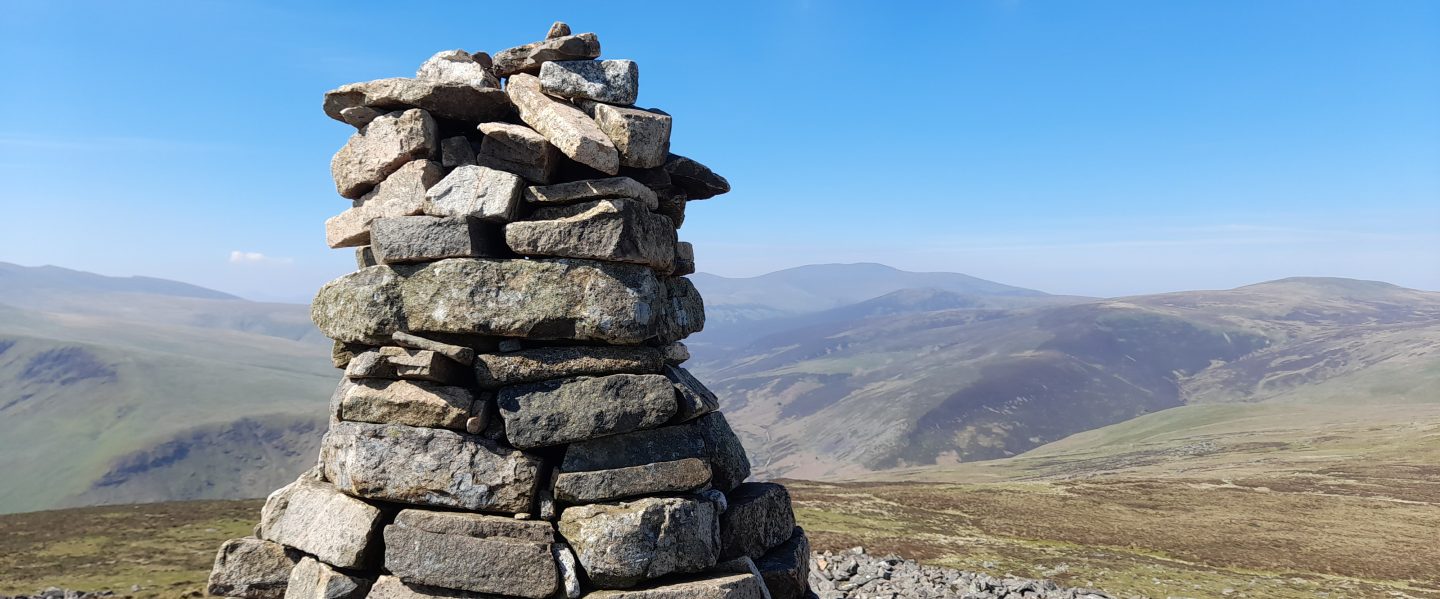

Hello readers! A few weeks ago I was on holiday on the coast of Northumberland, in the most northerly corner of England. I’ve lived my whole life in the north, but for some reason, I’d never visited this part of the world. Maybe I thought it was too close to warrant a week-long trip? In any case, I’m glad I went, because although the Northumberland coast shares many similarities with the rest of the border region, its character and history are quite unlike anywhere else in northern England.
We stayed in Bamburgh…
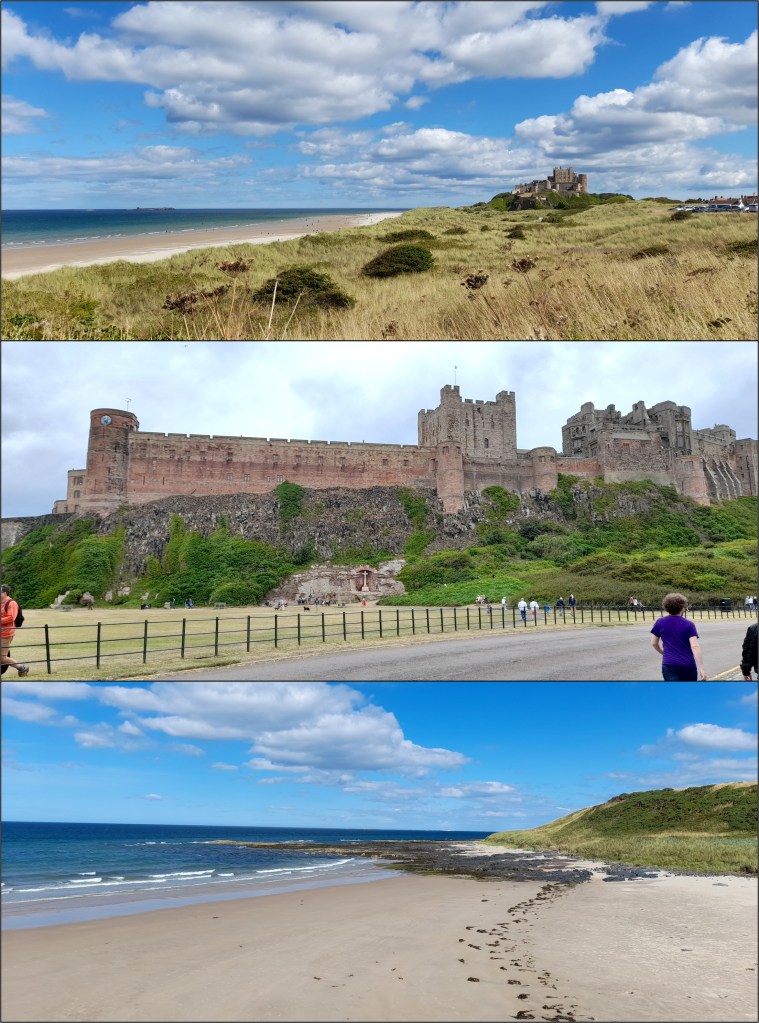
Bamburgh is a tiny village with a big castle and an even bigger car-park. We visited in peak summer holiday season, but I was still astounded how busy it was. The biggest draw for the tourists is presumably the castle, but with tickets costing £17.46 per person (and with all the money going to its private owner, rather than a charity) we decided to give it a miss. Instead, we circumnavigated the castle via the beach and the dunes, then spent a very pleasant day walking along the coastline.
The beaches around Bamburgh are beautiful, with white sand and calm, shallow waters that were (just about) warm enough for a swim in late summer. The Northumbrian coast is legally recognised as an Area of Outstanding Natural Beauty (AONB), giving it additional protections, mostly to preserve the rare wildlife that lives there.
Around the village of Bamburgh, we didn’t see much wildlife besides the dune plants, as the beaches were busy with people and their dogs. Thankfully, it was easy to escape the crowds by walking just half a mile north. Here, within the dunes, we saw dozens of butterflies, and at one point my partner accidentally disturbed a hare that had been snoozing in the marram grass, causing it to charge past us at full speed.
Once we were beyond Bamburgh lighthouse, we didn’t see another soul until we headed back inland. We had the white-sand beaches to ourselves, and it was incredibly peaceful. We stumbled upon a WWII gun emplacement, a concrete box that was still mostly intact, with bolts on the floor where the gun used to be, and lots of empty, cylindrical holes on the walls where they used to keep the shells. It looked out over Budle Bay towards Lindisfarne – and provided a quiet reminder of how many times this coastline has come under attack.
Hello again, Whin Sill
As long-time readers will know, I love a bit of geology, and Bamburgh certainly didn’t let me down on that front. Bamburgh castle sits atop of an outcrop of the Whin Sill, which is a thick layer of dolerite that stretches across vast swathes of northern England and the North Sea. It formed around 300 million years ago, when huge volumes of magma intruded beneath the ground and spread out in a pocket hundreds of miles across, but only up to 70 m thick. There is no consensus in where the magma originated, but in the Bamburgh area, you can find bubbles trapped in the rock, stretched in such a way that the magma could only have been flowing westwards when it first arrived here.
The Whin Sill beneath Bamburgh castle is an impressive sight on its own, especially because you can see its lower margin against the sandstone. However, what always amazes me is how far this magma travelled. I grew up near the Whin Sill in the northwest, where it can be traced along the Pennines, forming spectacular cliffs at High Cup Nick and High Force. It is also exposed along the most spectacular section of Hadrian’s Wall, near Housesteads Roman Fort. The fact that this very same shelf of rock can be found in Bamburgh, hundreds of miles away, is incredible. I’m always left wondering how the magma had enough energy to spread over such a wide area, and how quickly it flowed. Pretty slowly, I reckon, given that there’s no evidence of the rocks melting around it.
The Farne Islands
Across the sea from Bamburgh are the Farne Islands, which are further outcrops of the Whin Sill. The dolerite has formed steep, columnar cliffs on which thousands of birds make their nests. The only way to see them is to take a boat trip out from Seahouses, the town south of Bamburgh, where several fishing vessels have been repurposed to carry hundreds of gawking tourists.
We managed to time our visit for the very end of puffin season. Most puffins had already headed north for the summer, returning to Iceland or northern Scotland. Still, we saw a dozen or so, instantly recognisable from their frantic flapping as they hurtled through the air. We also saw gannets, the largest seabirds in the British Isles, and guillemots.
The dominant birds on the islands, however, were the kittiwakes. At the time of our visit, there were thousands of them, making a terrific racket as they called from their nests on the cliffs. Most of their chicks had fledged, but many were still learning to fly – and we had the misfortune of watching a young bird fall into the sea, only to be grabbed and drowned by a herring gull. The animal kingdom is a brutal place…
There are so many birds nesting on the Farne Islands that they have stained the dark, dolerite cliffs white with their droppings. The resulting stench is indescribable – mostly damp, kind of fishy, and certainly not pleasant. Clearly the birds don’t mind living on several decades’ worth of their own excrement. Maybe the bright white colour helps them spot their home from further away? I guess there must be some evolutionary benefit to having insoluble shite.
We also saw plenty on seals during our trip, either basking on rocks, or occasionally bobbing their heads above the water. Most of them were out hunting when our boat went by, making them very difficult to photograph (apologies).
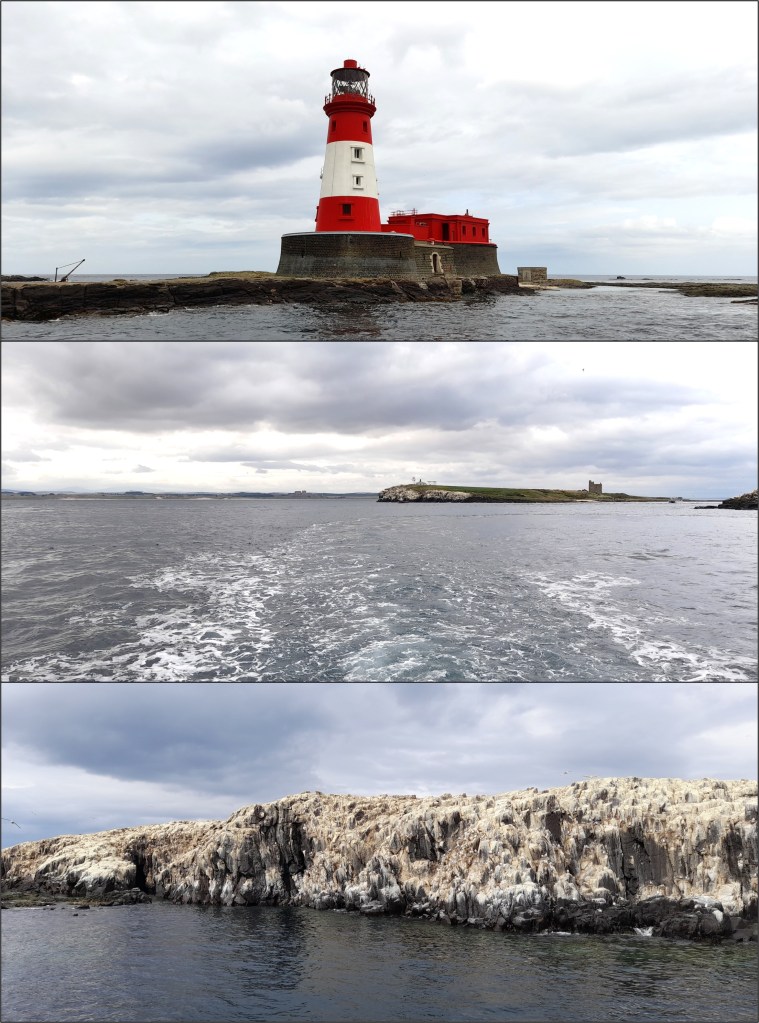
The Farne Islands are also home to the lighthouse where the famous Grace Darling once lived. In 1838, when she was 22 years old, she rowed out with her father to rescue sailors from a wrecked ship during a storm. The Victorians loved this story, and it was heavily romanticised, causing young Grace to become a national hero. She died four years later from tuberculosis, but her story only continued to grow, leading to paintings, sell-out stage productions, and even a poem by Wordsworth. There is a monument to her, close to her grave, at Saint Aidan’s Church in Bamburgh.
A pilgrimage to Lindisfarne
Lindisfarne is famous for its causeway. Visitors can drive to the island, but only when the tide is out – and although there are plenty of signs reminding tourists of this simple fact, people still get caught by the rising waters on a semi-regular basis. On the day of our visit, the tide closed in behind us, trapping us on the island for six hours before we could leave again. Thankfully, it’s a wonderful place to be trapped.
The most eye-catching building on the island is undoubtedly the castle, built on a protrusion of our old friend, the Whin Sill (actually, it’s technically the Whin Dyke at this particular location, but let’s not get into the details – not least because there is no consensus over how this feature formed). The castle was first built in the 16th century on the orders of Henry VIII, using stone from the nearby monastery which he had recently dissolved. He intended to use its strategic location to defend against possible Scottish invasions, but in the end, it served no real purpose. In 1901, it was bought by a publishing magnate, Edward Hudson, who had it extensively modified. Still, although it might not be a particularly “historic” castle by British standards, it is certainly striking – and unquestionably photogenic.
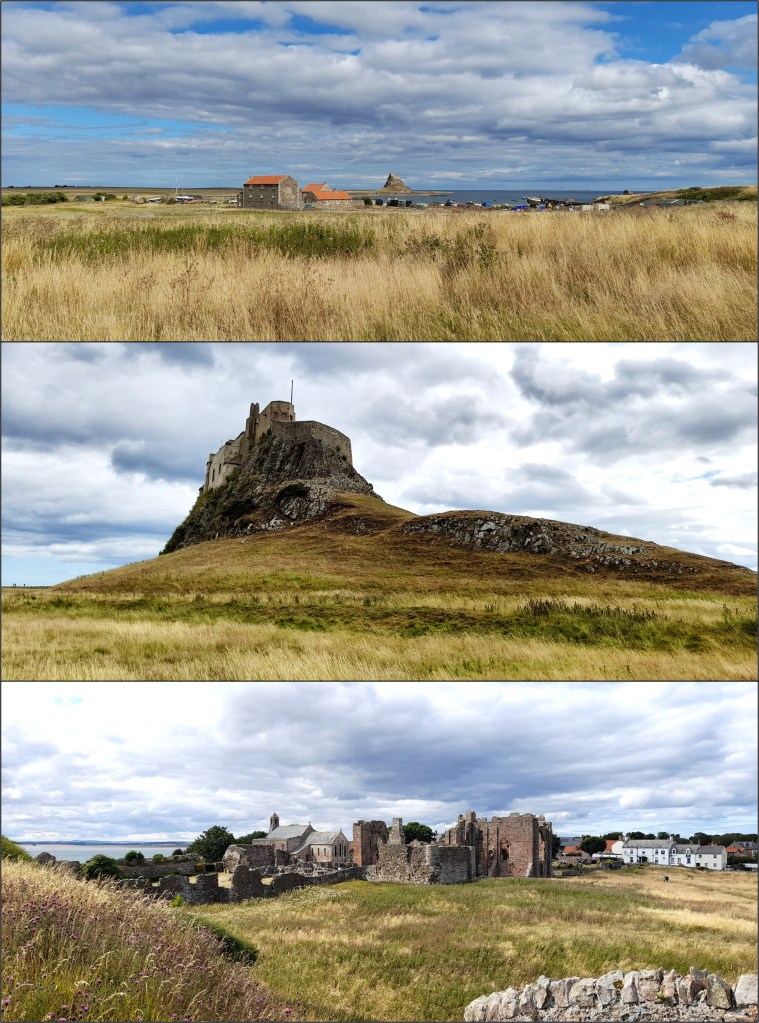
A deeper history of the island can be unearthed in the ruined monastery. It was founded by Irish monks in the mid-7th century, and it operated for 900 years before Henry VIII decided to dismantle it – and all the other English monasteries – so that he could divorce his wife.
However, the Lindisfarne monastery had managed to survive far more brutal attacks before Henry VIII’s final death blow. In 793, Norwegian Vikings ransacked the monastery, and many monks were killed and enslaved. This attack is often regarded as the beginning of the Viking era in Britain – although Lindisfarne was never raided again. The main invasions of the 9th century were from Danish Vikings, who landed further south in Kent and East Anglia. The surviving monks continued to live in the Lindisfarne monastery as the Danes expanded their territory further north, and they only fled the island in 875, when the Vikings took the Kingdom of Northumbria. The monastery was then re-established following the invasion of William the Conqueror in 1066, where it survived in peace for another four centuries.
Thankfully, much of the monastery’s priceless history and artefacts survived the attacks from Vikings and from Henry VIII, including the famous Lindisfarne Gospels, beautiful manuscripts that were painstakingly copied out and illustrated by the early Lindisfarne monks.
Bede and the “Golden Age” of Northumbria
Virtually no written documents from the northeast exist between Roman occupation and the arrival of the Anglo-Saxons. However, Anglo-Saxon Northumbria was a hub of trade and learning, and produced much more recorded history than many other parts of Britain – certainly more than the northwest and Wales. This is mostly thanks to Bede, a monk operating from Jarrow, South Tyneside, in the early 8th century. He wrote a history of Britain from the Roman invasion onwards, including the establishment of a royal palace in Bamburgh and the founding of the Lindisfarne monastery.
It probably comes as no surprise that, as a fantasy author, I’m particularly fond of this period of Anglo-Saxon history. Actually, I’m not sure if “fond” is the right word; I find it fascinating, but I’d never want to live through it. It’s a very violent period of history, which perhaps explains why it doesn’t receive so much attention in British schools. I remember learning about Romans and Vikings, but I don’t think we ever discussed the Golden Age of Northumbria. So, for those interested, I thought I’d recount a brief history of the region, which I was inspired to read up during my visit.
A brief history of Bamburgh
Even in Roman times, Northumberland was very sparsely populated. Bede starts his historical accounts with the arrival of the Anglo-Saxons in the sixth century, when King Æthelfrith made Bamburgh his home, naming it “Bebbanburh” after Bebba, his wife.
At this time, Northern England was divided into two culturally distinct regions: the Britons lived in the northwest, and the Bernicians lived in the northeast, separated by the Pennines. King Æthelfrith managed to take the southern kingdom of Deira (Yorkshire), and this marked the beginning of the Kingdom of Northumbria – temporarily, at least – which stretched from The Humber to the Firth of Forth.
Æthelfrith fought battles all across northern England and Wales, on one occasion killing over a thousand unarmed monks in Gwynedd (what a lovely fellow he must have been). He soon met a true warrior king’s death: killed in battle by some angry East Anglians, who subsequently moved north to take his territory as their own. However, the East Anglian king, Edwin, didn’t last long. He met a true warrior king’s death somewhere near Doncaster, killed by an alliance of Welsh and Mercians. Æthelfrith’s three sons then returned to Bernicia, having been biding their time in Scotland.
The eldest son, Eanfrith, reigned for a year – before being killed by Cadwallon of Gwynedd (maybe still angry about all those monks). The second son, Oswald, was a lot more successful. He killed Cadwallon in a battle near Hexham, then reunited Northumbria.
Bede has a lot of good things to say about Oswald, who was (supposedly) a devout Christian. He invited an Irish monk called Aidan to take residence in his kingdom, who came all the way from a monastery on the Hebridean island of Iona – and ordered him to build the Lindisfarne monastery. Christianity spread through the region, and Oswald was later made a saint for his efforts.
However, Oswald wasn’t a peaceful fellow. Eight years later, he met a true warrior king’s death, fighting the Mercians (and potentially the Welsh) somewhere near Oswestry. Nobody is sure what he was doing so far from home, as Bede seems reluctant to provide answers; it appears that Oswald’s intentions were less than honourable. Although he is remembered as a saint, he killed a LOT of people – even if he didn’t hit his father’s record of a thousand unarmed monks.
After Oswald, the third son, Oswiu, took the throne. He killed the guy who killed his brother (eye for an eye and all that – perfectly Christian behaviour), and managed to die of old age at 58. His first son ruled for a bit, and then his second son, Aldfrith, who ruled entirely peacefully, thereby starting Northumbria’s Golden Age.
The Golden Age was ended by the Danish Vikings, who took the southern half of the kingdom and instigated severe instability in the northern half, which continued to be ruled from Bamburgh. Eventually, the kingdom was swallowed up and divided between England and Scotland – and Bamburgh lost its status.
In summary…
The Northumberland Coast is a beautiful place with a rich history, and it is relatively easy to escape the tourist hot spots and find somewhere calm and deserted. I’m happy that the trip prompted me to learn some history that was overlooked at school, reframing the common misconceptions of the “dark ages”.
Happy reading, and have a lovely week!
Links:
Williams et al. (2025) Unravelling the complex record of magma flow and solidification in sills. Journal of the Geological Society, 182(6), https://doi.org/10.1144/jgs2024-120. (This is an open-source article, free to read, which has a nice map of the Whin Sill!)
Discover more from C. W. Clayton
Subscribe to get the latest posts sent to your email.


Being a big fan of The Last Kingdom, I recognized where you were right away!
Loved reading about your visit so much that I watched – or rather listened – to a few YouTube videos about it and the village while I knit this morning.
Such a beautiful place and fascinating. Maybe I’ll get to see it myself some day!
LikeLiked by 1 person
Thank you! It is such a beautiful place. You’ve also reminded me to finish watching The Last Kingdom. I watched the first two series on the BBC, but then it moved to Netflix! Hopefully I haven’t spoiled the ending by reading some actual history.
LikeLike