
Hello readers! I have been thinking about the journeys taken by characters in fantasy media, and how they often follow a similar environmental route. Stories tend to start in “green” locations, such as meadows or forests, before sending the hero to foreign lands which have a more “yellow” hue, such as deserts or wastelands. This is a common fantasy trope, with Tolkien’s The Lord of the Rings trilogy being a classic example (I can’t think of a greener starting location than The Shire). However, the trope probably didn’t originate with Tolkien, and I find its continued prevalence quite intriguing. It tells us a lot about the readers and writers of the fantasy genre.
In this post, we’ll discuss examples of the “green-to-yellow” trope, and explore why so many creators (including myself) choose this structure for their work, consciously or not. We’ll also consider some counter-examples, and ponder whether fantasy stories can be elevated by leaving this trope behind – or whether it is a key part of their identity.
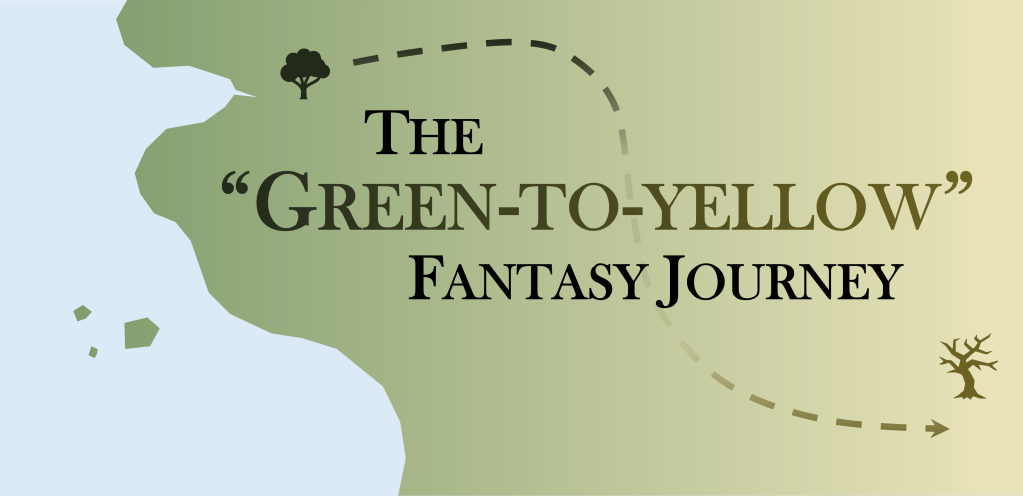
The quintessential “green-to-yellow” journey…
Picture a green location. It probably has rolling hills, luscious grass, verdant woodlands and gurgling streams. A bit like that Windows XP desktop background – maybe with some additional sheep. Now picture a yellow location. It probably has dry, cracked earth, a blazing sun in the sky, bare rocks and desiccated river channels. A bit like you’re viewing it through that “Mexican filter” used on American TV.
I named this trope based on photos of the Earth from space. From such a distance, we can see that most of the land surface is either green or yellow, vegetated or deserted. There is obviously a huge range of different climates and environments on our planet, just as much as in fantasy media, but I thought these two colours provided a simple divide. For a fantasy story to fit the “green-to-yellow” trope, the protagonist must start out in a green region, then leave their home to travel to a yellow region.

Some examples
The Shire is a textbook example of a “green” location at the start of a fantasy story. The characters have grown up there, in a place which is stable and safe, and are forced to travel to foreign lands which are decidedly less green. Their end goal is a barren wasteland with an active volcano – the epitome of inhospitable.
There are more examples than I can recount here, and I’m sure more will spring to mind once I finish writing this post. Picking some random samples through the decades, I recall Stephen Donaldson’s Thomas Covenant chronicles (1977-1979) following a similar environmental journey (although this series hasn’t aged well and I didn’t finish it). Robert Jordan’s The Wheel of Time series (1990s) also falls into this structure, just about. Joe Abercrombie’s The Blade Itself (2006) starts out somewhere hilly and damp, and takes the characters into a wasteland – although not all the characters have “green” origins. You can even find examples in science fiction, such as Frank Herbert’s Dune (1965), which starts on the rainy planet of Caladan before moving to the desert planet of Arrakis.
As I racked my brains to think of more examples, lots of video games sprang to mind. Pretty much every Legend of Zelda title starts with Link living in a forest, before journeying to somewhere more inhospitable – usually with a desert and a volcano in the mix somewhere. The Kokiri Forest in Ocarina of Time (1998) is a prime example of a “green” starting location. The Xenoblade Chronicles (2011) games follow the same pattern, typically starting out in grassy worlds before moving to deserts. Now I think about it, every Mario platforming game starts in a green, grassy world… This trope might be more prevalent in video games than it is in books and films!
(If you can think of more examples, please suggest them in the comments.)
It’s easy being green
I think the main reason for employing the “green-to-yellow” trope is because, from a narrative standpoint, it is more compelling to have a protagonist start from a place of relative comfort before being challenged. If they are making a journey across a fantasy world, the environment is an obvious way to challenge them; it makes sense to test their endurance against inhospitable climates such as deserts and wastelands. Frodo’s journey would have been a lot less compelling if he had started out in Mordor, dying of thirst, only to become increasingly hydrated and refreshed as he headed towards Sauron’s cosy hobbit-hole in The Shire.
Another reason for fantasy journeys being “green-to-yellow” rather than “yellow-to-green” is because this is the experience of many fantasy writers, and is relatable to large parts of their audience. The Shire is clearly a fantastical version of England, and by journeying away from it, the hobbits (like British holiday-makers) will naturally encounter foreign climates where the weather is hotter and dryer. As a reader from northern England, I understand and resonate with this journey; I myself have travelled to hot Mediterranean climates to visit volcanoes. I have felt the relief of returning from such holidays to see the green fields and woodlands of my home. The “green-to-yellow” journey resonates with me on a deeply personal level.
The trope doesn’t always work
In order for hot, desolate environments to challenge the protagonist, they must be poorly equipped to handle them. In medieval-style fantasy stories, this makes sense, as technology is limited. The protagonist doesn’t have sunglasses, sun cream, or a hand-held battery-powered fan to keep them cool. They don’t have Stanley cups. So, if they go to the desert, they are in for a rough time.
However, this won’t be the case for all fantasy worlds. In some stories, particularly in science fiction, characters have access to technology which makes their journey much easier. In fact, they might not consider the desert to be challenging at all – in which case, the “green-to-yellow” trope makes little sense.
This is particularly true for video games. If there are no environmental mechanics to make the gameplay harder in desert regions (e.g., quicksand, sandstorms, or characters being affected by temperature swings), why is the desert presented as a dangerous, foreign entity? Are players expected to automatically associate “yellow” environments with alien cultures, and the feeling of being far from home?
Counter-examples
The first counter-example that sprang to mind was the original Star Wars trilogy (1977-1983). The story begins with Luke living in a desert, having spent his whole life there, and ends with a big battle on a green, forested moon. This is the exact opposite of the “green-to-yellow” journey – but I’d argue that it works by borrowing the same principles. By starting Star Wars in a desert, Lucas reinforces the notion that this story is far, far away – relying on the audience to recognise “green” environments to be homely and comfortable, and “yellow” environments to be alien. Once Lucas has used “yellow” locations to establish his alien setting, his story can go anywhere, because with science-fiction technology, the environment is not a major challenge for the characters.
Another counter-example is The Horse and His Boy (1954), part of the Chronicles of Narnia by C. S. Lewis (which I revisited recently). The story begins in an oppressive desert empire and ends in the green and pleasant land of Narnia. However, the principles are still same: the yellow desert is hostile to the protagonists, while the green rolling hills are welcoming. It works because the story is about running away from danger towards freedom. The characters are saving themselves, rather than going on a selfless quest for the good of the world. Having the “green” location as the end goal allows Lewis to set up Narnia as a beacon of hope and liberty, while depicting the “yellow” desert as harsh and unjust (the story is overshadowed by unsavoury British colonial undertones).
But what about readers who come from deserts?
The success of the “green-to-yellow” fantasy trope relies on a shared cultural understanding within the audience, who assume that green locations are friendly, and yellow locations are hostile. So, I assume this trope must fall flat for audiences in real-world desert regions. How does the “green-to-yellow” journey resonate with them? Do they enjoy having desert regions (and often their inhabitants) depicted as naturally hostile? I doubt it. But I obviously can’t speak from experience.
When I read about a character departing their northern-European-esque birthplace and venturing into dry, barren wastelands, I can very easily imagine myself in their shoes. My perception of foreign environments aligns with the author, and with the fictional character. A lot of the awe and wonder I feel is probably based on my own experience rather than anything conjured by the author – but the author was probably bargaining on that response. The story is aided by our mutual fear and respect for deserts. However, this will be fundamentally different for a reader who didn’t grow up in a landscape like The Shire, and who happens to call a place like Mordor their home.
Do we need a fresh perspective?
There is nothing inherently wrong with the “green-to-yellow” trope. As discussed, many writers (including myself) construct these fantastical journeys based on their own experiences, and many readers are drawn towards this narrative structure for the same reason. However, we should all remember that this is not a universal experience.
Britain has a temperate climate with a warm summer and no dry season (this is how it is defined by the Köppen climate classification). Around the world, only 350 million people live in this climate type – which, for discussion’s sake, we will call the real-world equivalent of the “green” fantasy environment. Compare this to the 600 million people who live in arid, desert, hot climates – the real-world equivalent of the “yellow” fantasy environments. If you are writing a book for a global market, and you use the “green-to-yellow” journey trope, you are catering to a minority. In fact, the most populated climate zone on Earth is the tropical savanna, which contains 1.6 billion people. This region receives a lot less attention than either verdant green vales or windswept yellow deserts…
So, if we’re writing and reading fantasy that presents green, temperate regions as natural, comforting homelands, and dry, arid regions as hostile, foreign environments… Who will resonate with this? Sure, a “green-to-yellow” journey might still facilitate a great story, and there will be other elements of the plot which are accessible to everyone, but the geographical locations might not ring true to some people – most people, in fact.
But this raises an interesting question. Are fantasy books written for a global market? Or are fantasy books actually written and consumed by a niche audience who have ancestral roots in Europe?
Is this trope a problem?
I’ve been considering this trope a lot recently, because I have realised that I rely on it quite heavily myself. Tropes are fine in moderation, if you ask me – but it’s good to be aware of them. Many fantasy worlds aren’t so fantastical after all; authors and readers want something that reminds them of their real-world environment, so they can use this as a base for their imagination. I want to live in the green comfort of The Shire, because it looks like an even homelier version of my home. And when characters go exploring, I want them to see scary environments that look nothing like my home – that is to say, rocky and desolate. The “green-to-yellow” journey trope works for me personally. It probably works for a lot of British people.
However, this trope won’t resonate for most readers on this planet. This “green-to-yellow” journey, so prevalent in fantasy, is a product of a British upbringing, amplified by Tolkien and then by his fans. We’ve exported that trope to the global fantasy market without considering how alienating, or even offensive, that might be to the rest of the planet.
Is this a problem? In some cases, yes. Desert environments are naturally hostile to white Europeans – that much is undeniable. But some books (looking at you, Narnia) take this a step further and suggest that the people in those desert environments are also naturally hostile. This is a huge problem, and it still occurs in books today. I think the “green-to-yellow” journey itself, however, is innocent. So long as you describe a fantasy land, with fantasy people, with no prejudiced allusions to the real world, you’re probably fine.
Can this trope be subverted?
Can any of you readers think of a true subversion of this trope, where the “yellow” desert environment is portrayed as homely and comforting, and the “green” temperate environment is portrayed as hostile? I imagine that there is plenty of historical fiction with this narrative structure, given the horrors perpetrated by the British Empire… But is there any non-Earth-based, traditional high fantasy that tells a story through this lens?
In summary…
The prevalence of the “green-to-yellow” environmental journey in fantasy media simply reflects the dominance of European and North American writers and readers in the fantasy market. Even in fantasy worlds, readers want connections back to reality. I only hope that other parts of the world have their own fantasy tropes, rather than being force-fed Europe-centric stories… If you can think of any more examples or counter-examples of the “green-to-yellow” fantasy journey, please let me know.
Happy reading, and have a lovely week!
Links:
What are the most populous climates? https://www.perrinremonte.com/expe-fr-1
Discover more from C. W. Clayton
Subscribe to get the latest posts sent to your email.


