
Hello readers! It recently occurred to me that there are an awful lot of pubs in fantasy media. And I’m not talking about bars or cafes, or any other alcohol-selling venues – I’m talking about very British-feeling pubs. Is this a trope? Do people regard pubs as fantastical environments?
As someone who grew up in northern England, the prevalence of British-feeling pubs in fantasy never struck me as odd. Their existence and long history was just a reality that I recognised – so why wouldn’t fantasy worlds have pubs too? But having done some travelling to other parts of the world, I have now come to appreciate that pubs – and we’ll get to the precise definition in a moment – are a very British (and Irish!) phenomenon.
Nearly every country in the world has some sort of nationally-recognisable blueprint for an establishment that sells alcohol. However, the pubs and inns portrayed in fantasy media are most commonly modelled after British pubs. And that got me wondering – what is it about the British pub that feels so fantastical? People have come to expect “tavern scenes” in stories and D&D sessions – but what they really expect is a pub!
In this post, I’ll first attempt to distinguish pubs, inns and taverns from other alcohol-related establishments, then try to explain what makes a British pub. We’ll then dive into some examples from various fantasy media, and explore why people are so drawn to this trope. Can it all be traced back to Tolkien? Again?!
Differentiating pubs, taverns and inns…
In fantasy media, you are far more likely to encounter inns and taverns than “pubs”. Authors and readers seem to prefer these labels, presumably because “pub” sounds a bit too British and mundane – and maybe a bit silly? Nonetheless, most of these fantasy establishments fall under the broad “pub” umbrella.
In the UK, the terms “pub” and “inn” are often conflated. This is because both will serve you beer – which is all most customers care about. However, inns originally offered food and accommodation too. Over the years, many inns stopped providing rooms due to the cost, but they kept their historical names. As such, we have plenty of “inns” in the UK that are actually just pubs. And this doesn’t cause us too much confusion.
Inns are thought to have appeared in Europe in Roman times, to serve the weary travellers moving along those many miles of Roman roads. They not only provided food and lodging for the travellers, but also for their horses. Over time, they also started to serve as a community space for the locals, who wanted alcohol just as much as the travellers did. And as the centuries went by, people started travelling further and in greater numbers, so the inn business boomed. You’ll find them in any novel set in the pre-20th century. Even Jane Austen’s Pride and Prejudice (1813) describes numerous inns – not that anyone would ever describe these pivotal plot points as “tavern scenes”.
A tavern, by contrast, is a place that only serves alcohol. Maybe a bit of food too – but usually nothing substantial. You might also call these places “bars”, but the term “tavern” is often preferred in fantasy media, presumably because it sounds olde-worldly. And in the UK, places might call themselves “taverns” while still being widely regarded as “pubs”. Again, this doesn’t cause us too much confusion.
Why the prevalence in fantasy media?
Stories typically require various social settings to advance the plot. And for most of European history, socialising has revolved around the consumption of alcohol. It makes sense for characters in pseudo-medieval fantasy stories to spend time in taverns. And when the characters are on a journey, an inn would be the logical place for them to stay. It is also a believable place for them to listen to locals and other travellers, making it perfect for plot and lore exposition – and in video games, an ideal place to pick up quests.
In many parts of the world, inns are now a thing of the past. The services they offered have been divided across different establishments: hotels for accommodation, restaurants for food, and bars for alcohol. I suspect that their prevalence in fantasy media is not just due to pseudo-historical accuracy, but due to their other-worldly feel; they are familiar enough for the audience to recognise, but are different enough to remain exciting. Who wouldn’t want to stay in a hotel with a pub and restaurant downstairs?
In the UK, however, traditional inns still exist! Most towns still have one – so, for us Brits, inns aren’t confined to fantasy or historical settings. When I was reading Lord of the Rings for the first time, probably around eleven years old, it didn’t strike me as odd or fantastical that the hobbits would stay at an inn. It just made sense. The Shire was a reflection of the world around me, sans technology, so why wouldn’t it have inns?
But this brings me onto my main argument. Why is the cliché fantasy inn British? Why not base it on some other culture, like a French bed and breakfast? Or an American motel?
First, let me try to describe what I mean by a British pub…
According to the Campaign for Real Ale, who rate and review pubs across the UK, a pub is a licensed premises which must be open and welcome to the general public without requiring membership or charging for admission, and which must allow drinking on the premises without requiring food to be consumed. This suits the definition of most fantasy inns and taverns nicely – hence why I used “pub” in this post title.
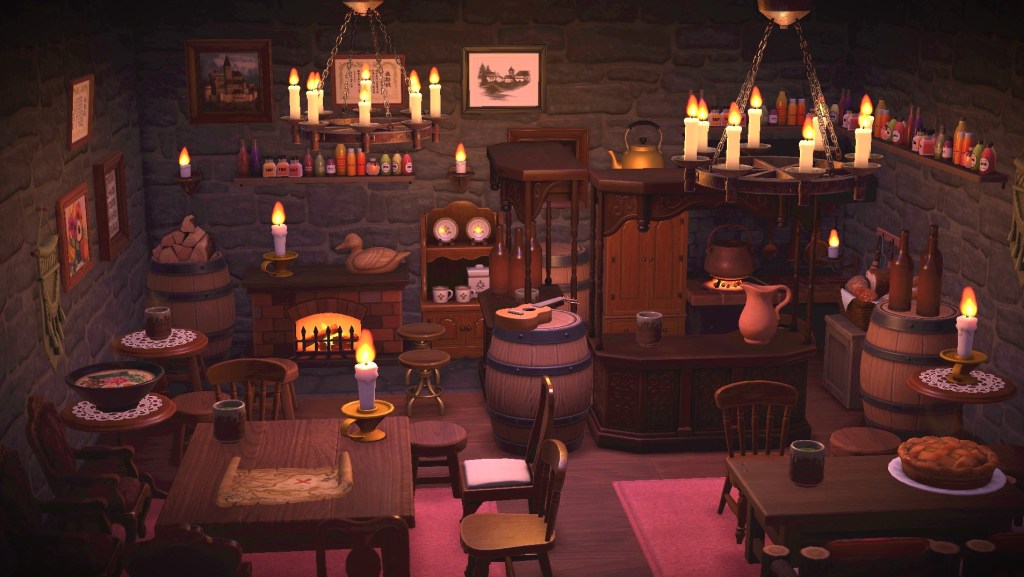
However, most people in the UK would have a slightly narrower definition of a pub based on appearance and atmosphere. Pubs are warm and homely, with a bar serving drinks, and tables to sit at. Your classic pub is in an old building with thick, stone walls, maybe with wooden beams on show, and a big fireplace. Modern pubs might not have this architecture, but they make up for it with their furnishings: usually heavy wooden furniture, lots of small paintings or black-and-white photographs framed on the walls, and maybe even some Toby jugs or taxidermied pheasants on the mantelpiece. The smell is predominantly of stale beer, with a whiff of sweat and/or wet dog, and the soft furnishings still have a slightly smoky aroma despite smoking having been banned in pubs for twenty years.
Another key feature of British pubs is that there is no table service. You have to go up to the bar to order drinks, where you will typically join a rowdy scrum vying for the attention of the bar staff. You can pay for drinks at the point of service, rather than being forced to rack up a tab and pay at the end – which means that people often take it in turns to go up to the bar and “buy a round” for the group (now a social minefield thanks to non-drinkers requesting cheap soft drinks and the coeliacs requesting extortionate gluten-free beers, but I digress). I don’t think the bar scrum happens anywhere else in the world. Or indeed, anywhere else in the UK. Usually we love a queue.
I’ve tried to find pub equivalents in other parts of the world. The Germans and Austrians have a “brauhaus” tradition (translating to “brewhouse”), and these establishments have a similar cosiness to pubs. However, servers bring alcohol to your table, so there is no chaotic atmosphere of people jostling to reach the bar. They also seem to serve a very limited selection, with the most traditional selling only the beer they brewed themselves, and unlike British inns, they aren’t associated with providing accommodation (I had to go on German Wikipedia for this, so apologies if things got lost in translation).
Spain has “tabernas” (translating to “taverns”), which are again similar, although they have table service. The atmosphere is also very different; you wouldn’t find sticky red-and-white tablecloths in a British pub, nor find the majority of seating out on the street (global warming might be changing that one though). The French have bars and cafes, but nothing I would call a pub. The Dutch have “bruine kroeg” (“brown bars”) which are cafes serving coffee and alcohol. They often have dark, wooden furniture and lots of paintings on the walls, so they look more like British pubs, despite being typically smaller with far fewer tables. However, they often play background music, which many British pub goers would frown upon. Pubs should be filled with the clamour of conversation, or with excruciating silence. Nobody asked for Maroon 5 on tap.
The Americans have bars, but these usually feel like modern establishments – probably due to the fact that drinking was prohibited until fairly recently, and because the country itself is younger than most British inns. They also have sports bars, filled with TVs, which have unfortunately become more common in the UK. Most pubs here now have TVs, but a good one, in my opinion, will have only a limited number of screens (and ideally none at all). And they will only come on for important sporting events.
Now let’s think of some fantasy examples
I’ll start with the most obvious: The Prancing Pony, in Bree, from J. R. R. Tolkien’s The Lord of the Rings. This could well be the fantasy inn that determined the look and feel of all future fantasy inns… The one inn to rule them all. Although there are plenty more pubs to be found in Middle Earth, especially in The Shire. Bywater has The Green Dragon (popular with Frodo, Bilbo Merry, Pippin and Sam), Buckland has The Bridge Inn, and Frogmorton has The Floating Log (a most unfortunate name). The Campaign for Real Ale would have a wonderful time in The Shire.
Another fantastic example are the pubs of the Discworld series by Terry Pratchett. Ankh-Morpork officially contains 228 pubs and inns (this total notably excludes hotels, wine bars and nightclubs – because Pratchett, like all Brits, intrinsically understood the definition of a pub). Pubs in Discworld have names such as The Mended Drum, The Bunch of Grapes, The Fiddler’s Riddle, The Goat and Bush, and The Miner’s Arms (a dwarf bar where remarks such as “just a half, thanks” could land you in trouble). All these names easily fit into British pub-naming tradition; even The Goat and Bush is making fun of the real Bull and Bush in north London. The Mended Drum is the most often visited in the series, and it exists down a set of stairs, in a dimly-lit room with cheap furniture (to be replaced after the inevitable bar fights) and with sawdust on the floor (to absorb the inevitable blood).
In George R. R. Martin’s A Song of Ice and Fire, The Inn at the Crossroads makes an appearance in several books. The inn has been around for so long that it has had numerous names, including The Two Crowns, The Bellringer Inn, The Clanking Dragon and The River Inn (with Martin having come up with histories for each of these names). It’s three storeys tall, with the upper storeys overhanging what used to be a river, although the river has since moved. Descriptions are fairly limited, but it sounds like a classic fantasy inn, with wooden kegs and a fireplace getting a mention. It has a kitchen and (importantly) a stable. However, it apparently has enough room for 130 people – which seems like a lot!
In The Kingkiller Chronicles by Patrick Rothfuss, The Waystone Inn is run by the main character, and is used as a backdrop for the framed narrative as he recounts his adventures. The inn contains a wooden floor and a “black stone hearth”, and has “rough, splintering barrels” behind a bar made from mahogany. It has a handful of regulars, but is never busy thanks to its rural location. Interestingly, the men eat stew at the bar – which I wouldn’t consider to be normal behaviour at a pub! You could drink at the bar, sure, if it’s not too busy – but you would go to a table to eat!
In The Malazan Book of the Fallen by Steven Erikson, The Phoenix Inn exists in Darujhistan, a big, ancient city with a tropical climate (nothing British about that). It is described as an old, stone building, poorly lit, with dirty windows, and has a wonky, old wooden sign above the door (classic). The bar serves ale in mugs or pewter tankards, and it also has a kitchen that serves limited food. A competing inn called The Peacock operates nearby – which is a very believable bit of worldbuilding. Why would a town have just one inn?
There are also examples in video games. Taverns feature prominently in The Witcher (both books, games and disappointing Netflix adaptations), and the Witcher III even has an Inn at the Crossroads in Velen – an ode to George R. R. Martin, perhaps? Or just a common-sense name? There are numerous inns/taverns in Skyrim, pretty much in every settlement you visit, such as The Bannered Mare in Whiterun, The Winking Skeever in Haafingar, or The Frozen Hearth in Winterhold. These serve as places to rest your character, pick up quests, or listen to the locals dump lore (who all sound surprisingly similar… as if they were all voiced by the same five actors).
Finally, I’ll mention The Snuggly Duckling in Disney’s Tangled. This is a classic pub, and of course it’s where all the local villains hang out. Which also reminds me of The Poison Apple in Shrek 2, which has “unhappy hour” from 5-7 pm.
So, why are fantasy pubs so similar to British pubs?
It makes sense that Tolkien’s inns would be very British, because he wrote The Shire as a fantastical version of England. However, many modern fantasy authors are American, and their worlds are only vaguely European – so why are the inns and taverns they describe so British? Did people really read about The Prancing Pony and think “yeah, that’s it – that’s a fantasy pub” and decide never to innovate?
It makes sense to me that British authors write British pubs. It’s what we know. But when Americans write British pubs, you get strange incongruencies such as customers slurping stew at the bar (no disrespect to Patrick Rothfuss). Obviously it’s a fantasy world and the rules might be different there, but still… Such elements feel incongruous because everything else is the same as in a British pub! Even when the world outside feels distinctly Scandinavian (looking at you Skyrim) or even like a North African desert, the inns still feel British.
It could be that Americans associate “British” or “Irish” bars with an olde-worlde atmosphere, so they assume that these establishments belong in a pseudo-medieval fantasy setting. Perhaps the idea of a pub has been mythologised in the same way as inherited status or the Welsh language.
Still, I can’t keep whinging about Americans appropriating British pub culture. I feel lucky to be able to spend time with my friends in cosy pubs, rather than being forced to dress up and drink from overpriced flagons at a ren faire. We have something great here – no wonder they fantasise about it. And the flipside to this, of course, is that we really are old-fashioned in the UK. Our pubs are a hangover from the real medieval times.
In summary…
British pubs are the best in the world and they have become a prevalent fantasy trope because people literally fantasise about them. We would all love to go to The Prancing Pony. Who wouldn’t? They sell ale in pints!
Happy reading, and have a lovely week!
Discover more from C. W. Clayton
Subscribe to get the latest posts sent to your email.


I enjoyed the piece, but I think there are two places where the argument becomes a little muddled for me.
Firstly, I’m not convinced that the typical fantasy inn or tavern can really be described as a British pub in disguise. The modern British pub is a much later institution, while fantasy inns usually borrow the older functions of inns and taverns, with food, lodging, ale, stabling and travellers passing through. It may be more accurate to say that the modern pub inherited features from those older establishments, rather than that fantasy inns are modelled on pubs.
Second, once you bring in German, Spanish, Dutch and other European drinking traditions, doesn’t that weaken the claim that this is specifically a British phenomenon? For me it rather contradicts your central claim and seems to point toward a much broader European tradition of communal drinking houses and inns. Tolkien certainly helped make the cosy English inn a default image in modern fantasy, but that feels like a safer claim than saying fantasy taverns are fundamentally British pubs.
LikeLike
Thank you! And yes, I wholeheartedly agree with your first point. This was only meant to be a bit of fun, and I don’t think fantasy inns are pubs in disguise – I just thought they were the most similar, if we’re making real-world comparisons. I find it interesting that in other parts of the world, the old inns didn’t evolve into pub-like establishments, and were instead replaced by bars. The evolution of inns to pubs seems to be unique to the UK, and of course this then became the default image of a fantasy inn/tavern thanks to Tolkien. If you told someone to sketch a fantasy inn/tavern, they would probably produce something that looks remarkably similar to the oldest pub in my hometown!
LikeLike