
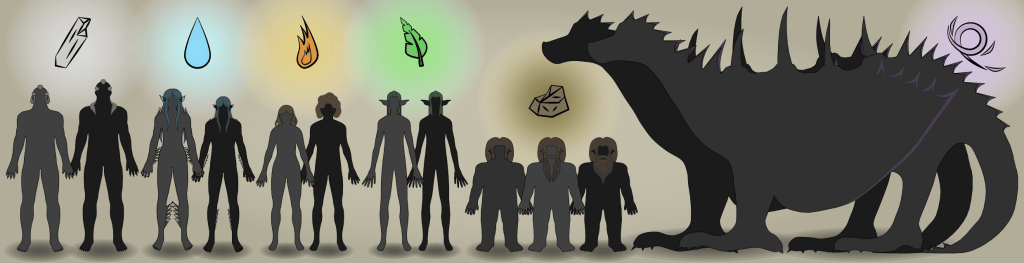
Hello readers! I have decided to improve the general world-building on my Highmoor art pages, starting with this reference diagram for the six hallowed species that inhabit the world. If you’ve read the books and struggled to visualise how big the characters are in relation to one another, hopefully this will clear things up! And for those interested, I thought I would share my thought process. There are no spoilers here; feel free to read if you have nothing better to do.
It started with seven gods…
The world was created by seven gods who arrived from long-lost lands over the sea. Each god designed a unique, sentient and intelligent species to live in the world alongside them, to harvest resources and build civilisations. I’ll list these from left-to-right in the diagram above: Jarn, god of metals, created goblins; Yokva, goddess of water, created nymphs; Gloed, god of fire, created humans; Skogur, goddess of greenery, created elves; Jorin, god of rocks, created dwarves; and Trekja, goddess of the air, created dragons.
The seventh god, Eldingar, created trolls. However, trolls are missing from the diagram – and this is intentional. Most people do not consider trolls to be a hallowed species, because they do not consider Eldingar to be a god. Centuries ago, he turned on the other gods and waged war on their creations, killing thousands of people. The gods defeated him, then trapped him deep beneath the world – but he continued to sow discord by sending foul, twisted creatures to the surface, testing the limits of civilisations and causing constant destruction. His trolls do not speak, or eat, or reproduce; they are seemingly immortal and very reclusive, living only in the highest mountains at the very centre of the world.
Over time, the power of the remaining six gods started to fade. Eventually, they lost their physical forms and became spirits, and their influence over the world waned. Their people were left to govern themselves, and they split into warring factions, fighting over resources. These factions are mostly – but not strictly – determined by species, with some being more cooperative than others. Nations led by dwarves, nymphs and humans have generally maintained a peaceful allegiance, whereas nations led by elves and goblins have become isolated and aggressive. Dragons, meanwhile, are so few in number that they have no nations of their own, and only involve themselves in politics and wars on an individual basis.
The biology of species
These six creations are true species, rather than races. Members of separate species cannot reproduce and create fertile offspring, although half-breeds are possible. In fact, all half-breeds involve humans, a quirk that is generally regarded by all the other species as being a mistake or deliberate provocation from Gloed.
All six species have male and female sexes for the purposes of reproduction. Dwarves, however, have an additional group entirely detached from the reproductive process. Why Jorin created this third group is anyone’s guess – some dwarvish academics theorise that by weakening the power of inheritance, family barriers are broken down and communities are strengthened. These asexual individuals dedicate their lives to mastering skills, advancing technology, or supporting the sprawling inner workings of the dwarvish bureaucracy.
Why are they “hallowed”?
The hallowed species have no doubt that they are distinct from the animals that inhabit the world – even though these animals were also created by the gods. However, the question of what defines a hallowed species has been contentious for centuries. Most people would argue that language is the defining characteristic, which provides yet another reason to exclude the trolls from this select group. Loyalty is another. No other creatures in the world were created to be companions, followers or worshippers of the gods – they were created as part of the natural system, and are typically viewed as resources. The six hallowed species enjoy an elevated status, bestowed on them by the gods themselves.
Another uniting feature is that five of the six hallowed species are bipedal – all except dragons. Trekja wanted a creature that broke all convention, so she gave her dragons four legs and two wings, making them unique among all warm-blooded creatures. The other gods modelled their creations after themselves, standing on two legs with a humanoid form. Nobody knows why the gods looked this way. Nobody knows where they came from, and now that they have become spirits, it is impossible to get any answers.
Variations within species
Three of the six hallowed species contain distinct races of people. Humans have the greatest variation, with characteristics tied to various regions across the world, although there has been extensive mingling over the centuries. Elves have three broad groupings defined by hair and skin tone, and these groups mostly live in separate nations. Nymphs are sub-divided into naiads and dryads, preferring to live amongst rivers and trees, respectively. The other three hallowed species don’t have races; any differences in appearance are random or induced by their environment.
Where do they live?
Some people have dwelt in one place ever since the gods first created the world. Humans have always resided on Mount Gloed, where their creator once lived, and where he passed into spirit form. Nymphs have always lived in Yokvandir, and dwarves have always lived in Assatur. The land around the central Troll Mountains, however, has always been hotly contested, and has been variously colonised, invaded, and abandoned throughout recorded history. Highmoor, on the northwest margin of the mountains, is mostly home to humans, who are under constant siege from the witches who reside in the Northern Wastes. However, the forest on Highmoor’s southern border is home to all six hallowed species, many of whom have fled their homelands seeking peace and solitude.

And despite all this complexity, I chose to write about boring old humans…
The protagonists of my books are all humans, and the action largely revolves around the politics of their nations, influenced by goings-on in the outside world. The first book is set within a small region northwest of the mountains, hundreds of miles away from nations of other species. I introduce dwarf and dragon supporting characters, and have elves and nymphs as background characters, but the main action revolves solely around the humans.
Is this a bad thing? I didn’t consider it to be a drawback at the time. It felt natural to write a story from the human perspective, exploring the complex history of witches and wizards. However, a few readers have suggested to me that meeting elvish and goblin supporting characters in books two and three was almost a surprise, because they forgot that these other races exist. And to this I can only say… Oops. In my head they were always there. I’m not dumping all this backstory on my blog in retrospect – it’s been in place for over a decade, from before I started writing. And yes, the cast diversifies from book two onwards.
I guess this is the problem with writing a story that is substantially smaller than the world in which it takes place. I could have built a crew of characters from every corner of the world, and crafted a plot that allowed me to explore each of their cultures and backstories in turn. But this never appealed to me. I ended up writing an adventure that was more character-focussed, and maybe the world-building took a back seat along the way. It all depends what you want from your story, I suppose.
I’ve always been happy with the idea of an enormous world, too large to explore in the space of one story. This is why the world map that I made is foggy around the edges. Those other countries and peoples aren’t particularly relevant to the narrative I was trying to tell, and I didn’t want the story to become a tick-box exercise as the characters go sight-seeing.
Progress update
I am currently formatting the paperback edition of the second book in the series, Sylvre. The new-and-improved digital edition will also go live, hopefully within the next month, and definitely before the end of the year. I’ll write a dedicated post at a later date, reporting my favourite spelling and grammar mistakes… Rest assured that if you own the first edition with all of its annoying errors, I will make the new edition free to download for a limited time, so you can replace it.
I am also inching towards releasing the fourth book. It is still with the review team, and they have promised to send their notes by the end of the year.
In summary…
I hope this post provided some insight into the fantasy world that I have been keeping in my brain for the last decade or so (maybe two decades, actually). As I’ve been writing, I’ve been pondering why I chose these six fantasy creatures in particular. Nymphs seem like a pretty rogue choice for a high fantasy novel – but I wanted a society that was naturally female-focussed, as opposed to the male-focussed human, orc or dwarf societies that have become fantasy tropes. Maybe I’ll explore that some other time?
Happy reading, and have a lovely week!
Links:
C. W. Clayton books on Amazon: https://www.amazon.co.uk/C-W-Clayton/e/B09YZXSQ3D
My Amazon author page: https://www.amazon.co.uk/stores/C.-W.-Clayton/author/B09YZXSQ3D (you can also follow me on Amazon if you want)
Highmoor series maps:
Highmoor series art:
Discover more from C. W. Clayton
Subscribe to get the latest posts sent to your email.


