
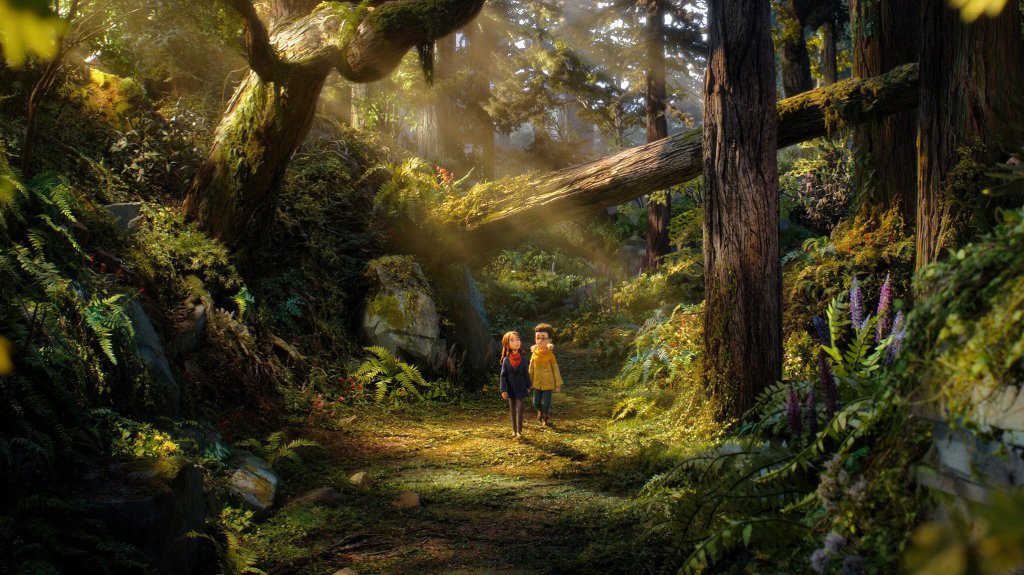
Hello readers! Wildwood is one of the best films I have seen this year, and easily the best fantasy film I have seen in a long time. Technologically, this film is incredible – it sets a record as the longest stop-motion animation ever made, and the character movements are so smooth, and the set pieces so sprawling, that I had to keep reminding myself that it is stop motion, and that it should be impossible. I’ve heard people comparing Wildwood to Narnia and Lord of the Rings, but it is darker and deeper than the former, and quirkier and smaller-scale than the latter – finding a perfect middle-ground while carving an exciting and emotional niche of its own.
Wildwood is made by studio Laika, who also made the excellent stop-motion films Coraline (2009) and Kubo and the Two Strings (2016). The studio is based in Portland, Oregon, which is where the film is set. The animators’ deep emotional connections with the city and its wild surroundings have clearly elevated their art, with every beautiful, hand-crafted set demonstrating a profound connection with nature and a love for the quirkiness of Portland and its residents. To top it all off, the voice acting is stellar, with plenty of recognisable names in the cast (if you care about that sort of thing). Oh, and the music is excellent!
I can’t say much more without spoiling the plot. So, if you would like to remain unspoiled, stop reading and go and see it! This film probably won’t be in cinemas for very long – it hasn’t come close to breaking even on its production costs.
Minor spoilers from here!
As I was watching the film, I wondered if it might be based on a book. The plot has a level of complexity that rarely arises when a story is born as a screenplay – and lo and behold, when I looked it up afterwards, I learnt that Wildwood is a novel for children, written by Colin Meloy and illustrated by his wife, Carson Ellis. I don’t know why I hadn’t heard of it – maybe it didn’t sell that well in the UK? It was published in 2011, so perhaps I had already aged beyond the target demographic. It’s hard to believe that this was aimed at children, though – the film was so dark and violent that I often found myself astounded that it got a 12A age rating.
Laika got the rights to make Wildwood into a film mere weeks after the book released. They have been waiting to make this project for years, and I’m glad they took their time. This was a perfect fit for the Portland-based studio, and technology has now progressed far enough for them to bring such a grand vision to life.
The story begins when teenager Prue sees her baby brother captured by a swarm of crows. She chases them into the woods outside Portland, with her classmate (not-quite-friend) Curtis in tow. They find themselves in the Wildwood – a magical realm cut off from the real world by an impenetrable wall of dense ivy, which mysteriously parts to let them through. The wood is home to four or five distinct societies, who comprise a mix of humans and talking animals, and who nurture strained or outright antagonistic relationships with one another. Prue and Curtis are soon split up, allowing the plot to follow their separate paths through the woods, slowly revealing more about its history and inhabitants.
The citizens of the wood possess a baffling mix of technology, from medieval swords and shields to twentieth-century post-vans. The talking animals retain some of their animal traits (leading to comedic encounters with dogs and balls, for example), but are largely presented as matching humans in their intelligence – although the humans seem to be the default leaders of all societies except the birds. It’s easy to draw parallels with Narnia, and the writer clearly took inspiration from that world. However, Wildwood is much darker and more complex, free from any furry Jesus lions stepping in to save the day.
The long histories of the forest societies are never explored in much detail; for example, we don’t learn when the wood became isolated from the rest of the world, or why the humans are still in charge now that bears are equally intelligent and demonstrably stronger. Our introductions to each group are only surface-level – but I found that this didn’t matter. This isn’t Lord of the Rings, with heavy world-building and hefty appendices. Wildwood has a smaller scope, and by focussing on the development of Prue and Curtis, and leaning into the spectacle of nature, it finds its own strength – while still managing to pull off one of the best battle scenes I have ever seen. In stop-motion, no less!
My only complaint with the film is that it’s a little long. Most of this, I now realise, is inherited from the book, because the plot seems to have been lifted with little modification. Just past halfway through, things slow down a bit; the story veers off-course, and we get some exposition that we probably don’t need. I can see that the writers are trying to bolster the emotional backstory, but the pacing is sacrificed as a result, and it probably didn’t need to be this way. Still, even if the film is twenty minutes longer than it could have been, I don’t see this as more than a minor flaw. I was still riveted the whole time.
That’s it for my review – stick around if you want to hear about Laika’s stop-motion animation process.
How did they do this?!
Throughout the film, I kept wondering how Laika managed to pull this off. We have chase scenes, fight scenes, and huge landscape shots – all of which are purportedly stop-motion, and made by hand. Obviously I had to dig a bit deeper into this, to uncover if and how computer animation was used.
Laika creates facial expressions by first computer-animating them, then breaking the animation down into 24 frames per second, then 3D-printing each frame. The 3D-printed faces are then stuck onto puppets which are moved by hand. This is a million miles from Aardman, with animators mashing Gromit’s plasticine eyebrows up and down between disapproval and dismay. Laika’s 3D-animation to 3D-printer pipeline kind of feels like the stop-motion equivalent of rotoscoping, where 2D animators draw over real-life videos to capture realistic motions. It’s certainly an interesting technique.
There are 136 scenes in this film, and some of them are large enough for the crew to walk through or sit in. If you want to see this for yourself, follow the links at the end of this post. The scenes are all at different scales; sometimes, trees are made to be very small, and other times, they are almost as big as real trees. Again, I think VFX did a lot of heavy lifting here, expanding the scenes to the horizon. Most of the up-close trees are physical props, but I suspect that most of the distant trees are CGI.
The film had 236 puppets in total, one of which was a huge eagle with 9000 feathers, all inserted and animated by hand. Airborne sequences, or scenes with characters leaning and nearly falling over (e.g., Prue riding her bicycle over obstacles and around corners), were achieved by using green props, which could be digitally removed afterwards. It turns out that the swarm (or “murder”) of crows was CGI, simply because there were too many to animate. Still, the digital models were at least based on physical 3D models. I don’t know how they managed the enormous battle scene – my guess is either some amount of digital copy-and-pasting of several stop-motion sequences, or it was entirely computer animated. All I know for sure is that it couldn’t have been shot in one go, because it had more than 236 puppets – and it would have taken several human lifetimes to organise.
I don’t know why I’m so fascinated by determining what is “real” and what is digital. I suppose that when I’m told a film is stop-motion, and I see swaying forests and swirling mists, I can’t help but get suspicious. There’s nothing wrong with using VFX, of course, especially when the results look this good – and the film is still incredible either way. I just felt the same niggling scepticism that I feel at photography exhibitions, when I wonder how much time was spent in the Adobe creative suite. Does digital manipulation make art any less impactful? Maybe a little, sometimes. This film wouldn’t have packed the same emotional punch if it had been entirely computer animated, and it also couldn’t have achieved the same grandeur and scope if it had been entirely made from physical props. So, the stop-motion elevated the story and the setting, and the VFX, in turn, elevated the stop-motion… But can we still call this hybrid artform “stop-motion”? Where’s the line?
Perhaps none of this matters. It’s still an excellent film, and an incredible feat of art, engineering, and ingenuity. I only wish that the distinction between real and digital wasn’t constantly on my mind these days.
In summary…
Wildwood is amazing, and you should certainly see it if you can, on the big screen if possible. I can only hope that it eventually performs well on streaming services, because we need films like this to keep being made, pushing the limits of what animation can do.
Happy reading (and watching), and have a lovely week!
Links:
https://variety.com/2025/film/artists/laika-wildwood-innovative-techniques-bigger-scope-1236547703
Discover more from C. W. Clayton
Subscribe to get the latest posts sent to your email.


