Hello readers! In October 2018, Netflix acquired the film and TV rights to The Chronicles of Narnia, a seven-book fantasy series written by C. S. Lewis. Now, eight years later, they have released a trailer for their first film: The Magician’s Nephew, directed by Greta Gerwig. And given that this blog has turned into an unapologetic Narnia analysis centre recently, I feel justified in wanting to share a few thoughts.
WARNING: If you haven’t seen the trailer or read the books, or you don’t want any spoilers before the film releases, read no further! I will be discussing the plots of multiple books in the Narnia series.
My first thought…
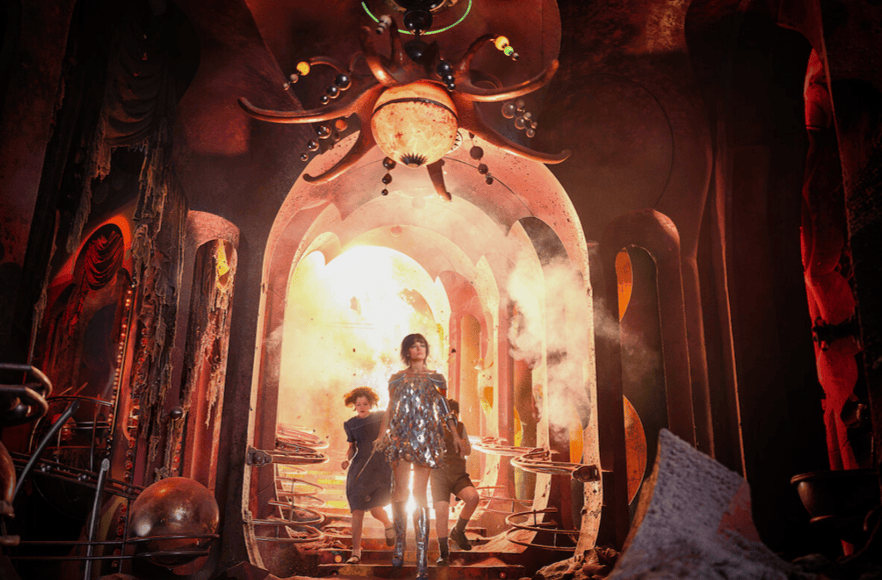
This looks expensive. And colourful. But hey, isn’t it refreshing to see a bright and vibrant blockbuster film? We don’t want yet another fantasy world falling prey to the toned-down, washed-out colour palettes of recent years (looking at you, Wicked).
Overall, the aesthetic isn’t what I would have gone for, but so long as Gerwig’s 80s-inspired, science-fiction-leaning vision is consistent, I can see it working. Gerwig seems to have kept most of the plot from the book, which means that the adventure will unfold across multiple worlds – and there is no plot-relevant reason that every world should have a European fairytale appearance. Maybe space-alien-chic will work? Still, Jadis and the city of Charn look very different to how they were described in the book… I can’t help feeling a tad concerned.
More importantly: why The Magician’s Nephew?
Another way of pitching this question: why not The Lion, the Witch and The Wardrobe?
There have been several adaptations of the Narnia books since they were first published in the 1950s, and The Lion, the Witch and the Wardrobe has always received the most attention. This makes perfect sense, because it is the first book in the series, and easily the most well-known. Disney made a film adaptation in 2005, and it was warmly received by critics and audiences alike. It stayed true to the source material, had excellent animal animation and practical effects, and had a surprisingly action-packed final battle considering its family-friendly nature. Disney then went on to make film adaptations of the second and third books in the series – Prince Caspian and The Voyage of the Dawn Treader – and although the third film wasn’t quite as well-loved, it made a good ending to a solid trilogy.
The reason these films are a natural trio is because they have Lucy as the main character (and Edmund I guess, ugh). After this, the books start following different protagonists. In the 1950s, Lewis evidently saw no reason not to do this – if he was bored of his characters and wanted to introduce some new ones, why not? In this day and age, however, dropping your main characters for seemingly no real reason (ageism?) is generally a bad business move. The audience was invested in Lucy, so why would they come back to watch a story about her boring cousin, Eustace, and some random girl from his school? I can see why Disney didn’t bother with the rest of the series.
So, why has Gerwig decided to adapt The Magician’s Nephew? It’s a prequel to the other Narnia books. And, like most prequels, it should be consumed after the reader has formed an emotional bond with the primary narrative. If you were adapting The Hunger Games, for example, you wouldn’t start with The Ballad of Songbirds and Snakes.
In terms of plot, The Magician’s Nephew is nicely self-contained, like all the other books in the series, so it won’t pose any issues in the form of cliff-hangers or character ages. However, the audience must already be familiar with Narnia and Aslan for the plot to have any emotional resonance. Furthermore, the two children in this book do not feature in any of the other books as protagonists – they only come back as side characters, and only as grown-ups! If Gerwig means to adapt the whole series, this is not a good starting point. It will be very difficult to develop a sense of continuity without any returning characters. What led to her to this decision?
Did she just… Follow the box set?
Earlier this year, I revisited all seven of the Narnia books, having not picked them up since I was a child. My box set (now a creepy time-capsule of early-2000s digital cover art) puts the books in narrative chronological order, with The Magician’s Nephew coming first. However, I decided to ignore the numbering and read them in publication order, starting with TLTWATW (I’m sorry, I can’t type it every time). I had a hunch that I would learn more about C. S. Lewis if I read the stories in the order he wrote them – and I was right.
I am firmly of the opinion that The Chronicles of Narnia should be read in the order in which they were published. This way, you get to see Lewis’ ideas develop, and you see the progress of his world-building. He didn’t ever plan these stories in narrative chronological order; The Magician’s Nephew is the second-last book in the series, and only exists to provide context and back-story for a fantasy world to which he and his readers had already grown attached.
Actually, I’ll go a step further: I think The Magician’s Nephew would be a terrible place to start reading The Chronicles of Narnia. In TLTWATW, Aslan’s powers are revealed gradually, and when he comes back from the dead, it feels truly miraculous. Throughout the other books, his powers grow and grow, and the reader learns more about who he is (furry Jesus), how he operates (sometimes on his hind legs), and how mortals should perceive him (with fear and love, obviously). But if you read The Magician’s Nephew first, Aslan is introduced to you as an immortal god. He literally appears from nothing and conjures a universe. If you then go on to read TLTWATW, all the jeopardy is gone. You know he can never be killed. You know he has god-powers. The magic is ruined.
Still, despite many fans having pointed out the downsides to reading the books in narrative chronological order, this is still how Harper Collins publishers package the series. Since 1994, the books have been numbered in narrative chronological order, prompting children to start reading The Magician’s Nephew first. And this is a terrible shame.
(As an aside, they also end up reading The Horse and His Boy in between TLTWATW and Prince Caspian, despite this story following completely different protagonists, being set outside Narnia, and having Peter, Susan, Edmund and Lucy only as side-characters, and as grown-ups! Very disruptive to the narrative flow of the series…)
So – did Gerwig just follow the numbers on the spines of her books? Or was there some logic to this decision?
Building from the ground up
I suspect that Gerwig didn’t want to be seen “remaking” TLTWATW, given that it had already been adapted so successfully by Disney. That would be like remaking Lord of the Rings, or Harry Potter– Oh, wait. Never mind. They’re actually doing that.
Still, Gerwig probably wanted to avoid comparisons with Disney’s films. Choosing to start with The Magician’s Nephew gives her a clean slate, with an audience devoid of expectations.
Well. Not entirely devoid. A small (very small) portion of her audience will have read the books – and believe me, we have some serious expectations.
Gerwig clearly wants to be different
It is immediately apparent from the trailer that Gerwig wants to make her adaptation very distinct from the source material. Empress Jadis, who will eventually become the White Witch, is dressed in a short skirt, with armoured shoulders, and has short, spiky black hair. She is certainly not queenly in the manner that Lewis described. Also, she is very human-looking, rather than being a giant. I can see the logistical difficulty in making her a giant, of course – but this woman is meant to be terrifying. I’ll try to hold back from passing judgement too soon… But that outfit is not giving terror.
Something else I noticed is that the time period seems to be different from the book. Lewis never gives an exact year, but suggests it is set “when your grandfather was a child” – which in 1955 would translate to the very late 1800s, or very early 1900s. The cars in the trailer are certainly not from the turn of the twentieth century. They look more like 1930s or 1940s cars. Indeed, the children seem to be scrambling around a bomb site, which might even suggest that Gerwig has set The Magician’s Nephew after or during WWII.
Now, if this is true, it would be a major change from the original books. TLTWATW starts with Peter, Susan, Edmund and Lucy being evacuated during the blitz, and the other stories follow on from this, generally one per year (with the exception of The Horse and His Boy, which exists only in the separate, nonlinear timeline of Narnia). If Gerwig has set The Magician’s Nephew 40-50 years later than Lewis’ original story, will she shift the rest of the series too? This would place her adaptation of TLTWATW in the 1980s or 90s.
Would she do something this drastic? Quite possibly – because it would easily set her adaptation apart from Disney’s.
Overall, I’m apprehensively curious
Whether this film is fun or not, I will no doubt find it engaging from a critical standpoint. Having become so familiar with the Narnia series this year, I will probably end up lecturing my friends at length about how Gerwig failed/succeeded (delete as appropriate) to capture the spirit of the book, and how she clumsily/effectively handled the aspects that, to put it mildly, “haven’t aged well”. The main message I’m getting from the trailer is that this will be a visual spectacle – and who can complain about that?
Happy reading, and have a lovely week!
Links to my Narnia content:
Discover more from C. W. Clayton
Subscribe to get the latest posts sent to your email.


