

Hello readers! We have now reached the penultimate entry in the Chronicles of Narnia, having read them in the order in which they were published. The Magician’s Nephew is a prequel to all the books written so far, in which C. S. Lewis describes the origins of Narnia. Unfortunately, the plot is decidedly weaker than the previous few entries, even if the book has some striking ideas and settings. There is no over-arching goal, so the book consists of a series of short, unfulfilling “quests” in which the main characters lack agency. Also, the religious allegories (or “supposals”, to use Lewis’ preferred term) are back at full volume.
Sadly, this is a low point in the series for me. I therefore find it strange that Greta Gerwig has decided to start here with her film adaptations… Out of all the books so far, this would probably be the hardest to adapt. More on that later – let’s dive into the plot.
SPOILER WARNING!
This plot summary will contain plot spoilers.
Plot summary…
The Magician’s Nephew is set in the late Victorian period, much earlier than all the other books, and it has two new protagonists: Polly Plummer and Digory Kirke. Polly lives in a terrace in London, and Digory moves in next door. He has come to live with his Aunt Letty and Uncle Andrew (siblings), who are looking after him and his terminally ill mother. Polly immediately asks Digory if his uncle is as mad as people say. Digory admits that his uncle has a secret study in the attic, and that he has heard yells from inside.
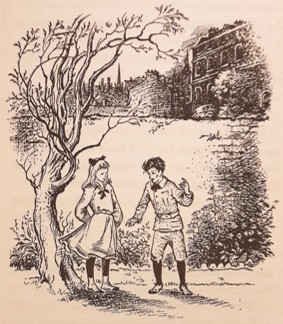
It is a rainy summer, so the children spend time in the den Polly has built in the rafters of her house. They find a gap near the edge of the wall, and they are small enough to squeeze through, between neighbouring houses. They try to reach the deserted house two doors down – but they miscalculate and end up in Uncle Andrew’s secret study.
Unfortunately, Uncle Andrew is in his study, and he locks them in so that they can’t escape. He announces that “two children are just what I wanted”. Apparently, he is in the middle of a “great experiment”, and although he has done tests on guinea-pigs, he now wants to conduct tests on children.
The children try to convince him to let them go, before their parents notice that they are missing, and he seems to relent. However, he offers Polly a gift before she leaves: a bright yellow ring from a tray on his desk. And as soon as she touches the ring, she vanishes.
Uncle Andrew tells Digory that it is magic. When he was young, he received a box of dust from his godmother (who he claims had “fairy blood”), which came from Atlantis (why?). Eventually, after meeting some “devilish queer people”, he learnt that the dust had been “brought from another world”, and has the power to carry a person back to the place from which it came. So, he used it to create the magic rings: yellow rings transport people to other worlds, and green rings bring them back. He has made guinea-pigs vanish using the yellow rings, but until now, he has had no way to test the green rings. He tells Digory that the only way to save Polly is if he goes after her with two green rings to bring them both back.
Digory has no choice. He puts on a yellow ring, and instantly feels as if he is rushing upwards – only to burst out of a small pool in a woodland with his clothes completely dry. As soon as he arrives, he forgets where he came from. He sees a girl sleeping beside one of the trees, and when she notices him, they try to work out why they recognise each other. Then they see a guinea-pig, and remember what Uncle Andrew did to them.
They jump back into the pool wearing their green rings, and see London materialising around them. However, they don’t go home. The woodland was full of pools, and Digory wants to explore other worlds.
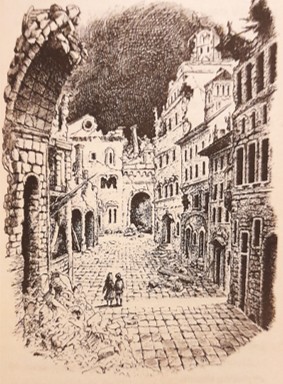
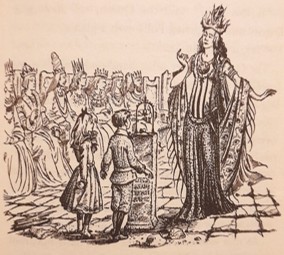
The first world they find is filled with dull, red light. They appear in a courtyard between buildings that have been deserted for hundreds of years, with no sign of life. Inside, they find a hall full of giant waxworks wearing extravagant clothes, and a tiny golden bell with a hammer beside it. An inscription warns that the bell may bring danger, and that they might go mad with curiosity if they don’t ring it.
Polly refuses to ring the bell, but Digory is adamant – and he fights her off in order to strike it. The ringing grows louder and louder, until the ground is shaking and the roof falls down. Then, when the ringing stops, the final waxwork in the hall rises to her feet, and introduces herself as Empress Jadis of Charn.
Jadis leads them out of the palace as it falls apart around them. She points out dungeons and torture chambers, and the children realise that she is a horrible woman, and that Charn was a horrible place. Outside, they see the ruins of a giant city, and Jadis recalls a time when it was bustling with “the cracking of whips and the groaning of slaves” and “the sacrificial drums beating in the temples”. Now, there is an old, red sun on the horizon, and only a single star in the sky. This world is nearly dead.
Jadis reveals that she was the one who killed it. The city was at war, with Jadis’ sister having led an insurrection against her. Jadis’ armies had been defeated, but rather than surrender, she decided to kill every living being left alive, except herself. She went into an enchanted sleep, waiting to be awoken by someone ringing the bell.
The children try to escape by grabbing their rings. Unfortunately, Jadis grabs on to Polly’s hair and is pulled with them, back to the “Wood Between the Worlds”. Here, she loses her strength, and they try to throw her off – but she grabs Digory as he jumps into the pool, and the three of them end up in Uncle Andrew’s study.
In London, Jadis recovers her strength. Uncle Andrew is immediately besotted with her, and she sends him to bring slaves and transport. He shuffles off to order a cab, but on the way, he stops for a quick drink of brandy, and to ask his sister, Aunt Letty, to lend him money. Jadis demands what is taking so long, and Aunt Letty stands up to her (“she did not approve of bare arms”), demanding that Jadis leaves the house at once. When Jadis tries to curse her, nothing happens – and she realises that her magic powers don’t work in our world. Still, she retains her physical strength – so she picks Aunt Letty up and throws her across the room. Thankfully, she lands on a mattress she had been mending, and she sends the housemaid to alert the police.
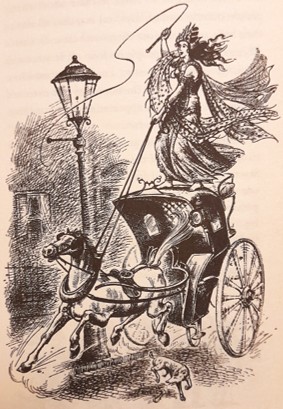
Jadis and Uncle Andrew leave in a cab. Polly escapes back to her house to reassure her parents that nothing is amiss, and Digory wonders how he can take Jadis back to her own world. A while later, he hears a commotion, and sees Jadis riding a hansom cab like a chariot, standing on top of it. A crowd of policemen and onlookers follow her – but when she announces herself to be “Empress Jadis”, they laugh. Unimpressed, she wrenches a cross-bar off an iron lamp-post, and they all fall silent in dismay. She starts lashing out at them, using the bar to knock out a policeman. Digory and Polly run to try and help, and Digory manages to grab Jadis’ foot, dragging her back to the “Wood Between the Worlds” – but to their dismay, they have brought the cab horse and the cab driver too.
They jump into the nearest pool – then realise that this isn’t Charn. They have ended up in a world which is totally dark and silent. Then, suddenly, they hear a distant voice. The blackness explodes with stars, and then the sky lightens, enough for them to see a barren landscape. As the sun rises for the first time over this new world, they see that the singer is a lion: Aslan.
Aslan summons grass and vegetation from the bare rock as he paces back and forth. He is slowly moving closer to them, seemingly minding his own business – but Jadis is intimidated, and lobs the iron lamp-post bar at his head. It bounces off without perturbing him, and a lamp-post starts growing where it lands. Jadis flees in terror.
Suddenly, Aslan changes his song, and the ground is filled with lumps which rise and break open, releasing hundreds of animals into the world. Finally, he stops singing, and moves between the new animals, touching noses with a select few – including the cab horse brought from London. These chosen creatures form a circle around him, whereupon the small animals grow larger, and the large animals grow slightly smaller. These are the talking animals of Narnia – and they are soon joined by fauns, nymphs and dwarfs emerging from the trees and rivers.
Aslan tells Digory that it is his fault that Jadis arrived in this new world, and he must set it right. He sends Digory to bring an apple back from a tree in the mountains, and gives the cab horse wings in order to fly him there (it all sounds very majestic until Lewis compares him to “a huge pigeon”).
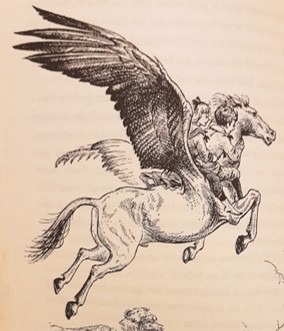
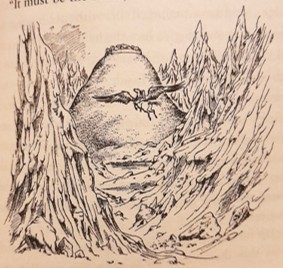
The children fly west and find a walled garden with golden gates, which display clear instructions not to steal the fruit – but the gates open for Digory immediately, and he easily retrieves an apple from the tree inside. Just as he is leaving, he sees Jadis, who has climbed over the wall, stolen an apple, and already eaten it. She claims that it has made her immortal, and tries to tempt Digory to join her, but he refuses and returns to Aslan.
Aslan announces that the London cabbie will be the first king of Narnia, and he summons his wife from London to join him. They are crowned, and the animals celebrate. Digory plants the apple and it grows into a tree, which Aslan promises will protect Narnia from Jadis for centuries. He tells Digory to pick an apple from the new tree, so that he can take it home to cure his mother.
Aslan returns to the wood between the worlds with them, and he shows them that Charn’s pool has now dried up, showing that the world has died. He warns them that any world can die if wicked, powerful people drive it to ruin. With that, he sends them back to London.
As soon as he is home, Digory feeds the apple to his mother, and over the next few weeks, she recovers from her terminal illness. Digory buries the core in the back garden, alongside Uncle Andrew’s magic rings, and it grows into a tree. Many years later, when Digory is a professor, and has moved into a big house in the countryside, a storm blows down the apple tree – and he has it made into a wardrobe.
My thoughts overall
I enjoyed this story less than the others because it bounced between three very different locations (London, Charn, Narnia), and lacked a coherent structure, with no over-arching goal. The last three books all had clear aims: sail east to find Aslan and the missing lords, travel north to find the missing prince, travel from Calormen to Narnia. Without a central plot device, The Magician’s Nephew feels more haphazard. There are some really great ideas here, but they don’t feel as if they belong in the same narrative.
Also, setting a large part of the story in London took away a lot of the magic. It is harder to suspend your disbelief when confronted with a reality you already understand, and Jadis is less imposing when her powers are taken away. Her antics in London make her seem ridiculous rather than terrifying, especially when most of her interactions with other people are played for comedic effect. This is the woman who will eventually kill Aslan. She could do better than wait for Uncle Andrew to order her a cab.
Now, onto some of the more intriguing aspects of the book…
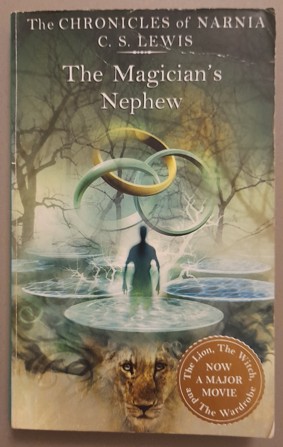
This is revealed to be a prequel very early
Lewis is clearly writing this story for readers already familiar with The Chronicles of Narnia. He opens the book by explaining, “this is a story about something that happened long ago when your grandfather was a child”, making it clear that the book is set in the past, unlike all the other books, which had been set in the almost-present. Unfortunately, this opening sentence has not aged well; my grandfather was a child when this book was published, not when it was set! Maybe Lewis didn’t anticipate his book still being read 80 years later?
When Digory reaches the forest, Lewis reveals in a very off-the-cuff manner that he would become “the famous Professor Kirke who comes into other books”. I feel like this could have been a big reveal near the end, when we learn about Digory turning the apple tree into a wardrobe – but perhaps Lewis thought the reader would understand Digory better if they knew his career trajectory?
It would be confusing to read this book first
The Magician’s Nephew is described by the publishers as being the first in the Narnia series. However, I think a child would be very confused if they started here. Lewis frequently references the other books, and the magic of seeing Aslan creating Narnia from nothing is diminished if the reader has no clue who Aslan is, or what Narnia is. The whole point of an origin story is to answer questions that arose from the original material; it isn’t usually the best introduction to a fantasy universe.
The purpose of The Magician’s Nephew is to address questions from readers familiar with the series, for example, why some animals can talk and others can’t, why some talking animals are larger than dumb ones, and why Narnia has such a strange ecosystem. All of these are answered very simply: the world is the way it is because that’s the way Aslan wanted it. There is no ecosystem. There is no evolution. All the animals erupted out of the ground fully formed, and Narnia is only a few centuries old when the Pevensie children first arrive there.
None of this knowledge is required to enjoy The Lion, the Witch and the Wardrobe. Providing the history of Narnia is largely fan-service, making The Magician’s Nephew a reward for those readers who became deeply invested in the series. I certainly wouldn’t recommend this as the starting point for reading the Chronicles of Narnia.
How will Greta Gerwig adapt it?
I can’t work out why Gerwig has decided to start her Narnia film adaptations here. Disney did the sensible thing, starting with The Lion, the Witch and the Wardrobe – the story that everyone already knows. Perhaps Gerwig is banking on people being intrigued by something new and different? If so, the second instalment might be a let-down, returning to very familiar territory. There is a long debate to be had over the reading order, and I might devote a supplementary post to it – but in my view, it makes much more sense to read the books in the order of publication.
Now, let’s return to discussing the book itself.
Polly is sensible, and thankfully not a wet blanket
I like Polly as a main character. She isn’t as self-assured as Jill, but she is much more interesting than Lucy, and is leagues ahead of Susan. Polly is adventurous and creative, having built a den for herself in the attic, in which she writes stories. When the children end up in the Wood Between the Worlds, she is the one to suggest that they mark which pool leads back to London, so that they don’t get lost. Still, she remains more of a supporting character than a true protagonist. It is Digory who makes the key decisions that drive the plot (e.g., awaking Jadis, retrieving the magic apple), and Polly’s role is to provide sage advice, trying to influence him. When it comes to creative thinking and problem-solving, Polly is always slower; for example, it is Digory who determines the wood exists between worlds, rather than being a world in its own right, and he contradicts Polly in order to make this assertion.
The gender fixation
As with other books, Lewis often goes out of his way to make clear distinctions between men and women. In many cases, it is unclear why the characters are making these distinctions –for example, when Polly and Digory are arguing over whether to hit the bell in Charn, Digory suddenly proclaims that “girls never want to know anything but gossip and rot about people getting engaged” to which Polly responds, “how exactly like a man!” – which is a very odd thing to say. The children’s ages are never stated explicitly, but at a guess, they must be around 10 or 12. There is no way Polly would call Digory a man.
There is a chance that Lewis was alluding to some deeper philosophy on temptation and curiosity, but if so, the message is unclear. I’d assumed that the bell was an allegory for the forbidden fruit in the Garden of Eden, so it seemed odd to me that Digory, the man, was the one to be tempted in this allegory. It felt like a subversion of Christianity, if anything. Maybe this is why Lewis, a staunch Christian, ended up muddling the message. Or maybe I’m too science-brained to understand it…
Uncle Andrew is a great villain
Uncle Andrew is very different from the other villains in the series so far, in that he lives in London and has no real power. In some ways, the fact that he conducts evil deeds in our world makes him more scary; the threat of a mad uncle locking you in his attic to experiment on you feels more real than the threat of a Witch in a fantasy world. His appearance is immediately alarming, as he is “tall and very thin” and smiles “showing all his teeth”, and if you had any doubts regarding his evil nature, it is soon revealed that he has killed scores of guinea-pigs: “Some of them only died. Some of them exploded like little bombs.”
He is also undeniably creepy. Having locked Polly in his office, he remarks: “It’s not every day that I see a little girl in my dingy study; especially, if I may say so, such a very attractive young lady as yourself.” Yuck. I think this would have been considered disgusting even in the 1950s.
In modern terms, Uncle Andrew is an incel. He has never had a girlfriend, but not for lack of trying; he is obsessed with his appearance. When Jadis arrives, he is immediately besotted with her because of how beautiful she is, and despite cowering in fear whenever they are in the same room, he fantasises about her the moment she leaves. The man has no job and no prospects, and is forced to live with his sister, who manages the household finances (which I’m sure Lewis thought was suitably emasculating).
Uncle Andrew states his worldview in a long monologue to Digory after he sends Polly to another dimension. He explains: “You must understand that rules… however excellent they may be for little boys – and servants – and women – and even people in general, can’t possibly be expected to apply to profound students and great thinkers and sages. Men like me, who posses hidden wisdom, are freed from common rules just as we are cut off from common pleasures. Ours, my boy, is a high and lonely destiny.”
If he posted stuff like this on Reddit today, the man would end up on a watch list.
Narnia feels less magical now
Shortly after creating all the animals and calling his first council, Aslan decrees that the London cabbie will be the first King of Narnia. This is just some random guy from another world, but Aslan decides that he is superior to the other animals, and that he will be king. He even summons the cabbie’s wife from London in order to join him and provide him with children (and this isn’t even my cynical inference: Aslan decrees that their children will be Kings and Queens of Narnia, and of Archenland). This makes Narnia feel a lot less magical. The kings all came from some random cabbie?
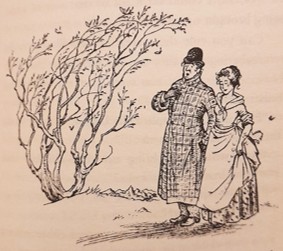
It could be argued that the arrival of the cabbie was all part of God’s plan. But if this is the case, Digory’s arrival in Narnia with Jadis was not so much an accident as fate – everyone’s favourite fantasy get-out clause. To me, this doesn’t feel like a satisfying origin story for a fantasy world. Now, more than ever, Narnia feels derivative. It is no longer its own entity; it has had connections with our world from the very start.
Did we get two forbidden fruit references in one book?
I have already discussed the magical bell in Charn being a biblical temptation allegory, but we also get a second, much more obvious forbidden fruit allegory later in the book. Digory finds what is essentially a Garden of Eden, with clear instructions not to take any fruit. Jadis, of course, takes it – which I suppose makes her Eve in this allegory, releasing all the evil into Narnia. There isn’t anything wrong with having two forbidden fruit references in the same book, I suppose, especially when the book is exploring the theme of genesis, but it does make the plot feel muddled.
In summary…
The Magician’s Nephew has some really great ideas, but as a whole, it lacks cohesion and direction. I love the early sections in which Digory and Polly explore the ruins of Charn, as this is the first world in the Narnia series that has felt truly detached from our own. Unfortunately, the following chapters with Jadis in London don’t feel particularly magical, and the revelation of Narnia’s origins feels like a let-down. Let’s hope that the final book, describing the end of Narnia, is more inspiring!
Happy reading, and have a lovely week!
My Chronicles of Narnia analysis series:
Happy reading!
Discover more from C. W. Clayton
Subscribe to get the latest posts sent to your email.


6 thoughts on “The Magician’s Nephew (1955) is… a collection of ideas”